Tuesday, February 27, 2007

Aloo Dum(b), and Oil-free


Now, before anyone can indignantly wonder how the versatile aloo (potato) can be dumb, please rest assured that it’s a transferred epithet – I’m the dumb one when it comes to gravies – too lazy for the great South Indian thickener, coconut, that I rarely use, somewhat lazy when it comes to other grinding and processing, and clueless when it comes to shortcuts to achieve the same effect, but this is so simple and seems a handy formula to employ whenever I need a gravy, whatever the vegetable! And what’s more, as the title tells you, it’s oil-free!

I didn’t think I’d make it to this JFI hosted by Vaishali of Happy Burp, but wanted to try my grandmom’s recipe – in my home, and I’m sure in yours as well, certain dishes were made only for the night, certain only for the morning. Well, my grandmom’s night potato recipe was often a light curry of tomato gravy, and her lunch recipe was a heavier curds/yoghurt kurma.

I knew the kurma would take some detecting as my grandmom’s not around now to give me the recipe and I wasn’t too keen on the tomato gravy as I hate how the skins separate from the fruit and roll into long, triangular bits and float in the curry (and I didn’t know the technique to avoid that except to blanch and puree the tomatoes, which I’m not going to do for the love of anyone), so I pretty much told myself I wouldn’t put up anything for Jihva – till I chanced upon this recipe in this little book of Oil-Free Cookery by Satarupa Banerjee (Rupa & Co, 2003).
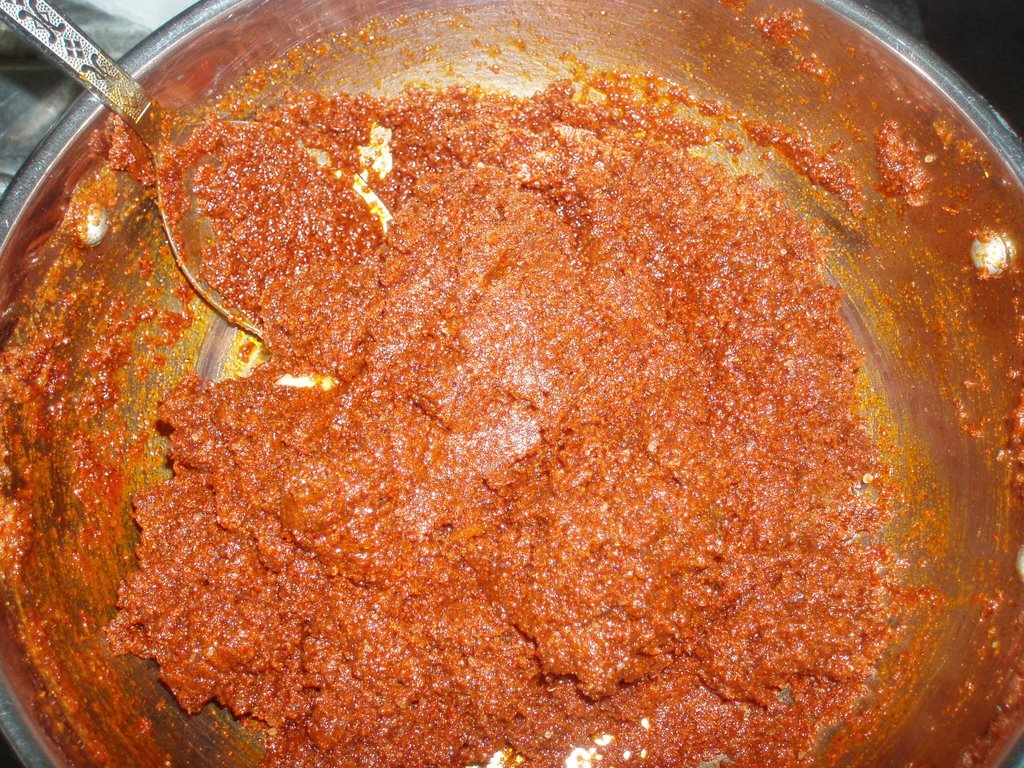
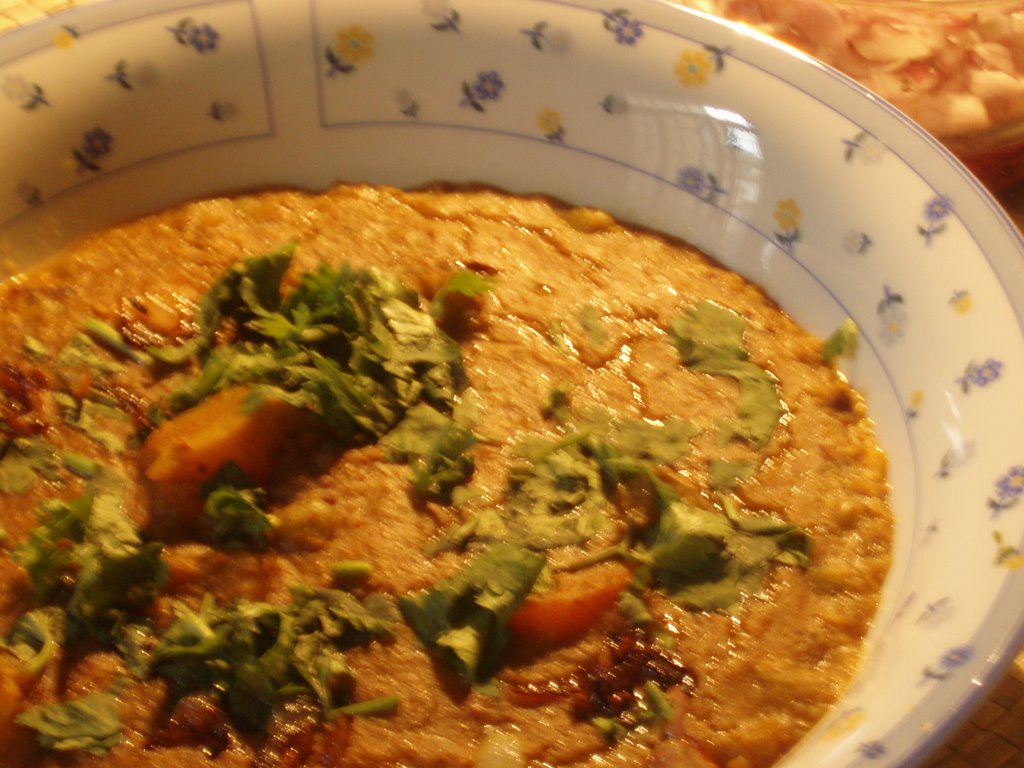
And what a discovery it was! The smell and look pre-masala-sprinkling brought back memories of that dinner recipe my grandmom would make, and gave me the base for gravies with other vegetables.

Now, about dum aloo – I’ve been scouring the Net for the history of this dish – there are as many recipes as there are potatoes – there’s a Kashmiri version, a Bengali version, a Benarasi version, a Lucknowi version, a Hyderabadi version, and who knows, maybe a Chettinad version as well! (It may then be called urulaikizhangu kulambu, or equally painstakingly in Telugu, bangaaladumpala pulusu/koora – in Telugu, ‘dumpa’ means root/tuber, and I assume the prefix ‘bangaala’ refers to Bengal. Pulusu refers specifically to a tangy gravy and less specifically to a wet dish.)

A friend in school, a Bengali-phile, would always mention this dish. “Aloo dum,” she’d cry, raising her hand enthusiastically, probably when we were discussing favourite foods. All of us in that charming small town of our childhood would stare uncomprehendingly, wondering what on earth it was, and she’d launch into how she was more Bengali than Telugu because her granddad worked in Bengal. The memory, buried deep all these years, comes back to me as I write.

When I got my first Kashmiri recipe book, aloo dum took on a totally different colour. Literally. Without ambling over to check my cookbook rack, I remember having to saute red chilli powder and perhaps a bit of curds in oil, a pinch of dry ginger and aniseed (saunf) and then putting in baby potatoes to make a thin, brilliant, red gravy.

This evening, I even saw a recipe that involved gouging a hole in the spuds, filling them with pista and walnut and making an aloo dum of them – uber Kashmiri? Not sure, it sounded fascinating, but calorific and tiring. So without further ado, here’s oil-free, fuss-free, cooking-for-dummies aloo dum(b) my way, it requires even less work than the book prescribes – no pastes/powders to be ground, just some peas to shell.

Potatoes, scrubbed, peeled, quartered – 5, medium size
Curds/Yoghurt - 3-4 tbsp
Shelled peas – 1 cup
Ginger – 1 inch, minced/mashed
Garlic – a few cloves, mashed roughly
Onion – 1 medium, chopped
Tomato – 1 medium, quartered
Green chilli – 1 (I used a bit of red chilli paste since I had that)
Turmeric – a pinch
Salt – to taste
Bay leaves – 2
Coriander seed/Dhania powder – ¾ tsp
Garam masala/Curry powder – to taste

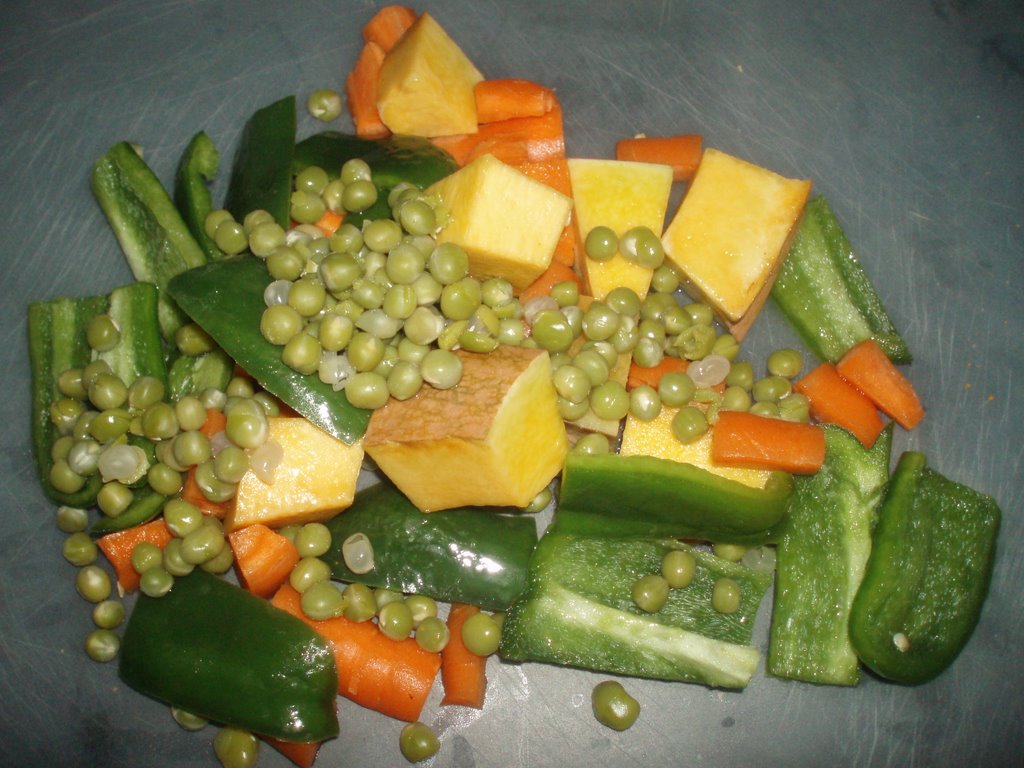
Beat the curds. Mix potatoes, curds, salt, peas, ginger, onion, chilli and turmeric. Let it keep for an hour.

Then, heat a cup of water in the pressure cooker/pan. Add tomatoes, garlic and bay leaves. Cook till the tomatoes are soft.

Add the potato mixture, close the pressure cooker, and once the steam emerges from the vent, put the weight on it. After it hisses once, put it on simmer and cook for about 8 minutes.
*The cooker will hiss a couple of times but don’t switch it off in a hurry. (For those using pans, I would recommend a little more water and simmering the dish with a lid on.)

Once the steam escapes on its own (without you fiddling with the weight), remove the weight, check the consistency of the gravy and cook down till it’s as thick as you like.
*You can even crush a few pieces of the potato in the gravy to thicken it.

Finally, add the curry powder and the coriander powder. Check the seasoning and adjust it to your taste.

Finish off with a garnish of coriander leaves. Goes well with rice and breads.
Enjoy!

Tags:

Thursday, February 22, 2007

Eggstensions

Will suit ovo-vegetarians too, just keep reading, don't let the picture turn you away!


This recipe is mine, he said, as she finished with the camera and put it back in its suede pouch.
It will be duly acknowledged, she said.

So here it is, the spouse’s brainwave! To us, it was a new thing but in general, not really that new.

The vegetarian version

My helper at home would always tell me to break an egg into any vegetable stir-fry that I was making, that it would be “super” – but the idea of mixing up an egg with vegetables never appealed to me. Finally, one day, I asked her to do it for me, she made it with beans and carrots, was it tasty!

Temper the oil with some mustard and cumin seeds, some onion, if you like, put in the veggies (about a cup-and-a-half), season them, let them cook after stir-frying them on 'high', break a couple of eggs into them and scramble. Add some more seasoning and curry powder if you think it's necessary, at this stage.

Somehow, I never repeated it, though, and the recipe stayed dormant in my mind till the other day when the spouse, on an impulse, whipped out a packet of frozen prawns from the freezer, thawed them under running water singing paeans to how this particular meat was oh so simply thawed, and quite without any idea of what shape the dish was going to take, started sautéing the prawns pink. We didn’t have any ginger-garlic paste ready, and neither of us was going to start skinning ginger and garlic and grinding them at that late hour, so he said, shall we break an egg into it and see what it’s like? A bit of hesitation, and then I brought two eggs and cracked them into the pan and scrambled them – and voila, a blog post was born!

Using egg (or vegetables) to stretch the curry is an old habit. If there isn’t enough potato to go around, add some pumpkin. If there isn’t enough meat to go around, add some potatoes. Or simpler still, leave the daughters out and feed those choice morsels of meat to the sons.

Before I can get any more snarky, here's the recipe:

Prawns/shrimp, shelled and deveined - 250 gm
Some salt, chilli powder, curry powder - a pinch, to taste, a teaspoon, a tbsp, take your pick of the amount
Eggs - 2
A bit of coriander
Oil - 2 tsp

Saute the prawns, season with just a little salt and chilli powder till cooked. Break two eggs into the pan, put in a little more salt and chilli powder into the eggs, add the curry powder and mix them up with the prawns, stirring constantly, till they are scrambled moist. Remove from fire, sprinkle chopped coriander. You can add some lime juice for added flavour. (I didn't think of that when we made it.)


Note: The texture of the eggs changes when you re-heat it in the microwave but it's tasty all the same. Sandeepa reminds us that the prawns/veggies made this way can be a good thing to put in fried rice!


Tags:

Sunday, February 18, 2007

Wedding musings

I don’t have a dish to write about, just a haze of thoughts and posts that I’ve been planning but didn’t crystallize or materialize in post-tour work. I’ve been away attending a wedding and associated events - which was hectic - but a lot of fun as well.


Pic from http://www.horton-szar.net/clipart/food.php

It’s probably been a while since the trend started but I encountered it for the first time – a live pesarattu counter at a wedding breakfast, and the ginger chutney served along with it was the yellow-green variety and not the familiar red variety that I know. I don’t attend too many weddings and even less in other cities so it’s interesting to see what the caterers come up with each time. Of course, that depends on the faith(s) the bride and groom practice (or don’t) but most wedding feasts I attend tend to be vegetarian (many non-vegetarian communities too serve strictly vegetarian meals when it involves rituals) so we’re set for veggie talk.
As a kid and teenager, my impression was that wedding meals were usually ho-hum – the mandatory muddapappu, pappucharu, a palav, maybe, a few chips, one or two vegetables (potatoes and peas, perhaps, and brinjal/eggplant in some form), curds/yoghurt, a pinch of salt in the corner of your plate, a bit of chutney, a spoonful of pickle, a banana, jalebi and mysore paak (the hard variety, not the ghee-saturated one that goes by the name of mysurpa now), paan and ice-cream, for that really special touch. Now you get all this and more. So even if you’re served only a spoonful of each vegetable, you don’t really need to ask for second helpings to feel full – only if you want to revel in the good taste once more. And again!
Even at a sit-down, served meal, you get at least three sweets from beginning to end not counting the ice-cream, and one of them could be the semiya payasam. An all-time favourite, I don’t ever remember coming across it growing up. I never thought about it then but looking back, I wonder why? Preparing it in large quantities was too complicated? Well, I’m glad to say this wedding served it in cute little tubs, and it was divine. At an associated lunch, we were also served a cutlet that would have been routine if not for the addition of melon seeds – nice twist!

Exclusively wedding fare?

And some dishes, I’ve ever seen them only at weddings and associated events – vankaya pakodi (eggplant with pakodas), vankaya/dondakaya with fried peanuts, a sour-and-spicy gravy that contains paneer (cottage cheese) or lotus seed, palav with fried bread cubes (to approximate the taste/texture of meat?) and once in a while, strange combinations of vegetables that I’d like to remember and recreate at home but always slip my mind. It’s not that the others I’ve mentioned can’t be made at home, they can, but somehow, neither mine nor my friends or relatives seem to make those dishes.

A glutton is made

What I do hate about wedding meals, though, is how the video man and the photographer zealously come to catch you at that most awkward moment when you are busy shoveling these glorious morsels into your mouth, casting you in a rather gluttonous mode in the memoirs of that family for posterity. For many years now, I make sure I don’t have my hand anywhere near my mouth when this team comes along with its long, snaking cables and interfering flash bulbs – I fiddle with the leaf/plate that my food is served in, move my food away from me to a corner, as if it’s too much for me, keep my head resolutely down, or stonily stare the camera team away into slinking off to the next batch of feasters.

Give it a thought

First, the qualifier: I’m writing about wedding meals only because this is a food blog and I don’t have a recipe ready – it’s not like it’s the main takeout for me from a wedding, so I’ll take the opportunity to preach a bit – I dislike the way guests criticize the hosts for a meal that was not up to their expectations in taste and range. Sure, the feast is something to look forward to, but don’t we attend weddings to honour the invitation, to wish the couple a good life? Why is it that so many of us go on discussing and gossiping about the food, how bad it was, and how miserly the hosts were just because some curry didn’t have enough ghee or cream in it or because there were just two sweets instead of three? Are we so badly off that we can’t afford to make/buy those things ourselves that we should feel so let down? All of us love free lunches, but shouldn’t we end our disappointment with a measured observation, if at all, rather than mean comment?

Tags:

Thursday, February 01, 2007

Easy Peasy!


As it’s winter, fresh peas are available in abundance and I spent one rather backbreaking night shelling a kilo or more of peas and watching a DVD. I even started out saving the pods for a peel stir-fry but quickly tired of checking each and every pod for a blemish.
Coincidentally, Pooja announced her weekly event would feature green peas and I wanted to participate, but probably the mind-numbing job of shelling so many peas in a single sitting had its effects on me – I couldn’t think of a single unusual recipe featuring peas. Well, it has to be unusual to me, at least, otherwise I’m not too keen on putting it up in my blog.
So I started hunting through my cookbooks and finally settled on this Rajasthani curry featured in Nita Mehta’s book. What I found unusual in this recipe was the addition of mangodi (vadiyalu in Telugu, I think, and the brown bits in the photo above), dried preserves made from flour, usually deep-fried to make crunchy accompaniments to chaaru (rasam/soup). In fact, the ‘vadiyalu’ made from urad daal/black gram are used in a sweet-and-sour tamarind-and-jaggery gravy in the parts I come from, but this one here is a spicy, somewhat tart, thick gravy that is accompanied by other vegetables.

Posted by Picasa


In pic above: Home-made mangodis/vadiyalu

The books informs us that this is a typically Marwari dish and that Marwaris are very fond of mangodis. In their case, they are made from moong daal. The ones I had have been tucked away in the bottomless pit that passes for my fridge for a year or so now, and I’m not sure what daal they are made of, but I used them anyway.
Here’s the recipe adapted from the book:

1 cup mangodi
1 cup shelled peas (you can parboil them ahead)
2 medium potatoes, peeled and diced, mangodi-size
A pinch of asafoetida/hing
1 tsp – cumin seeds
1 tsp or less – chilli powder
½ tsp - turmeric
Salt to taste
1 tsp or less - garam masala/curry powder
A few coriander leaves
Oil – 3 tbsp + 1 tbsp

Grind to a smooth paste:
2 big tomatoes
1 inch piece - ginger
1 cup curds/yoghurt
1 tbsp besan/gram flour OR rice flour

Fry the mangodis till crunchy and brown in the 3 tbsp of oil. Add the peas and potatoes, cover and simmer till done on low flame. The mangodis have to become soft, don’t worry about keeping them crunchy.

In a larger frying pan, heat 1 tbsp oil. Put in the cumin seed, when it browns, add the asafoetida. Then add the chilli powder and immediately add the ground paste. Let it fry/boil for a while, add turmeric and then the vegetable and mangodis. Cover and simmer till you get a thick gravy, or if you don’t have the patience, let it boil and roil till it thickens, finish off with a sprinkle of curry powder and coriander leaves, turn off the fire and get on with the rest of your day!

Tags:

Tuesday, January 30, 2007

Curry Leaf Crush

 
Posted by Picasa

I know, it’s nothing more than fried curry leaf, but considering that I’ve never seen a recipe for curry leaf raita with it, I think it’s worth putting up in the blog.

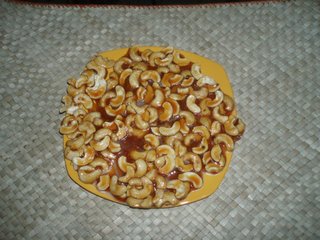
It was a serendipitous discovery for me. Cashew lover that I am, when the flesh is willing and the spirit is weak, deep-fried cashew nuts often find a place in my pantry. Of late, a store near my place has started frying them with a spicy, salty mix of curry leaves, so much so that they come coated green! And the considerable amount of curry leaf dust rendered oh so crisp and spicy by all the seasoning that’s gone into the snack makes it an awesome accompaniment to plain curds/yoghurt.

In India, nowadays some vegetable shops hand over curry leaves by the bushel – you are not charged for it and the grocers stuff your shopping bags with so much you have to tell them you just want a sprig or two.

I, for one, haven’t discovered how to store an excess of curry leaf effectively in the refrigerator (mine still wilts and darkens) but just last week I read somewhere that frying and putting them in will help. Somewhere else, on the Net, I think, a Web site said freezing them on the stem was a better option.

Here's some information from Buzzle.com: The curry leaf plant (or tree if you wish), is a native of Tropical Asia, southern India and Sri Lanka. Belonging to the Rutaceae family, the Murraya Koenigi plant grows to a height between two and five meters, depending on various factors.

The plant is found almost across the length and breadth of the India and Sri Lanka.
Curry leaves are best used fresh. While some people may add it to their curry powder, it is largely a seasoning leaf, to be used only in specific curries to provide specific tanginess.

Apart from cooking, the curry leaf has a number of medicinal uses. It is an essential ingredient of almost all traditional medicine systems of peninsular India. Unani, Ayurveda and other systems use it to cure ailments such as piles, to allay heat of the body and to treat leucoderma and blood disorders. In India, the curry leaf is used to prevent conditions such as nausea and stomach upsets. It is also used in treating skin irritations and poisonous bites. Its oils are invaluable as repellants and to cure skin disorders common to the tropics.

A friend boils it in coconut oil and uses it on her hair to keep it black.
Read more about it here

Most South Indians swear by it but in the finished product, like chillies, it ends up being pushed to a side of the plate as it’s deemed a bothersome presence, probably because the flavour it lends is more delicate than the actual taste. In fact, long ago I read a story titled ‘Karivepaku’, the Telugu name for curry leaf, where it becomes a metaphor for wives and mothers who slave over their families but get very little appreciation!

A few months ago, vexed by the large amount of curry leaf that the vegetable shop dumped on me, I threw a handful into a chicken curry and discovered the secret to the chicken curry I’ve tasted in the many no-frills, non-vegetarian, ‘military’ hotels that are popular in South India. (Find that recipe here.)

This curry leaf crush is a good thing to have handy not just for yoghurt and for the usual seasoning/tempering that your food needs, but can also be an instant mix for rice. Mix it with hot, soft rice, adjust the seasoning, enjoy! It will also come in handy to sprinkle on snacks and mixture (a typically Indian snack which’s a medley of daal, nuts and other fried savouries).

There isn’t much technique involved – all you need is some salt, chilli powder, about two cups of washed and dried, loosely packed curry leaves, 3-4 tbsp of oil. Heat the oil, put in the curry leaves and keep sautéing till they turn dark and papery – it takes a few minutes. Season with salt and chilli powder, let cool. Once it cools, crush it with your fingers, store in an airtight container.

For the raita, mix a spoonful or two of it into a cup of yoghurt and enjoy!
When I mentioned this to my friend, she said a healthier, oil-less version would be to heat the curry leaves till they shrivel and dry - take your pick!

 
Posted by Picasa


This is my entry for Kalyn's Weekend Herb Blogging hosted this week by Ulrike of Kuchenlatein.

Tags:

Thursday, January 25, 2007

Five Things Most People Don't Know About Me

So this is the flip side of me telling the whole world and its sister that I love memes! I get tagged to reveal five things that the world doesn’t know about me – and run the risk of letting the whole world know what an uninteresting person I am. It’s been a few days since Anna of Anna's Cool Finds tagged me for this meme, and every day since then, I’ve been jotting things down whenever I remember, desperately trying to total up five, and think I’ve just about made it.

But first, a diversion - here's a bit of my kitchen:


Ok, back to the five things:

It's been almost eight years since I started blogging. (I updated this on April 9, 2013.)

Not many people know that I have a blog - just some family, and a few friends.

Hardly anyone knows why my blog’s called what it is: Many, many years ago, two cousins and I reconstituted some packet soup, poured it into mugs and took ourselves out to the front verandah. A few sips later, my boy cousin suddenly said, “Wait!” and scurried into the kitchen from the verandah where we were sitting – he refused to tell us what the matter was. Then he scurried back to us and showed us his soup mug – there they were – tiny, curled-up, soft, white worms that could well be mistaken for noodle rings or pasta alphabets or whatever! Well, they were quite dead, of course, but when I was thinking of a name for my blog, I thought of how the worms had well, wormed themselves into our soup, and … it’s not entirely logical that I say my soup came alive when the poor things died, but let me not explain further and make it all prosaic and boring!

Not many people know that I taught English for a short while. That was my very first ‘job.’ I was taking a course in computers when the people that ran the centre there decided they would do well to start a TOEFL course and asked me to teach it. I had just two students, both much older than me, engineers, I think. I was paid Rs 750. It was only for a few weeks.

And (confession time!) not many people know that once in a while, I can’t bring myself to eat a dish that I’ve put on my blog!

I tag Pooja and Coffee for this meme!

Sunday, January 21, 2007

Oaty Tomatoes (Answer to Guessing Game)


Well, most of you got the coriander right – that was obvious. But only Asha got the oatmeal right. For the rest of the ingredients, see the recipe below! I don’t understand why clicking on the pic didn’t result in anything – did you have that problem too?



It’s been a hectic few days since my last recipe post, what with work and folks at home and then work again. I almost didn’t miss blogging, and that’s saying a lot considering my involvement with it qualifies as obsession, but am glad to say it has been crying out loud and clear for my attention the last few days. I wanted to participate in a few events but because of the busy-ness, I didn’t give them much thought, other than to buy a couple of packets of small tomatoes (grape or cherry tomatoes, I suppose) and wonder what on earth I would do with them. I’m like that – buy everything exotic on the face of the earth, keep it for weeks (if it’s perishable) or months and years (if not so perishable) and wonder how the hell I’m going to use it/get rid of it without feeling the pinch until it finally rots/irritates me so much I whisk them off the shelf and into the dustbin.
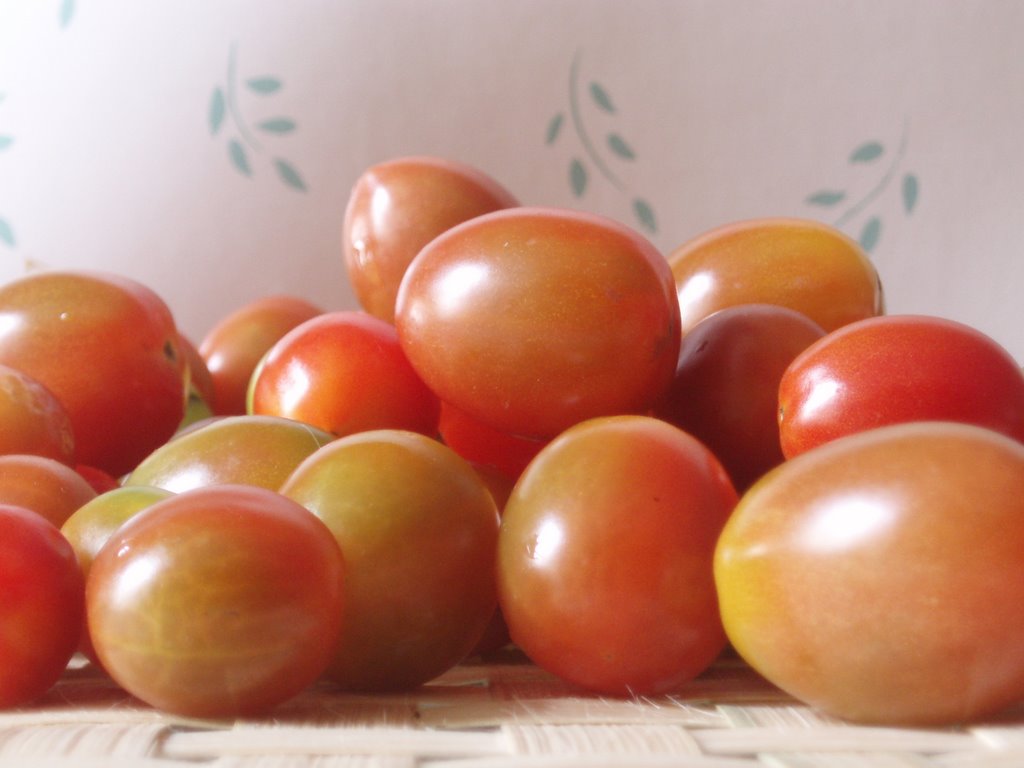
I’m trying to get rid of this habit – the self-control it involves demands inculcating in oneself an attitude of resignation, self-consolation and even a measure of cynicism – “How different can it be? A tomato is a tomato big or small, grape, cherry or plum!” Well, I’m glad to say it didn’t work this time – for one, I didn’t have much time to debate all these issues as my family, which had sent me to the grocer’s for a quick errand, was waiting impatiently in the car outside, and the challenge was too pretty to pass up - I can only hope the pictures do them justice. I’m also proud to say these tomatoes didn’t join the legions of exotic veggies and other foodstuffs that died in my fridge or pantry over the years!


I love salads, but can’t get the dressing right, and these tomatoes were too novel for me to waste in soups, daals and raitas. They didn’t taste extraordinarily sour or sweet, either, just plain fleshy! Leafing through my many cookbooks made me adapt a recipe from a Reader’s Digest cookbook which I shall call Oaty Tomatoes. Here’s what you need:

Baby tomatoes – 300 gm
Oats – 125 gm
Onion – 1 medium, minced
Coriander leaves, chopped – 2 tbsp
Butter – 1-2 tbsp
Salt and pepper, to taste

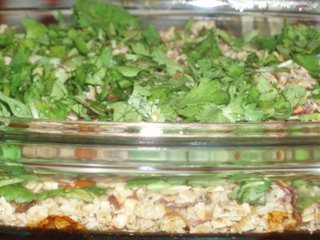
Preheat oven to 200 C. Halve tomatoes, place them cut side up in a baking dish. Season with salt and pepper. Bake for 20 minutes.
Meanwhile, heat butter and fry onion on low heat till soft and browning – that should take 15-20 minutes. Stir frequently. Now put in the oats, some salt and pepper and toast the mixture till crisp. Make sure you toast the oats really well, otherwise they tend to taste floury.
Top the tomatoes with this mixture once they come out of the oven. Garnish with coriander leaves all over!

This is my entry for Kalyn’s Weekend Herb Blogging being hosted by Scott of Real Epicurean.


Tags:

Thursday, January 18, 2007

Guessing game, and a Meme about Them


The guessing game first. Now tell me what this dish is, or what it contains. You have the herb to start you off, what do you think the rest are?


Now for the meme. (Am updating on popular demand)
Background: Jayashree of the blog My Experiments with Food wondered if we ever thought about how our blogger friends looked – I joked that we should do a meme, and Maheswari seconded it, so I started it but was reluctant to stick my neck out and do it ever since I read what Sandeepa had to say about it. But Asha tagged me for it, and I think it’s only fair that I do it when I started it so, here goes … this is how I intended it to be.

Sandeepa, who always has a comment for whatever I put up here, sounds like a sensitive person with a strong streak of humour. Looks? Hmm … I’m inclined to think she’s cherubic. Just a hunch, really can’t justify it. Please tell me if I’m right, Sandeepa.

Maheswari – a gutsy and creative soul, I would think, for the way she’s dealing with a couple of issues, including her failure to eat a good amount of fruit. Wish you all the best! As for looks, I’m not able to conjure up a face for her because I keep thinking of the South Indian actress Maheswari, who has sharp features and looks light-complexioned on screen.

Pooja sounds like a vivacious and fun-loving girl. For some reason, again one I can’t justify, I visualize her with short hair. Am I right, Pooja? And she must have a lot of energy if she conducts an event and does a round-up every week.

I'm hesitant to continue this, but here goes:
Coffee kept changing in my imagination. I keep thinking of her as a tall person in elegant clothes - could it be that her being a professor is giving me this impression? Does she have long hair? Or am I saying that because it fits the painter image? Tell me, do, Coffee!
Mallugirl, as she's signing off nowadays, reminds me of my classmate Shaheen. She was tall, smiley, had naturally brown, thick hair, well-defined features, was well-built, light-complexioned and used to wear bright pink offset by pale pink. I'm unable to put a face to Mallugirl, can only imagine a figure driving a car on New Jersey Roads because she's mentioned it - still, everytime I look at her blog, I think of Shaheen. Anyway, Mallugirl comes across as a busy mom who takes immense pride in her Malabar heritage. Beauty and symmetry are important to her, as her blog shows, an offshoot of her architectural instincts or most likely, she chose architecture to study because she was fond of these qualities.

Funny, isn’t it? I could be miles away from reality, but let me know how close I got!

Wednesday, January 10, 2007

Eggs over Greens, Bread


This is a great favourite with us ever since we discovered it. As with all great things, it seemed very simple once it was revealed, but really, the only tiresome bit about it is processing the fenugreek greens. But then, you can leave them out altogether or use larger greens which take lesser time.
The story: This is a traditional Parsi favourite which I read about in the book Parsi Food and Customs by Bhicoo J. Manekshaw, Penguin 1996. This is a real treasure trove full of painstakingly documented recipes, in which some ingredients’ lists run to more than a page! It’s also a good introduction to the community as it contains information about its customs and rituals. Come to think of it, it’s like an extended blog post – the recipes are borrowed from family, relatives, friends and the writing is very personal and involved.
I have eaten in a couple of Parsi restaurants before this book and after. I remember visiting a restaurant in Bombay after reading about it in a food guide. It was run by a Parsi couple and certain dishes were available only on certain days of the week – well, I was a budding, enthusiastic cook then, my cookbook collection was growing by leaps and bounds and mentions of Dhansak and Lagan Nu Custard seemed to be confronting me everywhere – the day after we landed in Bombay, I called the restaurant and asked the lady who answered the phone whether it was open for dinner, and whether we would get Dhansak that day. She said yes, and we went there. When I anxiously asked for Dhansak, she looked amused and asked me whether I was the one who called. It turned out to be regular stuff but the custard was truly to die for! I later ate cutlets in a Parsi restaurant in Pune, and were they delicious!We also ate a curry full of matchstick potatoes, don't remember whether we ordered the chicken or lamb.
But I digress. In these places, I didn’t notice the egg dishes I’m presenting now, so I don’t know how they would look in a Parsi home, but all the same, it’s a dish you must try. Depending on the time available, and the number of ingredients that go in, you can decide whether to serve them at breakfast or a bigger meal. I love making this dish, watching the eggs pool into the depressions, sunny yellow yolks in liquid whites flowing slowly into the rest of the dish until they begin to set and make a whole that you can divide and eat with rice or bread.

You can see the picture of fenugreek leaves and read a bit about it here.

Here’s the recipe as I made it:

Eggs – 4
Fenugreek (methi) leaves/Spinach – 1 big bunch of the big-leaf variety (the book suggests “20 bunches of the small variety that grow in the sands of Bombay beaches” as an alternative) – makes two cups
2-3 onions, chopped
Tomatoes – 2, large
Ginger-garlic paste – 2 tsp
Turmeric – a hefty pinch
Green chillies – 3-4 chopped, and seeded if you like (in which case, you can add some chilli powder)
Coriander leaves – a good fistful, chopped
Oil – 2-3 tsp
Salt, pepper or curry powder/garam masala – to taste

A pan large enough to hold everything

Wash fenugreek leaves thoroughly and chop. Mix them with salt and set aside for 30 minutes. Squeeze them out to get rid of the bitterness and some of the vitamins too. :)
Heat oil in the pan and fry onions till a light brown. Add green chillies, the ginger-garlic paste, turmeric and chilli powder, if you’re using it. Mix well and add tomatoes, coriander leaves and salt. Simmer on low heat for 3-4 minutes. Add fenugreek leaves (or other greens) now, mix well and saute for 1-2 minutes.
Spread mixture evenly in the pan, make depressions in it, and break the eggs into them. Season just the eggs with salt and pepper or curry powder. Wait till eggs set to remove from fire. Do all this in simmer mode.


Here's another version:
Cube 6 slices of crustless bread, fry in oil.
Fry 3 onions till light brown, then a couple of green chillies, ginger and coriander leaves. Season with salt.
Line the base of a pan with cubed bread, top with the fried onion mixture, make depressions and break three eggs into them. Season only the eggs with salt and pepper and wait till set on simmer.

This is my dish for Kalyn's Weekend Herb Blogging, hosted this week by Coffeepot of Coffee & Cornbread.

Tags:

Saturday, January 06, 2007

The Three Things Meme

Oh, how I love memes! I’ve participated in just a couple, initiated one (which hasn’t taken off despite being labelled ‘interesting’ – sob, sob!), and now this! Thank you, Sandeepa, for tagging me. I’m not going to be as self-effacing and humble as you were in your memes, oh no, and am going the whole hog with this just a day after you mentioned me – indecent haste, but that’s my meme personality!
I’m not sure whether it’s the late hour after an intense and long day at work or whether it’s the attempt to strike a fine balance between being engaging, honest, politically correct, smart alecky-but-humorous, venting some pet peeves but not wanting to carp, and tempting fate (WHEW!), but this took me hours to think over, complete and refine, and I’m still not satisfied! Oh well, you can’t have it all!


Three people/things that make me laugh

My Dad
Everybody Loves Raymond
Sridevi in the Telugu movie Kshana Kshanam

Three things that scare me

Me
Sleeplessness (but probably this blog/meme wouldn’t get done without it)
Weight gain :)

Three things I love

Travelling
Reading
Getting together with friends

Three things I hate

Male chauvinists (ugh!)
Jobless, malicious gossips
Braggarts

Three things I don’t understand

Science (I liked biology, though)
Why I want more clothes despite having so many
Why people extend invitations to visit them when they don’t really mean it

Three things on my desk

A picture of me sitting on a log in San Francisco
A Scrabble CD, which we bought long ago but haven’t yet unwrapped
A dolphin carved in stone

Three things I’m doing right now

Thinking of how to wow people with this meme :)
Wondering if I’ll be able to sleep after this
Wondering what I should put down as the third thing

Three things I want to do before I die

Travel extensively around the world
Live in at least a couple of the greatest cities and picturesque countries in the world
Be content

Three things I can do

Listen
Play word games
Do the dishes painstakingly

Three things you should listen to

Silence – so delicious in the late hours of the night and wee hours of the morning, with just a car or truck to offset it now and then
Birds chirping in the early hours of the morning – I’m surrounded by concrete but I still hear them, isn’t it magical?
Still afternoons, enhanced by the occasional rustle of leaves or a crow cawing

Three things you should never listen to

Raucous music (now I know ‘raucous’ is subjective)
Well-meaning people who egg you on to break your diet just this once
Yourself – if you agree with them

Three things I’d like to learn

Patience
Baking
More languages (I know five-and-a-half – I can read Russian, but don’t remember enough to understand it or speak it, any longer)

Three favourite foods

Salads
Most seafood
Fresh, thick curds/yoghurt

Three beverages I drink regularly

Water, water and more water, that’s it!

Three TV shows/Books I read as a kid

Enid Blyton
Amar Chitra Katha
Sesame Street

Three blogger friends that I am going to tag
(Only if you're interested)

Lera
Manisha
Mallika

Monday, January 01, 2007

Baked Leftovers


PLEASE CLICK ON THE PIC TO VIEW IT BETTER

There are the strangest of superstitions and beliefs and I consider this as one of those – if you do something today, on New Year day, you’ll be doing it for the rest of the year. So, if you spend money today, you’ll be doing that the rest of the year (oh no!), if you eat a lot today, you’ll be gorging the rest of the year (oh no no!), whatever animal you think of, the year will go by at a pace matching that animal’s (really, what will they come up with next!), and if you blog today, you’ll be blogging the rest of the year (Yes, Yes, Yes!)
Here’s a dish that I tried out yesterday – it’s a bake of leftovers and comes in handy when you have old bread that refuses to finish. I suppose it’s something like a soufflé with bits in it, it doesn’t have the velvetiness but it rises like one when it’s baking. It’s not my own recipe but I’ve seen it in several avatars in various books, but really, go ahead and do what you want – these are just guidelines:

Sandwich bread, crusts sliced off – 4 slices
Cooked prawns/veggies – a big handful, chopped
Eggs – 2, separated (* so that’s two yolks and two whites, beaten till stiff *)
Milk – 1¼ cups
Cheese – 4-5 cubes, cut up into bits/grated/just crumbled
Seasoning: Salt, pepper, mustard powder/chilli powder

Tear bread into pieces, soak in hot milk for 15-20 minutes. Add prawns, egg yolks, cheese and seasoning, mix well. Add egg whites, fold in well. Grease a baking dish and pop it into the oven.
I baked it for an hour at 180 C which I thought was too long, but the usual test – sticking a knife into it and seeing if it came out clean – took a long time. Funnily enough, it smells like sweet bread pudding and I felt full just inhaling it – I guess it was the combination of the milk and the bread, though why sandwich bread should result in a smell so sugary, I don’t know! After a while, I even began tasting the raisins (non-existent, of course)! It tastes fine, but there’s no correlation between the smell and the taste, know what I mean? Go ahead and try it, it takes little effort and makes a filling meal!
Tags:

Sunday, December 24, 2006

For the Festivities - Dum ke Laoz


This is a dressy dish that I’ve always dreamt of making but couldn’t because I would always fail to memorize the recipe – in the last few years since it’s been published, I almost always paid for this book but put it back regretfully as I felt it was too much of an indulgence.
A paperback never materialized but it so happened, though, that I had accumulated enough points on my loyalty card to be able to afford it without much guilt, so here it comes! The book is ‘A Princely Legacy – Hyderabadi Cuisine’ written by Pratibha Karan and published by Harper Collins Publishers India.
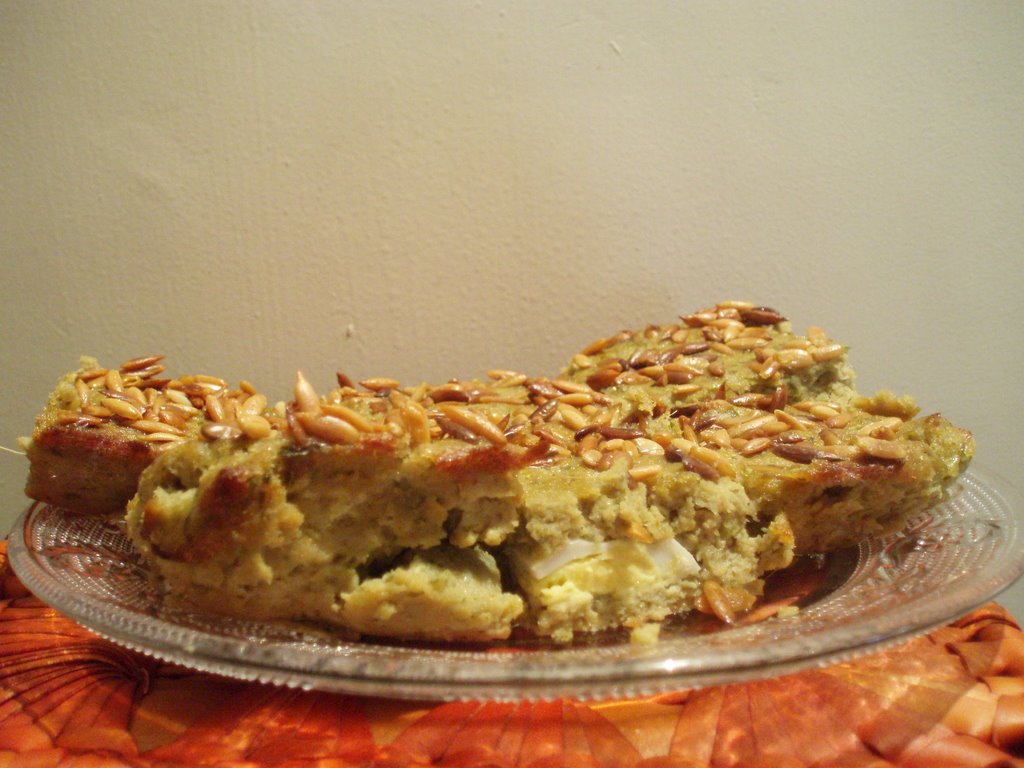
This is a really simple dish and there’s a terrific picture in the book, not a close-up, though. And the picture in the book looked typically golden brown, while my finished product is more green. But the proportions were haphazardly followed and I probably put in more coriander than necessary, giving it that green cast, but I liked it.
Today’s guinea pigs said it looked like a pastry/cake, which was good, because the book explains that’s how it gets its name - Laoz also means a sweet dish. In Hyderabad, it’s also called kheeme ki barfi, lagan ke kabab and Kashmiri laoz.
Most of the method is from the book (your forgetful cook did something wrong, as usual) but the measures are mostly mine:

500 gm minced meat (the book said 750 gm)
1-inch piece ginger, chopped
8 cloves garlic, chopped
A pinch of turmeric
A tsp of chilli powder
½ cup yoghurt/curds
1 egg, beaten
2 hard-boiled eggs, sliced
3 small onions, minced
½ cup coriander leaves, chopped
2-3 green chillies, chopped
A handful of cucumber seeds/skinned & flaked almonds (you can also use watermelon or muskmelon seeds or a combination of all these)
1 tbsp oil, if you like, to toast the seeds
A little more oil, to grease the baking dish and coat the kheema mix before it goes into the oven
Salt to taste

Boil the minced meat with ginger, garlic, turmeric, chilli powder, yoghurt, and salt, till tender. Grind into a fine paste (said the book, but I ground it into a fine paste with the beaten egg, onion, coriander and green chillies, which had to be mixed in after the cooked mince was ground.) Divide into two portions.
Fry the seeds, set aside.
In a greased baking dish, spread one portion evenly. Put the egg slices on it and cover with the remaining mince. Brush this layer liberally with oil – I used about two spoons. Sprinkle the fried seeds or nuts on top. Bake till golden. It takes about 30 minutes.
My experiment resulted in a spicy, moist mince cake which was a hit with most of the guinea pigs. Bon appetit!

WISH YOU ALL A MERRY CHRISTMAS!
Tags:

Friday, December 22, 2006

Pandan-Coconut Milk Jelly


DO CLICK ON THE PICTURE, IT'S BETTER VIEWED LARGE!

For someone who doesn’t use any form of coconut even once a month, Jihva seems to have put me in overdrive. I never thought I’d submit even one dish for Jihva for Coconut, leave alone two. But my thriving pandan shrub and unused packs of coconut milk and sugar are making for some very uncharacteristic behaviour, and so here it is!
This is a Thai/Malay recipe that I arrived at after reading various versions in books as well as on the Net. You can use agar agar for a more authentic and as a vegetarian option in place of the gelatin but I’m not sure of the proportions. The pandan didn’t lend its usual fragrance to this dish but just smelt like sap, even after I put in some vanilla essence. But I guess this is a dish high on texture and looks (though my photo may not do justice to it); it has a strong smell but a delicate flavour – what attracted me was the double-layered looks of the jelly.


For the pandan layer:

Gelatin (unflavoured): 1 tbsp
Water: 1½ cups
Sugar: ½ cup
Pandan leaves: 8-10, cut into strips

For the coconut milk topping:
Coconut Milk: 1½ cups
Gelatin (unflavoured): 1 tbsp
Sugar: ¼ cup

Preparation: Bruise the pandan leaves – you can pound them in a mortar and pestle, or whiz them once in the grinder. Boil them in a cup of water and strain the liquid.
Reserve one tbsp of the pandan water.
Dissolve gelatin in the hot pandan water. Stir well over low heat. Add the sugar, let it come to a boil and allow to simmer for a couple of minutes.
Put the reserved pandan water into this and let it come to a boil again. Pour it into a small-ish container/mould and put it in the refrigerator.

For the topping, dissolve gelatin in coconut milk on low heat, add sugar and stir well. Let it come to a boil.
When it’s still hot, pour the topping over the pandan jelly.
Before serving, cut the jelly into small pieces/shapes.

Tags:

Wednesday, December 20, 2006

Jihva for Coconut - Fish Curry


This is one vegetable technology hasn’t improved. I’ve seen vacuum, hand-held, electric – but nothing as effective nor easy to use as the coconut graters of our childhood.
Sit on the floor, rest your knee against the wooden base the lever and grater are affixed to — turn the lever on the right and the rotary grater on the left scoops out the fleshy part of the coconut held over it into zillions of soft, white snowflakes. Even the kattipeeta (the traditional implement used to cut/slice vegetables – usually a curved blade attached to a piece of wood), which ends in a sharp, serrated disc of steel meant for the coconut is not as effective.
That being said, I must say that when Ashwini announced Jihva for Coconut, I had to rack my brains long and hard to come up with an entry. For me, my fascination with coconut lay, and still lies, in the grater I described, the spray of fresh white against newsprint – but apart from the coconut-red chilli-tamarind chutney and kobbari louzu (coconut-jaggery balls) that used to be made at home, I don’t remember other ways we used it, perhaps to thicken a meat gravy? I’m not sure.
When I grew up and got interested in cooking, cookbooks made using coconut an often tiresome and doubt-ridden process. When it had to thicken a curry, the grinder never seemed to do its job properly, at whatever speed, pulse, frappe, whip, beat – the ‘paste’ would end up a loose mix of water, bits of chilli, coconut that refused to grind — and imparted an overwhelmingly coconutty taste to everything it was used in. I don’t think we used coconut milk at home, ever, so which cookbook was right? Squeeze the grated coconut with bare hands, put it in hot water and whiz it in the mixer, thin milk, thick milk, second extract, first extract? So out the coconut went, out of my kitchen and now and then makes an appearance in milk carton form, whence this recipe originates.
Fish curry
Seer fish: ½ a kilo - skinned, boned and cubed
Onions: 3 small, chopped
Thick coconut milk: 1½ cups
Dry red chilli, ground: 6
Pandan leaf: 2
Basil: A little
Cinnamon: 2-inch piece
Curry leaves: A few
Turmeric: A pinch
Fenugreek: ¼ tsp
Ginger-garlic paste: 1 tsp
Limes: 1-2, juiced
Salt: To taste
Put in everything but the limes into a pan and cook till the fish is done. Once it cools, add the lime juice. That’s it, you’re done!

Sunday, December 17, 2006

A Meme About Them

I was inspired to start this meme when I visited Jayashree’s site My Experiments with Food. She wondered whether we gave other bloggers a face and I joked that we should start a meme on ‘how do I think they look.’ When I visited her site a few days later, Maheswari of Beyond the Usual had seconded my suggestion, and so here it is!
I’m not sure how to take this forward except to tag a few people and request them to link me (http://whenmysoupcamealive.blogspot.com) in their responses and in turn mention my request to the people they tag – this is the first time I’m doing something like this and I’d like to see the course it takes.
So, I’m tagging Maheswari, Jayashree and Sandeepa of Bong Mom's Cookbook – all you have to do is tell us what you imagine your blogger friends look like, and maybe why you think they look so. I’m not sure if I can give my own opinions without being tagged so I’m not volunteering any :) And naturally, you'll do it only if you want to.

Tuesday, December 12, 2006

Prawn Pickle

Posted by Picasa

Growing up, pickles with any sort of meat were never something I had heard about, so it was a revelation tasting meat pickle brought back by friends from Kerala in our hostel.
It turned out later that that meat was beef so that effectively ended my gustatory experiments with meat and pickle but slowly, over the years, I began hearing of how so-and-so back at home had heard of somebody who made ‘chicken pachchadi’ and ‘mutton pachchadi.’ These reports would always be accompanied by an expression that said “What’s the world coming to? What will people pickle next?” I hadn’t heard of fish and prawn pickle even then, not from any part of the country, but came to discover them only much later.
The prawn pickle that I’ve tasted a few times over the last few years is made with lemon juice, garlic, fenugreek and mustard, much like the time-honoured recipes of many other pickles Andhra homes are famous for. I’ve even tasted one with the bite of cloves, which I found excellent.
These days, of course, due to the home-style stores in Andhra that specialize in making and vending traditional snacks and sweets once not usually found in sweet shops, non-vegetarian pickles seem to have become more popular and less ugh! The morsels found in them are an apology for meat and the masala is black, fried to death, probably due to the huge quantities they undertake to make.
At a book exhibition recently, I found a book that had recipes for two kinds of prawn pickle – one with tamarind and the other with lemon juice. I tried the lemon juice version today, and while I misread the instructions and messed up things midway, the end product didn’t turn out too bad.
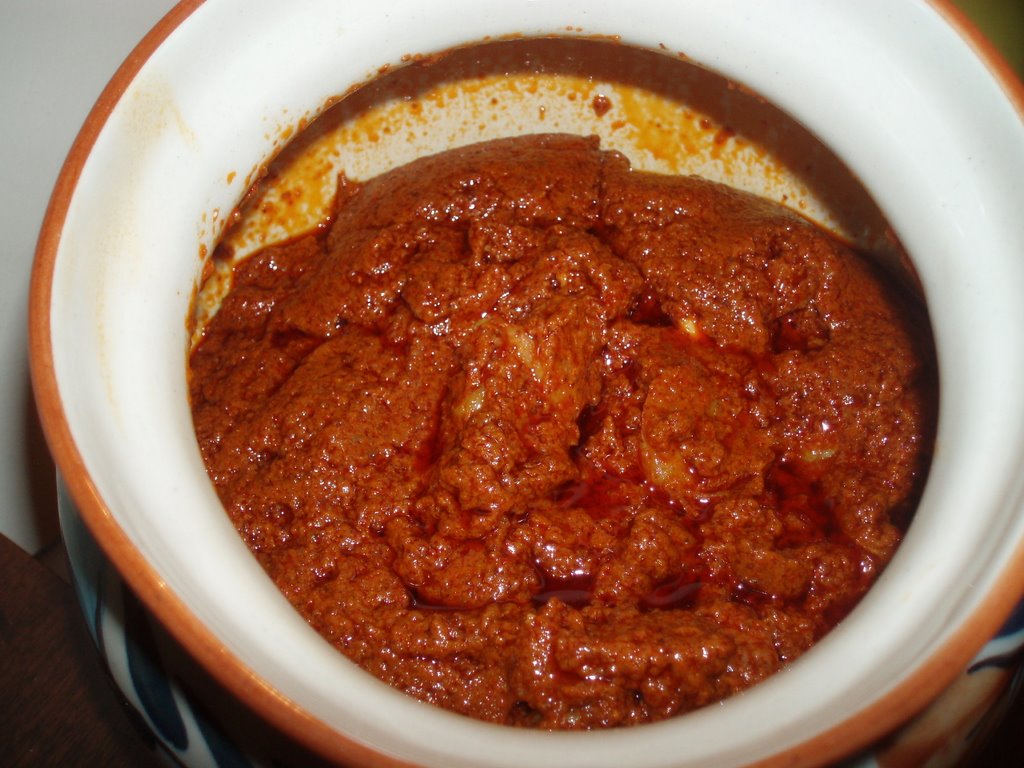
Of course, it’s still just a couple of hours since I made it – after wrestling with the photos, I immediately stuck it in the fungus-proof interiors of my wonderful fridge, so I’m not sure how good it inherently is.
Here’s the recipe then, as it’s found in the book. I do hate it, though, when these books don’t specify the kind of salt or the measure but blandly say “Salt - to taste.” Maybe the book expects its readers to be experienced, all-knowing cooks, I don’t know. Funnily enough, the list of ingredients in this recipe totally missed mentioning the salt but all the other pickle recipes said that. It’s not as if it’s a dish you can easily adjust the salt in – pickle-making is a delicate and difficult enterprise, all the more so when it’s your first time, why don’t authors think of that? I asked around and crushed two small fistfuls of rock salt and added it to the pickle – that’s another of its inherent uncertainties!

Prawns: 1 kilo (2.2 lb) (I used only half the quantity and frozen, thawed ones as I don’t know how to handle fresh ones)
Garlic: 4 cloves (you can increase the amount)
Turmeric: 1 tbsp (increase it, it might give the pickle more staying power)
Chilli powder: 100 gm
Salt: I used two small fistfuls of crushed/ground rock salt
Mustard powder: 50 gm
Fenugreek powder: 50 gm
Lime juice: 1 cup (I ultimately had to use 2 cups for it to retain some moisture)
Oil: ½ a kilo (I forgot to measure the volume, sorry, but it’s not impossible to weigh)


Shell the prawns, wash well, drain and place them in a bowl. In a frying pan, heat half the oil to smoking point and fry till “red.” Cool.


In the same frying pan, put in the rest of the ingredients, mix with the rest of the oil, then mix with the prawns and bottle in sterilized jars. Leave it to steep for a day and check for seasoning the next. Meant to be eaten with hot, soft rice. I would recommend putting it in the fridge.

Tags:

Friday, December 08, 2006

Bounty from the East


I knew it would arrive this way, not giving me time to savour receiving it and opening it immediately – smack bang in the middle of work, when I’m juggling two telephone calls and can’t open the door immediately when the bell rings. But thankfully, the postman didn’t have to ring twice; I got to the door in good time to be faced by a pleasant postman who said, “Foreign parcel, it was too big to leave in your letter box and the watchman said I should hand it over to you personally.” I thanked him at least thrice, closed the door and made a beeline for the camera, all the while looking nervously at my phones, willing them not to ring.
There, then, was my Blogging By Mail package from Kai Rui of Singapore, with many unusual ethnic foods – the most unusual had to be the chilli-tapioca-ikan bilis (a kind of fish) – I’ve never seen anything like that, neither the combination nor the brilliant red of the snack, made all the more bright by the orange of the packaging. Then there was a big packet of sultana biscuits, Kai’s childhood favourite, as she explains in a nice, neatly-written letter (how nice to receive letters on paper, such a rarity these days). There is also a pack of Singapore Hainanese Chicken Rice spice mix – Kai explains that it actually doesn’t originate from the Hainan island in China but is unique to Singapore, where it has a fervent following. In her favourite stall in Maxwell Road Market, she says, you have to wait for more than an hour to get that “plate of heavenly goodness.”
The Mee Siam is another national dish, of Malay origin. Kai describes it as having a “complex and intriguing” taste as it’s sweet and tangy at the same time. I can identify with that, Kai – we make vegetable stews with tamarind and jaggery, and they too are sweet and sour.
And I dread the sugared peanuts – if I begin eating them, I won’t be able to stop, I’m afraid. The ikan bilis and sugared peanuts are common snack foods served to guests when they visit during the Chinese New Year, Kai explains.
I’ve not opened any of these packets yet – the ikan bilis looks too beautiful to cut through! They came this morning, and I will update you when I use them. Thank you, Kai, for the gorgeous food, and thank you, Stephanie, for the pairing up and the organizing. Both of you have certainly dispensed happiness!
Tags:

Wednesday, December 06, 2006

Jihva and Just Deserts

The life of a food blogger is a hard one. Especially when events come around, and the pressure on oneself is to innovate/exhibit rather than humbly participate.
When Kay of Towards a Better Tomorrow announced Jihva for Jaggery and requested us to send in unusual recipes, yours truly immediately lined up two ambitious ventures, only to end up with thumping failures.
The lessons (oh yes, there always have to be lessons from failures): Trying to create a dish merely on the strength of having gorged on it throughout your life does not magically bestow on the eater the recipe; and payasam can curdle at any stage!
A friend recently said she didn’t believe in second attempts with recipes. She never, ever wanted to relive the failure, she said - the dish had turned an enemy, a friend who had failed her. Thanks to Jihva, I did make a second attempt, which is now making the rounds at work because I cannot bear to have a constant reminder at home of the consequence of my hubris.
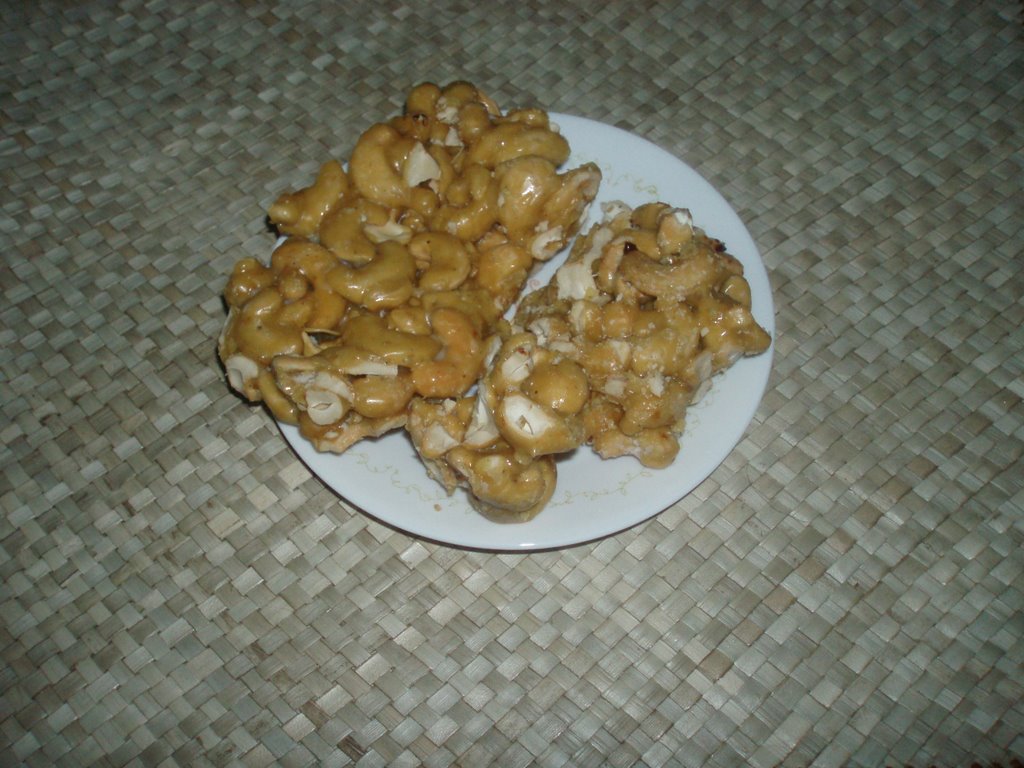
Yes folks, in the first episode, I set out to make this:


And ended up with this:


Both versions are called Jeedipappu Paakam, and in the parts I come from, the first is celebrated for its addictive, ghee-laden, cardamom-flavoured, expensive existence. The texture of the jaggery against the cashew nuts it envelops is something I can only describe as similar to icing. It comes in great big slabs, or rocks, and sometimes even a pair of brawny hands find the going tough when they have to break off smaller pieces – a firm tap with a hammer, or a sturdy knife driven into it, like the blade of an axe, and then borne down upon with all the might of your shoulders, does the trick.
But this is not to say it’s difficult to eat. On the contrary, it’s easy to get carried away. A friend in hostel used to overdose on this every time I took it back with me after vacation, and even the very real risk of a troubled stomach made only more sickening by the water scarcity in the loos couldn’t deter her from chomping on it all the time.
Well, I couldn’t find a recipe for it but it had to be simple, I thought: Just melt a cupful of jaggery in a little water to a stage where the syrup holds its shape in a bowl of water when tested, pour in a cup of cashews, a few spoons of ghee and a pinch of powdered, roasted cardamom seeds, whisk it off the fire and spread it in a plate greased with ghee, and your paakam is ready. (The rocks and slabs were, I thought, a function of volume – I was no accomplished mithaiwali after all, just a zealous, new food blogger trying to wow the world.) Alas! It was not to be - I ended up with my first chikki.
Not deterred, I stopped off at the store on my way back from work, bought a cannonball of light yellow jaggery, some more cashew and spent a good part of the night powdering the former, all the while dreaming of perfection from the second attempt, and the other dish I planned to display, a traditional, festive one that too!
My second attempt was just as bad, or as good as my first – and while my guinea pigs ate it without question and even the odd compliment, the ignominy of it all rankled – and instead of leaving well alone, I launched into my second sweet soon after I got back from work.
{Drumroll} Paalataalikalu!
My recipe for this sago-and-rice flour noodles payasam came off the Net. The sago was processed as per one of my fail-proof home cooking books, and everything was going along swimmingly fine. Even the rice flour, with which I was working for the very first time in my life, was cooperating. And what did I do? I raised the heat to boil the rice flour noodles, and met my comeuppance in the form of a heaving, creamy-brown ocean of curdle that I couldn’t salvage. I, friends, had got my just deserts!
{Curtain call, bow}
Tags:

Sunday, December 03, 2006

A Party Piece - Haleem Goes Vegetarian


This is a party piece even when it’s non-vegetarian. Come Ramzan, and visitors to Hyderabad would be whisked off to the Old City to try the Haleem and other dishes that would make an appearance only that month, apart from the kababs and khubani ka meetha (stewed apricots with custard) that the city is so famous for.
Now Haleem seems to be available everywhere in the city – I visited last year during Ramzan and every restaurant big and small worth its name had banners advertising its availability. I even remember Hareesh (a dish, not a guy), but am not too sure what it was or even whether I tasted it.
However, in the after-life (life after Hyderabad, that is, this is no ghost writing this piece), most of my friends are vegetarian, and pulaos, fried rice and “variety rice” (that favourite Madrasi term for various flavoured rice dishes) soon pall as they are commonly found. I had just begun collecting cookbooks then, and was thrilled to find this dish which proved to be the delight of every get-together we had since. Sadly, though, work and different schedules ensured we couldn’t meet often, but as a ‘welcome back’ dish for someone who loved it but told me not to bother with it, it’s just right.
The basic recipe is from Rotis & Naans of India by Purobi Babbar (Vakils, Feffer and Simons, 1990) but I made a few changes based on what I found in my fridge. On to the recipe, then!

1 ½ cups broken wheat (I used coarse wheat rava)
4 tbsp red gram/toor daal/kandi pappu
2 tbsp green gram/moong dal/pesara pappu (the book suggested masoor daal)
2 tbsp split Bengal gram/channa daal/senaga pappu
100 gm altogether – peas, yellow pumpkin, and carrots, cut into pieces (the book suggested peas, cauliflower and brinjals)
2 capsicum/green bell pepper, cut
3 medium onions, sliced

8 cloves garlic and 2 tbsp grated ginger, ground to a paste
1 tsp turmeric powder
1 tsp chilli powder
1 tbsp curry powder/garam masala
1 tbsp coriander/dhania powder (the book suggested 1 tbsp each of coriander and cumin seeds ground to a fine paste)
2 level tsp salt
6 cups of water
8 tbsps of ghee or oil (I used my flavoured ghee)

For garnish:
1 onion, sliced and fried crisp
Coriander leaves/hara dhania/kothimeera, chopped

Soak wheat and dals separately overnight. Wash well. Drain and keep aside for 20 minutes.

Heat half the melted ghee or oil. Fry onions until brown. Stir in garlic, ginger paste, fry for a few minutes. Add coriander powder, turmeric, chilli, salt and add wheat and dal mixture. Stir well.

Pour in the water. Cover and cook slowly over low heat for one hour till the wheat is soft and pulpy and the daals are tender. Add vegetables. Stir well. When ready, add curry powder and the remaining ghee or oil.

Keep stirring often. Despite all my heroic, conscientious efforts, it did keep sticking to the bottom of the pan between the stirs. Cook over low heat even now, but without the lid until the ghee floats to the top and the colour turns golden.

Once you’ve transferred it into a serving bowl, sprinkle the fried onions and coriander on top. Serve hot with lemon slices, mint leaves and a simple salad of cucumber, onion and tomato.

Warning: This takes at least two hours to make and a tremendous amount of patience. You also need to be alert. This stew can splutter and burn your arms and fingers. The end result is worth it, but then, make sure you serve it in limited doses to those who shouldn’t be eating all that ghee or oil!

As I was finishing it off and reached for something in my shelf, I noticed my bottle of olive oil looking down at me. Given that most of the ingredients are also used in Mediterranean cuisine, this dish would have probably tasted as good but lighter with olive oil, if any of you try, don’t forget to drop me a line.
And to borrow what many of my vegetarian friends unfamiliar with paneer/mushroom/tofu would say: “I believe it tastes just like non-veg.” It does.


Tags:

Sunday, November 26, 2006

A Random Chicken and ... Ohmigourd!


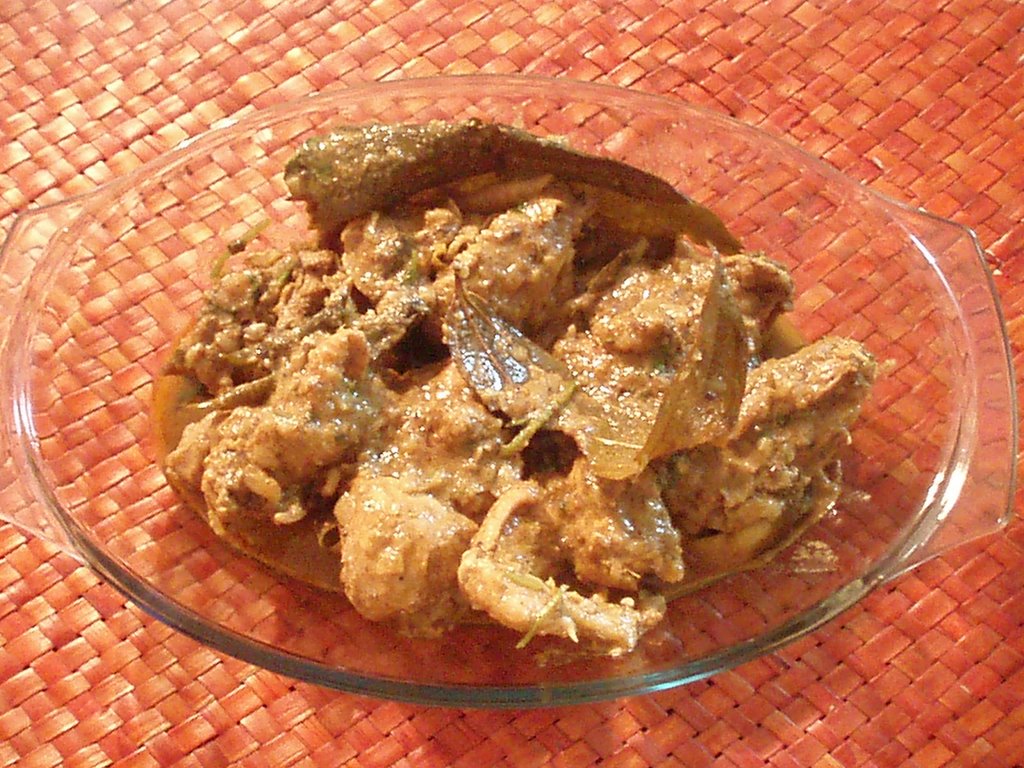
This chicken was an afterthought. It’s been ages since we summoned up the energy to buy and cook any meat at home — it involves a long, smelly, unhygienic and fly-ridden wait at the butcher’s, and the only time we have is Sunday mornings. Go a little late and you have to come back empty-handed. However, having found it in our weekly shopping expedition all nice and wrapped up sans the usual puddles and sticky splotches of bloody ooze on the shelves of the chiller (another big put-off), we bought it and turned it into one of the tastiest chicken curries we’ve ever made. Now I know how to make a South Indian ‘military’ hotel-type chicken curry – it may not be the exact recipe, I may not ever make it again, but it smelt just like it and I know how to do it, isn’t it thrilling? All those days of wondering why we never ever get that rich brown colour, that thick gravy, that flavour – well, all will be revealed soon!
(For those who don’t know what a military hotel is, it’s the term used in South India (in North too?) by a non-vegetarian hotel to distinguish itself from a meatless one – probably because of the belief that soldiers in the army eat a lot of meat everyday to gain and keep up their strength. It also serves very well to keep vegetarians from straying into its precincts!)

I’ve called it Random because I just threw in whatever I had by way of marinade, there was no recipe and the measures were slapdash:
Two ladles of fresh curds
Two fat pinches of turmeric
A tablespoon of ginger-garlic paste
Some Sambaar kaaram (a chilli powder mix with garlic, salt and coriander, NOT to be mistaken for saambaar podi/powder)
A really hefty pinch of curry powder/garam masala
Some more salt and coriander powder
I mixed in the marinade really well and sat the whole thing in the refrigerator for about three hours.

Siesta over, here’s what you need to do:
Chop two onions
Slit three green chillies (one of mine had turned a ripe red)
Fry them in three tbsps of oil
Throw in some leftover mint leaves (mine were 10 days old) and a few coriander leaves/cilantro
Add a couple of bay leaves
Fry this till all of it wilts
Then put in the chicken with the marinade, pour a little more water and cook covered on medium fire. Throw in a fistful of curry leaves, stir. (Voila, this is what gives it that military hotel taste!) Keep turning every five or seven minutes. Check the chicken for ‘doneness’, seasoning and add some more curry powder at the end. Simmer longer if you want a thicker gravy. Sprinkle with chopped coriander leaves. Soft, hot rice is a good accompaniment. Truly a lip-smacking, tasty dish which leaves your home fragrant for the rest of the day!
The other one is an old favourite which comes with its own story – read about it further down!


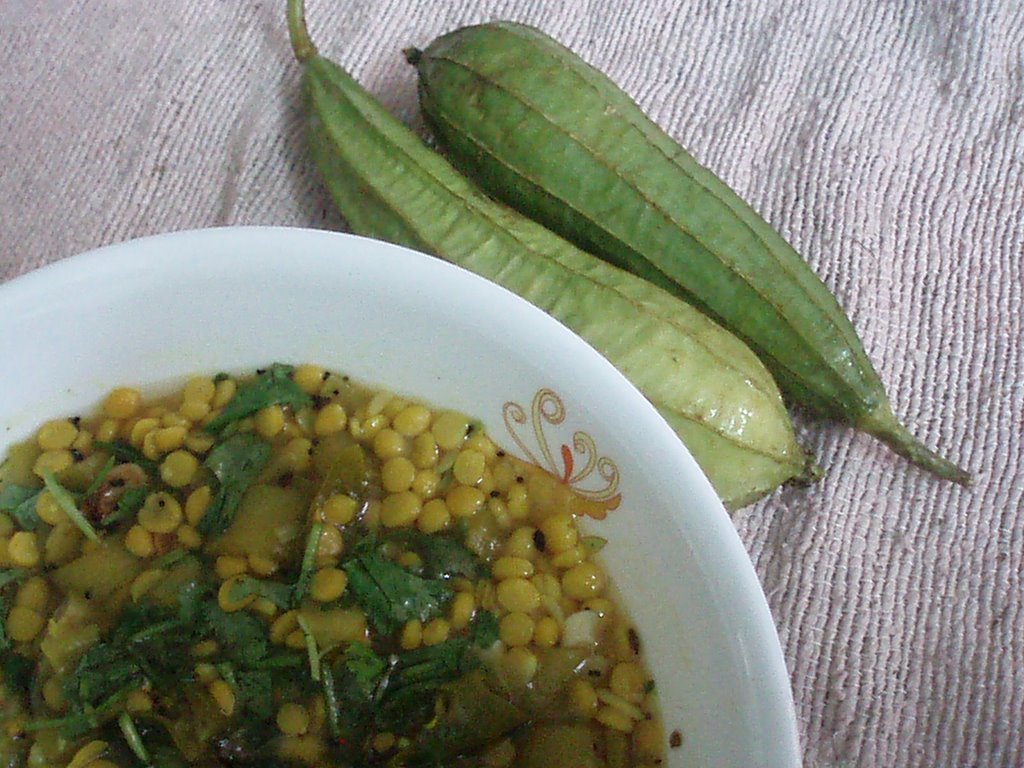
Funny how I forgot this dish existed and was a great favourite with me when my Grandmom was cooking! I recently saw a post on Masala Magic for Beerakaaya Pappu made with toor daal but as I said in my comment there, this was one daal that escaped our home, and the homes of others I knew. We made many others, though – with tomato, raw mango, a variety of greens, dosakaaya (cucumber/melon cucumber, as it was called in one of these blogs), vaakkaaya (sour little purple-green berries) …
Many days later, however, I suddenly remembered this dish. And I know why Beerakaya Pappu sounded unusual to me – we didn’t call our version by that name, but with an extra detail added – Beerakaaya Senagapappu, for the Bengal gram/yellow lentil that went into it. I remember Gran cooking a huge quantity of this and once even freezing it; for two or three days in a row, she would take this speckled green-and-yellow dish sparkling with ice out of the freezer, ladle a few servings into another dish, heat it and serve it.
I wasn’t interested in cooking then, and I couldn’t find the recipe in any book that I have now, but found one for ridge gourd with toor daal that promised to emulate the consistency of this old favourite. Only, it didn’t turn out as great as my Gran’s. This one used tamarind, I’m not sure hers did.

Here's how:

Ridge gourd/Beerakaya, diced – 250 gm
Bengal gram/yellow lentil/channa daal – 1 cup
Onion, chopped – 1
Tamarind – Lime-sized
Green chillies, slit – 6
Chilli powder – to taste, but half a tsp would do
Turmeric – a pinch
Salt

For the tempering:
Mustard seed – 1 tsp
Jeera/Cumin – ½ tsp
Black gram/split urad daal/minapa pappu – 1 tsp
Garlic, squished under the knife – 4-5 cloves
Dry, red chillies – a couple
Curry leaves – a few
Coriander leaves/cilantro, chopped – a fistful
Oil – 1-2 tsps

Soak the daal in water for a couple of hours, then cook with some water – it has to hold its shape. Then put in the ridge gourd, onion, green chillies, salt, turmeric and chilli powder and cook for another 5 minutes. Extract the juice from the tamarind, add it to the pot and cook some more. Or you can cook it in a pressure cooker/pan from the beginning but use the weight only at this stage. After one hiss, take it off the fire. Wait for the pressure to come down on its own. Don’t force the weight open, it’s dangerous.
In a small frying pan, heat the oil, splutter mustard, cumin and black gram, then the garlic, then the red chillies and curry leaves. Make sure it doesn’t burn and blacken. Pour this into the daal, garnish with coriander leaves. Serve with rice or even puris/chapathis. As you like it!
Tags:

Monday, November 20, 2006

How Green Was My Valley

This was my weekend break ... a long boat cruise from morning to evening, punctuated by a rather rustic buffet lunch at one of the villages on the banks of the Godavari. Cooked on another boat that followed us there, the lunch was set up on rusting trestle tables and served out of steel buckets. It included pulihora (lemon rice), plain daal, cabbage with channa daal, fish, mutton and chicken. Nope, there was no dessert. Middling in taste, but a good experience. Here are some pictures from the rest of the trip!


Sri Ramagiri, the hillock we passed as we set out on the cruise. The temple is dedicated to Lord Rama. The boatman asked, but we didn't break journey.


A slice of the landscape so typical of the early part of the journey. Our destination was Papi Kondalu, an area known for its mountains, vegetation and scenic beauty.


The mountains we wanted to see. We don't actually get off in that area but cruise along and then turn back.


Journey's end. Isn't it just like a scene from a painting? These are Dad's pictures.

Sunday, November 12, 2006

No Cowardy Custard!


Nope, this is no cowardy custard! It looks like the usual crème caramel but is flavoured with saffron and pepper, and omits the vanilla totally! This is my entry for November’s The Spice is Right hosted by Habeas Brulee.
You need to use a hefty dose of saffron and freshly ground pepper for the flavours to come through. It did smell eggy when it came out of the oven but not later. I once made caramel custard with orange zest and saw a recipe for one that included ginger — have to try that out when it’s binge time next!

The rules for the event demand that I mention a few facts about saffron and pepper – I’m sure most of you know but here’s my spoke anyway — Saffron is the dried stigma of the crocus flower (crocus sativus) and is used to colour and flavour food including biriyanis, pulavs and desserts. It’s very aromatic and combines well with milk-based desserts. Apart from its medicinal qualities, in Ayurveda, it’s believed to lighten skin so many fairness creams and soaps in India use saffron! It’s one of the most expensive spices, and that makes this an expensive dessert to make and eat – talk about hurting one’s own interests!
Pepper has a host of therapeutic applications as well, apart from culinary. It is supposed to act as an appetizer, and a drink using pepper and hot milk is used as a remedy for cough. As for why I chose them this month, I'm not sure - probably because I came to know about this event only this month and thought the spices would be a nice variation.

The recipe for the custard is a synthesis of various recipes that I’ve followed over time but the spices were my own idea. My experiment resulted in a mildly flavoured, set-just-right custard that tasted great after chilling for 3-4 hours. So, on with the show!

What you need:
1.5 cups heavy cream
3/4 cup milk
3/4 cup sugar
3 eggs
2 egg yolks (the whites can go into an omelette)
A tsp or more of saffron (soak in 2 tsp of hot milk)
1-2 tsp of pepper powder, freshly ground
A pinch of salt
Around 1/2 cup sugar for the caramel
Oven temperature: 180 degrees C

Here’s how: Scald the cream and milk in a saucepan (until you see tiny bubbles on the sides of the pan). Meanwhile, in a mixing bowl, slowly beat the 3/4 cup of sugar into the eggs and yolks. Even more slowly, whisk the cream-milk mixture into this egg-sugar mixture. Strain it through a double-lined/fine sieve. Stir in the salt. Add the saffron and pepper at this stage.
In a baking dish with deep sides, arrange some ramekins. (I used six because I had six, and found that I had some custard left over.) Put sugar for the caramel in a saucepan. Add just enough water to cover the sugar and put it on high heat. Very soon, it will come to a roiling boil, then thicken, and turn colour. Watch it very carefully at this stage, it can easily burn – when it is an even golden brown, carefully pour it into the ramekins. (It’s a good idea to wear oven mitts during this process as the saucepan will be very, very hot.) Make sure each ramekin has a thin layer of caramel.
Pour the custard into the ramekins, fill the baking dish with water enough to come halfway up to the sides of the ramekins. Bake until just set – it took me an hour but keep checking. Once it’s done, cool, cover with cling film and refrigerate.

To serve, run a knife around the edges and invert on to a plate. If you want to impress your diners, and yourself, float some strands of saffron and a few peppercorns in the caramel sauce around the custard, or sprinkle some saffron on top. I’d even go a step further and recommend you use only yellow lighting, not white, as long as this feasting is going on :) so that the glossy creams and browns of the custard are intensified! Ridiculous suggestion? Going too far? Who cares?

Wednesday, November 08, 2006

Paatoli (Veggie-Lentil Crumble)

Posted by Picasa

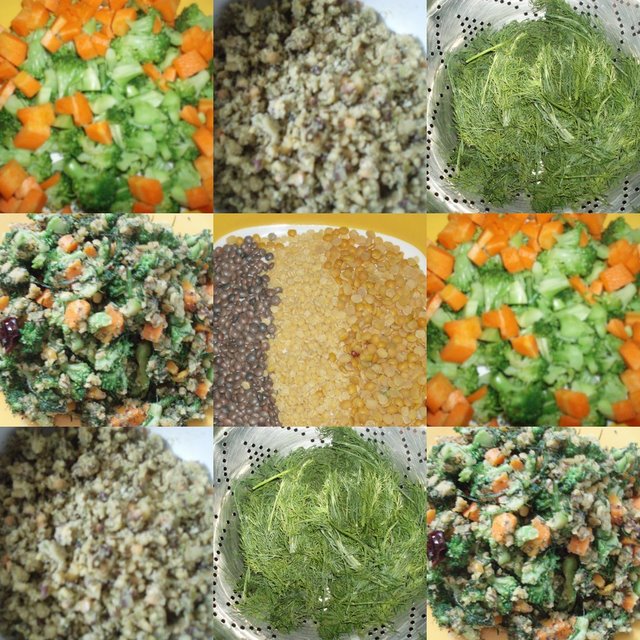
It sat in its box at the grocer’s, tossed along with the other heads. As soon as I saw it, I knew what my next post was about – paatoli with broccoli, carrot for colour and dill for flavour. It’s a versatile dish I first tasted only a few years ago, but seem to have achieved an approximation of perfection with only in the last few weeks.
Paatoli (paruppu usili in Tamil - that's the only other name I know) looks very pretty with green and red capsicum (peppers) bits, nice and green with the traditional French beans or cluster beans and I even made a slightly magenta version once with beetroot and carrot! The broccoli version is a serendipitous find – made years ago to see whether an “English vegetable” goes with a very traditional Indian dish.
Here’s my recipe:

1 small head of broccoli, cleaned, separated into small florets
1 big carrot, diced small
1 bunch of dill, washed thoroughly, chopped
Turmeric powder – ¼ tsp
Oil – 3-4 tbsp
Mustard seeds – 1 tsp
Green Chilli – 1, slit
Red chilli – 1, halved
Salt

½ a cup red gram
¼ cup black masoor daal
¼ cup green gram
All three lentils are to be washed and soaked in warm water half an hour in advance

3-4 green chillies, slit
Cumin – 1 tsp
Peppercorns – 1 tsp
Ginger – chopped, a tbsp
Coriander leaves – ½ a cup


1. Boil/microwave the broccoli and carrot with the turmeric and salt till just tender. They should not lose their crunch.
2. For the crumble:
Drain water from the soaked lentils, grind them in the mixer with some salt, slit green chillies, cumin, pepper, ginger and coriander leaves. Try not to use water – it should have the consistency of a coarse mixture - see centre picture, first row.
3. Put this mixture in a dish and steam it in a pressure cooker for about 12 minutes without the weight on – if you use the weight, you’re in for a watery paste and an irredeemable dish.
Make sure that the water at the base of the pressure cooker does not boil over into the dish containing the crumble. Keep an eye on the pressure cooker – it will emit steam only as long as there's water in it – as soon as it stops steaming, turn off the heat and put it in more water if the mix inside isn’t done yet.
4. Once it’s done, cool, crumble and set aside.
5. In a pan, heat the oil, put in the mustard, wait for it to pop, lower flame and then put in the green and red chillies. Add the dill, sauté for a minute or two.
6. Now add the broccoli, carrot and crumble. Fry for a while, check for seasoning and add salt if required.
7. The perfect paatoli will be powdery, light and not stick to the pan – but I find that this comes with practice. I also find that the veggies and lentils are disproportionate sometimes, but I don't see it as a failing unless the crumble obscures the veggies. You can always refrigerate extra crumble or extra veggies for another day!
8. This goes well with chaaru/rasam and rice, and is good to eat with a bowl of curds/yoghurt as well.

Thursday, November 02, 2006

Daal with Greens

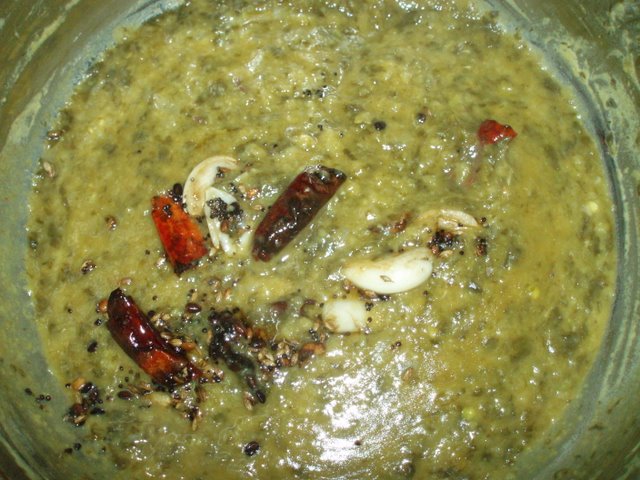
One of the distinctive features of Andhra cuisine, I think, is its daals with greens. Be it spinach, sorrel, amaranth and other varieties I don’t know the English names of, they can all be combined with lentils to make greeny-yellow affairs that go well with rice, pickles and appadams and even breads such as chapatti and puri. And if you soak the daal for a while and use a pressure cooker, it’s done in a jiffy! For today’s recipe, I’ve chosen what is known as chukkakoora in Telugu. Madhuli of My FoodCourt has a picture of these greens on her blog – I didn’t decide to put this in mine till I chopped up the greens and assembled everything in my spanking new stainless steel pressure pan and decided it made a pretty picture. This recipe works well for most greens and most daals, though I’ve never used channa daal, I must say. Chukkakoora (and gongura) is naturally sour, but for the other greens, you can use a little tamarind extract and one or two country tomatoes for added flavour. You can also go with just one of these or try a combination to see if the proportions work well — I confess I’ve never got the formula standardized so each daal is a discovery everyday, but rarely a tragedy! Now that I’ve made one confession, here’s another – I’ve never bothered with quantities, just rough measures so here’s what you need:
Posted by Picasa
1 bunch of greens – 100-150 gm – thoroughly washed and then chopped - if the stalks are big and tough, you can discard them
A cup or so of daal, preferably red or green, usually hulled – soaked well in advance
1 small onion, chopped
A pinch of turmeric
2 or 3 green chillies

(Optional)
2 tsps thick tamarind extract
A tomato or two, chopped

Tempering: Some cloves of garlic, crushed
Mustard seeds, cumin, black gram daal – all approx half a tsp
Red chillies – a couple, torn into three or four bits
Some curry leaves
A tsp or two of oil

1. Put everything in the pressure pan, check that there’s enough water to just cover the daal, and once the steam builds up and comes through, put the weight on the vent. Let it hiss a couple of times, turn the heat down to the lowest, wait a couple of minutes and turn it off.
Don’t force the pressure cooker open, wait for the steam to escape on its own – if you absolutely have to, sit the cooker in a plate or dish of cold water, that will hasten the process, and gingerly flick the weight to see if it’s ready to come off – if it hisses, it isn’t, if it’s a slow sigh, you’re almost there! If you don’t use pressure cookers, you’ll just have to boil the daal in a pan – I haven’t attempted that with success, so I won’t pretend I know about it, but something tells me it’s simpler to boil it without the other stuff first.
2. Now, once you open it, mash the contents into as homogeneous a mass as you can, season with salt and red chilly powder. (I don’t usually put in the salt till the daal is cooked as it might interfere with the cooking.) I also don’t put in the tamarind until after the daal's cooked but I’ve seen others successfully throw it in with the rest of the ingredients.
3. Now heat the oil in another pan, put in the black gram, let it brown, then the mustard seeds, let them splutter, now the cumin, then the garlic and red chillies and curry leaves – let them soak in the oil as much as they can. Make sure the pan isn’t burning, though. Now turn off the heat, tip the tempering into the daal, stir. Or alternatively, you can put the daal into the tempering, add the tamarind extract and salt and chilli powder at this stage, let it boil a bit and take it off the fire. I prefer the first method as the tempering doesn’t lose its crunch, relatively speaking. Posted by Picasa