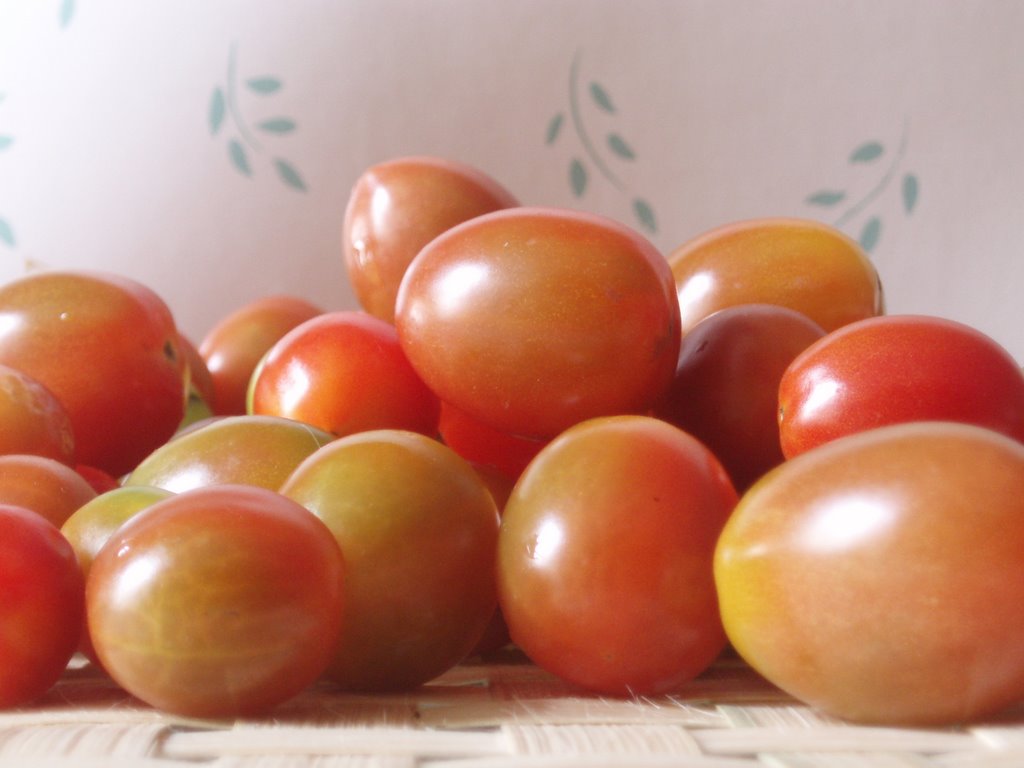
Showing posts with label tomatoes. Show all posts

Saturday, April 09, 2011

Unfried Green Tomatoes

I like my tomato pappu (dal) as red as a tomato. The yellow of the dal adds its own hue so ultimately it's like a burst of orange-yellow sunshine in a child's drawing.
(Okay, this picture is less sunshiney than I want, but do as I say, not as I show.)

Take two fistfuls of tur dal (red gram/pigeon peas), add a disproportionate amount of tomatoes to it, at least five, if not more, and boil away the excess water and it's ready.

When I saw some green tomatoes at the store a couple of weeks ago, I had to grab them. Of course, I had no clue whatsoever what I was going to do with them, but I had to have them. Looking at several recipes several days later on the Net didn't help either - I wanted to use them up quick and not have to buy extra ingredients to be able to use them up so I decided I would look for recipes for kootu - it would be like the dal I'm used to yet not quite, I told myself, and it would be a healthy and easy balance between my impatience to get on with using something and not wasting it and my desire to experience a new and unfamiliar taste.

But kootu recipes usually mean the tiresome processing of a coconut, which is the rarest of rare commodities in my home. I decided to tilt the balance in favour of the familiar - do away with the coconut, with the dal of choice (green gram) and use tur dal, with pepper and fennel to impart the novelty.

As the cooking hour progressed, I took a look at the pestle and it felt incredibly heavy. Never mind, the peppercorns will split when I splutter them in oil, I told myself, and got on with it. All they did was spit. And get shiny.The fennel didn't make any difference; I should have reached for that pestle, after all! I didn't add too much turmeric because I wanted the dal to look green, and added two or three round red chillies to add some contrast to the dal.


Here's how I think I made it:

In a pressure cooker (or pan),
- take half a cup of washed toor dal (pre-soaking will help it cook faster and softer in a shorter time)
- 6-7 quartered green tomatoes
- water
- a small onion, chopped up (optional)
- 1 or 2 green chillies, slit (optional)
- a pinch of turmeric

Make sure the dal is well covered by the water but not overwhelmed by it.

Let the pressure cooker whistle 2-3 times and then cook it on simmer for another 5 minutes. (Or just cook it till mushy in a pan)

Let the pressure drop on its own and mash it as much as you can.

Add the salt and some red chilli powder, if you like, at this stage.

If it's too watery, thicken it down by cooking it some more on medium heat, uncovered.

In a spoon of oil, pop 1/2 tsp each of mustard, cumin, peppercorns and fennel. A bit of asafoetida, if you like, or garlic. And 4-5 curry leaves and a couple of curry leaves. Chop up some coriander and garnish.

I'm sending this dal to Desi Soccer Mom who's hosting My Legume Love Affair, created by Susan.

Sunday, January 03, 2010

Going Back To The Tubers

The potato is a stem tuber, and 'roots and tubers' is a phrase. With this dish, I suppose I'm 'going back to the roots', now a much-used and often abused cliche, so there it is! When my grandmother still cooked for our family, this dish made a frequent appearance on our dining table at night.

Three days into the new year and I cooked only today. Some of the potatoes I had from ten days ago had put out monstrous sprouts, so much so there was too much sprout and very little potato. Off they went into the bin - the rest, peeled and chopped, made up about 1.5 cups. Then there were some tomatoes too that were going soft and squishy, five of those went into this curry.

I didn't add anything more, not even onion, because I didn't want to eat this curry for the next five days. I wanted something that would last me no longer than two days.

In my book, as well as yours, I'm sure, a recipe has to fulfill at least one of these two conditions to be deemed a success: It has to taste and look like your grandmothers' food, or it has to look like it came out of a restaurant!

Mine, I'm happy to say, looked very much like my grandmother's. And it lasted no longer than a day.


Potatoes, peeled, chopped/diced: 1.5 cups
Tomatoes: 5, chopped (about 2 cups)
Curry leaves: A few
Chilli powder: 1 tsp
Dry ginger powder: 1 tsp (you can use fresh ginger)
Salt: to taste
Water: 1 cup + 1/4 cup
Oil: 1 tsp
Mustard seed: 1/2-1 tsp
Cumin:1/4-1/2 tsp

Microwave (or boil till soft) the potatoes with a quarter cup of water for four minutes - in two 2-minute spells.

Heat the oil in a pan, pop the mustard and add the cumin.

Once the cumin sizzles, add the tomatoes, saute for 2 minutes and then add the salt, chilli powder and ginger powder. Add some of the water. Cover and let the mix get mushy on medium flame.

Now add the potatoes and give them a good stir. Simmer.

Let the tomato gravy cover the potatoes (but not quite drown them).

Add the curry leaves, simmer for another minute or two and remove from the fire.

Tuesday, October 07, 2008

Legumes All The Way!

I know it's a month-long event, and it's only the beginning of the month, but I was beginning to get anxious when no mails announcing contributions for MLLA-Fourth Helping arrived in the first few days of this month. The only legume dishes being made, it seemed, were those in my kitchen and I was wondering if posting all of them would be seen as hogging space, and attention. After all, I'm the host, is it right for me to post so many? Funny how the ethical dilemma of a host in the food blog world plays out - a real-world host is expected to make as much as s/he can, but would that be deemed an attempt at monopoly in the virtual world? What do you think?

I tried quelling these qualms for a few days by accepting an invitation to a certain social networking site and immersed myself in locating cousins and friends, having them discover me and the messages that dot our pages, how much of ourselves we are revealing, whether I should put up a picture, risk revelation, but the call of the blog is too insistent and loud to ignore. Funnily enough, it calls out as stridently even when I don't have my usual wit-/humour-/anecdote-laden (and yes, humility-laden) pieces to say, which leaves me feeling blue and wondering how I can sustain the blog ...

A couple of these dishes are rediscoveries, and one in particular was one I used to classify as "Oh-that-same-old-tiresome-must-eat-but-why-the-hell-should-I" salad. Made with moong bean sprouts, some tomato, some cucumber, an eighth of a medium-sized onion and a simple garlic-steeped-in-lemon juice dressing, it WAS zingy, but wouldn't have featured here except for Aparna's insistence.


The other rediscovery was of tomato pappu, or toor dal made with tomatoes. I know there are a number of recipes out there for this very basic, very typical Andhra dish, those even simpler than mine, but when I cook old favourites, the standards I aspire to are my grandmothers', not out of any unreasonable, fanatical loyalty to tradition but simply because they tasted better.


All you have to do for this recipe is this:
In a pressure cooker (or pan),
- take half a cup of washed toor dal (pre-soaking will help it cook faster and softer in a shorter time)
- 4-5 chopped tomatoes (the sourer varieties would be nice),
- 1 cup of tamarind juice (extracted from a small fistful of tamarind soaked ahead of cooking time in a cup of water)*,
- some more water,
- a small onion, chopped up
- 1 or 2 green chillies, slit
- a pinch of turmeric

Make sure the dal is well covered by the water(s) but not overwhelmed by it.

Let it whistle 2-3 times and then cook it on simmer for another 5 minutes.

Let the pressure drop on its own and mash it as much as you can.

Add the salt and some red chilli powder, if you like, at this stage.

If it's too watery, thicken it down by cooking it some more on medium heat, uncovered.

Temper with mustard, cumin, split and hulled urad dal, crushed garlic and curry leaves in a teaspoon or two of oil. You can even add a tiny bit of onion to the tempering. Garnish with some chopped coriander.

* In fact, you can even cook this without the bother of the tamarind extract - you can simply plop the tamarind into the pressure cooker along with the rest of the ingredients and mash it all up together. Accomplished cooks do that but I've not had much success this way.

** I find that adding the tamarind juice after the cooker's opened and then boiling it down works best.

And now we come to the discovery of the day - a moong dalma. You may remember my Orissa posts but soon after those, I acquired a book on Oriya cuisine and adapted this recipe from there.


Green gram/moong dal: 1/2 cup
Potato: 1, peeled, cubed
Small brinjals: 2, cubed
Drumstick (the vegetable): 1/2, cut into 1-inch-long pieces
Cubed radish: A fistful
Cubed carrots: A fistful
Red chillies: 2
Mustard seed: 1 tsp
Cumin powder: 2 tsp
Salt
Water: 1-1/2 cup
Oil: 1/2 or 1 tsp
Turmeric: A small pinch
Dry-roast the dal, wash it.

In a pressure cooker, or pan, place the dal, turmeric and all the vegetables except the drumstick.

When you sense the cooker's about to hiss (or just before the dal reaches the crumbly stage), remove from fire, open carefully and add the drumstick. Close it again and let it hiss once. Temper with the mustard and red chillies. Add the cumin powder. Mix well.

Eat well! And Happy Dasara!

Don't forget to send in your entries for My Legume Love Affair - Fourth Helping, originally created by Susan. The details are in the sidebar.

Friday, April 04, 2008

Of Coconut Milk and Bengal

As schoolchildren in a small town, we only had a few schoolmates from other ethnicities. So when someone came in on a transfer to this district headquarters from a strange town or bigger city, and if they spoke no other language but English to us, their exotica didn’t fade for quite some time. We also had the other kind – children who were originally from our State but who had rarely lived there, and who would fondly refer to their past place of residence as their true home, often discounting or denying the influence of Telugu and Andhra Pradesh in their lives, amusing/irritating/angering us as we saw fit.

One such of my classmates was a Telugu girl who had some family connection to Bengal, I think her grandparents had worked there; I remember that much about her though I don’t remember where she herself came in from. She was not like the others, spoke Telugu quite well, but constantly referred to Bengal, aloo dum and curds mixed with sugar. To put it mildly, that last thing took us some getting used to, but it was also my first exposure to Bengali cooking, if only in hearsay.

It was not till about seven or eight years ago that I found my first Bengali cookbook – not a very slick production, the author didn’t even sound Bengali (though there’s no rule that ethnicity determines authenticity), but the recipes worked very well. Though I have added another book or two on the cuisine to my collection since then, I always turn to this book when I look for Bengali recipes because the tastes of whatever I made from this were the same that I experienced in an ethnic Bengali feast I was lucky enough to sample a few years later (ratification, I mean).


However, I have to admit that this recipe sounded most un-Bengali to me, though I do know that coconut milk is used now and then. Only, I was familiar with chingri malai curry, not with egg malai curry – well, either I’ve not been reading the Bengali blogs too attentively or I haven’t been cooking or eating enough Bengali food, but this curry seemed as South Indian as it could get.

IF you don’t count the deep-frying of potatoes and egg yolks that is prescribed.

However, in the interests of our arteries, we can safely avoid this portion and go ahead with the discovery of Bengal.

This, of course, goes to RCI-Bengal, hosted by Sandeepa.

Egg Malai Curry

Eggs – 5, yellows only
Tomatoes – 3, big; blanched and sliced
Onion – 1, big
Garlic – 2 cloves
Ginger – ½ inch
Sugar – ¼ tsp
Potatoes – 2, medium-sized, boiled, peeled and quartered
Coconut Milk: 1 cup
Ground cumin – 1 tsp
Bay leaves – 2
Turmeric powder – ½ tsp
Garam masala – ½ tsp
Salt – to taste
Chilli powder – to taste
Coriander leaves, chopped – to garnish
Oil, to deep fry
Ghee, to sauté – 3 tbsp (I used oil, and only 1 tbsp)

Grind onion, ginger and garlic to a paste.

If you want to be true to the recipe, deep fry the egg yolks and potatoes on both sides. If not, you can use the boiled potatoes and fried eggs (a bulls eye, fried both sides, no runny yolk).

Heat the oil, add the bay leaves and onion-ginger-garlic paste.

When that seems well-fried (changes colour, loses smell is my cue), add the blanched tomatoes, salt, sugar and all the spices. Fry till dry.

(Well, dry isn’t exactly what I noticed, but it does become thick and concentrated.)

Turn down the heat, add the potatoes, then the coconut milk. Let simmer.

Once it begins simmering, add the yolks.

Simmer for five more minutes. Garnish with coriander leaves.


You can use the egg whites to make an omelette or scrambled eggs. Here’s an idea.

I'm away for a week or more, so until then, Ugadi greetings!

Tuesday, February 19, 2008

No Queer Fish This!

I was the kind who had waist-length hair, two plaits and liked wearing strings of jasmine in them. At least, I think I enjoyed wearing the flowers, because I’ve been missing that ever since I cut my hair, which was quite a long time ago.

The rigours of adolescence, studies and hostel connived to reduce my hair to a rat’s tail, and the best option to make it look better was to cut it. Off I went to the hippest saloon on a day we could get away from hostel for a couple of hours. The stylist, who to me looked really exotic for various reasons including her nose ring, her looks, the scarf wrapped around her head, and her unusually spelt usual name, held up my hair, took one look at it and pronounced it was full of split ends. There was no use cutting it if she didn’t hack it off right from the top, she said, warning me my hair would become pretty short then.

I told her to do the needful, and she gave me a step cut which, later, an aunt who lived in the West told me was called a shag, or a shake. Well, between Aunt and I, one had the former, and the other had the shake – I don’t remember who had which.

How I also bought the hairstylist’s specially formulated oil to restore my hair to its former splendour and used up exactly half of it the next day in post-haircut trauma is a tale for another day, but my hair has gotten progressively shorter since then, and poses a problem for many people who try to guess which part of India I come from. I would have thought it was a cinch to guess, given the rest of me, but it’s as much not, as I was to discover.

While Telugus who know I’m from Andhra Pradesh ask me if I can speak/read/write Telugu before proceeding to speak to me in English, others take it for granted that I hail from Punjab or West Bengal or Kerala, because of whatever aspect of my form they associate with these States. My name, and I’m not telling you what it is, is often taken for Bengali, and if I fib that I am, I’m asked to bring Sondesh (unfailingly pronounced the Bengali way) the next time we meet. My full figure is often mistaken for Punjabi but it really entertains me that people discount my height and my colouring when they make their stereotype-based assessment. And Kerala, I am not sure why. Maybe my colouring, and the fact that most Malayali women in their know sported short hair, probably.

I really don’t know, but I had the amusing experience of stepping off a train in Coimbatore and having a woman speak to me in Malayalam, asking me if I wasn’t Rega of Palakkad when I looked uncomprehending. At a meeting in Paris, an Indian colleague comes up to me and says something I don’t understand – when we introduce ourselves moments later, he says he had spoken in Bengali, and my name is further proof of my putative Bengaliness.

Then there was the friendly co-passenger in the train home, who declared that however much I had my hair shorn, my face made it quite plain I was typically Telugu. And there are others who say, “Ah, I didn’t say it but I guessed you were Telugu,” like it’s a fact better kept hidden, a truth they intuited but mutely conspired with me to keep silent! And there was the staff nurse at the hospital my Dad consulted who said she thought I was born during my parents’ years “in America because you are “little bit healthy” (yeah, that’s kind for “fat”).

This amuses me no end, and while I'm glad to look a bit of all these, I respectfully deny my name is typically Bengali, my figure is Punjabi and my hair is Malayali – my looks could be resoundingly Telugu, I suppose; I’m glad I reflect my heritage in some small way or the other. So in celebration of the number of States I could well hail from, let’s tuck into some fish, which is dear to all these ethnic groups.


The recipe is Tomato Fish, based on one from Nita Mehta’s Punjabi Khana.

Fish – 500 gm, cut into 2- or 3-inch pieces (preferably boneless/skinless)
Oil for frying

Marinade:
Salt – to taste
Red chilli powder – 1 tsp
Lemon juice – 2 tbsp
Coriander powder – 1 tsp
Cumin powder – 1 tsp

Combine all these ingredients and marinate the washed fish in the mix for 15 minutes.

Gravy:
Ripe red tomatoes – 500 gm, pureed (The author recommends blanching them first)
Oil – 1 tsp (she recommends 5-6, but the fish has been fried, so I didn’t go by the book)
Garlic – 5 cloves, skinned
Red chilli powder – 1 – 1-1/2 tsp
Salt – to taste
Garam masala – 1 tsp
Coriander powder – 1 tsp
Sugar - 1-1/2 tsp (I left this out)
Kasoori Methi – 2 tbsp
Coriander – to garnish (and green chillies too, the book says)

Heat oil in a shallow pan and fry the fish lightly. Do not make it crisp. Remove and keep aside.

Heat the 1 tsp of oil in a pan. Add the garlic and fry till light brown.

Add tomato puree and the other seasonings including the kasuri methi. Let it boil once, as your stir continuously.

Slide in the fish pieces and let them boil for 4-5 minutes.

Serve hot, garnished with the coriander.

Please don't forget AFAM-Pomegranate (link in the sidebar or further down) - the deadline of Feb 25 is fast approaching!

Monday, October 08, 2007

Herbal Hardsell

I had a couple of those rather desirable Old Mother Hubbard moments this past week when there weren’t too many veggies in the house (rare) and the ones I did have were beginning to rot (common). What I did have fresh were lots of potatoes so I told myself I would make a kofta (dumplings) curry with a tomato gravy (in whisper [rotting tomato gravy]) but come dawn and some fuzzy thinking, I ended up with mashed potato rather than koftas.

However, the surprise lay in the gravy, which I concocted solely to get rid of the tomatoes, coriander and celery I had at home – I expected it to be a mess both to look at and to taste but was pleasantly shocked to find that only one of those doubts turned into reality. This was not attractive to my eye, but think herbs (tres chic, gourmet), green leafy vegetables (healthy) and exotic (the combination), and I had a keeper. I’m also told it looked somewhat like the pav’s bhaji, a suspicion I harboured but couldn’t confirm till an observer told me.


It’s a fulfilling curry and you can even have it by itself if you want to keep away from rice or bread. It takes just one big potato, very little oil and is bursting with health and vitamins, to borrow a phrase.

Here’s how I made it:
One big potato, about 200 gm
Onions, chopped fine: Two
Tomatoes, medium-sized, minced/pureed: Five
Coriander, chopped: 1-1/2 cups, stalks and all
Celery: 2 stalks, with leaves, chopped
Savoury mint chutney, Indian style: 1 tsp (Substitute: 10-12 mint leaves and a spoon of lime juice)
Cumin seed: 1 tsp
Salt: to taste
Turmeric: ½ tsp
Chilli powder: 1-2 tsp
Oil: 2 tsp or less

Grind celery and coriander with a little water in the mixer to a fine paste. If you’re using fresh mint, add this to the mix. (I used the mint chutney because it was beginning to dry up.)

Peel potato, prick with fork all over, microwave for 3 minutes on either side, with a resting period of 3 minutes in between. Let cool, mash with a pinch of salt and mint chutney.

In a pan, heat the oil, pop the cumin and fry the onions till transparent.

Add the ground paste, fry well.

Add the tomatoes, salt and spices and let them cook to mush. Add a cup or two of water and let it boil down almost to the consistency you want.

So when it’s not quite thick enough, add the mashed potato-mint mixture bit by bit. Be mindful that the potatoes will do their bit to thicken the gravy.
Mix well, simmer till it’s as thick as you want. Remove from heat.

Strangely enough, without the usual additions of ginger and garlic, curry powder/garam masala or other whole spices, this was quite spicy. I wonder why. And the other revelation was the taste of celery – having never used it much before, and much less in curry, the only word I have to describe its taste is “interesting” – I would use it again.

I’m sending this off to Kalyn’s Weekend Herb Blogging, hosted this week by Kalyn herself – it’s the second anniversary round.

Wednesday, August 29, 2007

Paneer Makhmali

All I need to do is enjoy the rain beating an irregular tattoo on my windowsill, revel in my fever for which I took the day off from work and curl up with a mystery under a reading lamp, but here I am at my computer, under the glare of tubelights, trying to post something. It’s not even as if I badly want to post this or that I’m meeting some deadline I set for myself, but sleeplessness and a regularity with which I now gravitate towards the blogs that’s making me do this. Posting doesn’t feel like a chore, though – it’s quite a mixed-up feeling.

From the confusing to the simple: what I have for you today is a paneer/cottage cheese recipe. It’s taken from Nita Mehta’s book Still More Paneer, and the only change I made was to use mango ginger instead of the regular ginger.
That's mango ginger in the photo.


This gravy is a velvety affair (hence the name Makhmal, from the Persian), given that the ingredients are pressure cooked and ground, the base being coconut milk. It’s something of a shocker, essentially being paneer in tomato chaaru (rasam/soup South Indian style, with a dash of tempering), but it’s not as odd a match as it sounds. On to the recipe, then:

Paneer/cottage cheese – 200 gm, cubed

Pressure cook (2 whistles) with ½ a cup of water:
Tomatoes – 4, chopped roughly
Coconut milk – ½ cup
Mango ginger or ginger – 1-inch piece, chopped
Garlic – 8-10 cloves, skinned, chopped
Green chillies – 2, chopped roughly
Salt – to taste

Cool and puree in the mixer.

For the tempering:
Mustard seed – 1 tsp
Red chillies – 2, broken
Curry leaves – a sprig
Oil – 1 tsp

Transfer the puree back into the pressure cooker, bring to a boil.

Add the paneer and simmer for 4-5 minutes. Check for the consistency of your liking. Switch off the heat.

In a separate pan, heat the oil, pop the mustard, add the red chillies. Remove from fire, add the curry leaves, and add to the pressure cooker.

You can find a somewhat similar recipe here.

Sunday, July 22, 2007

Tomato - A Rediscovery, & Egg Drop Curry

Does it happen with you that some dishes are so common, once so much a part of your life, so taken for granted that for stretches of time, years even, you go without them, preferring to spend that time and energy in making other things to eat?


It does, with me, and the tomato curry I have here, a childhood staple, happened by chance and not by design. This week has not been one of my best, what with inspiration for the blog not striking, my sofa covers not being delivered on time (“This is the 21st century, you know, Mr Draper, women don’t sit at home waiting for curtains and sofa covers, they go to work, how would you feel if I didn’t pay your bill for the next two weeks?”), the gas cylinder not being delivered on time (“Madam, you booked it on the 10th, it still has not come?” “No, Madam, I booked it only on the 15th and this is only the second reminder, but yes, it still has not come.”), and various other irritants small and smaller. But somehow, I was feeling sunny this Sunday morning — The Spouse had brought stuff for Sunday lunch, and we had planned various things and things were going along swimmingly when we couldn’t find the curry powder and things went rapidly downhill after that.

One of the dishes I had planned was tomato egg-drop curry but after methi dal, the hunt high and low for the garam masala, and the tomato gravy, I suddenly found myself devoid of the energy to crack a few eggs into it. Well, I had to go back from the kitchen to the fridge, open the door, collect the eggs and carry them gingerly back to the kitchen and crack them one by one into the gravy, didn’t I? Nah, too much energy to expend, and I had to go out and shop a bit for the next week, go to the library to see if there were any Harry Potter copies left over (fat chance, so perish the thought) and voila, the tomato curry became a moment of rediscovery!

Not that I hadn’t tried to whip up this on occasion, but I would only be faced with tired old tomato mush, the skins curling up and coming apart, more brownish than red, but today (and this past week, actually, when I had tried the egg-drop curry), I realised the trick to this curry is to add a lot of water, finely chopped onions, and cooking for a long time! (Read about another tomato-ey rediscovery here.)

This is a curry/gravy tailor made for puris and chapattis, tastes great with rice too, and can be the base for several curries. In my home, a favourite variation was to add peeled, diced potatoes to it.

This is an as-you-like-it curry, vary the proportions as per availability and taste, experiment till you arrive at the version you like. This recipe is just a guideline:

Tomatoes: ½ a kilo/ 7 medium, chopped
Onion: 1 small, minced
Ginger-garlic paste: 1 tsp
Cumin seed: 1 tsp
Turmeric: A pinch
Red chilli powder: 1 tsp
Salt: to taste
Curry powder: 1 tsp
Oil: ½ tsp
Water: (Please see recipe)
Curds/Yoghurt: 2 tbsp, beaten

A frying pan with a lid

1. Heat oil in a pan, add cumin seeds.

2. Add onion, saute till transparent.

3. Add the ginger-garlic paste, fry for two minutes.

4. Add the turmeric, chilli powder, salt and the curry powder. Mix well.

5. Now add the tomatoes, mix well with the spices.

6. Add some water, enough to cover the tomatoes.

7. Cover the pan and let the mixture cook on medium heat for more than five minutes. (Keep checking to see that it doesn’t dry out and stick to the pan.)

8. If it’s boiling well and has a nice and healthy volume, gently mash the tomatoes with the ladle. If they mash easily, the curry’s done. If you feel the volume isn’t enough, add a little more water, and simmer. Keep checking for the consistency of your choice – I like it thick.

9. Once you take it off the fire, add the curds to the curry. Do you see the several yellow specks in the curry? That’s the curds, which makes it all tangy and nice. Now fry some hot, calorific puris, dip them into this curry and taste heaven!

I'll post a picture later of the tomato egg-drop curry I made sometime ago, but here's how you make it.


For this, at Step 8, when you have a thick gravy, turn the heat down to simmer, crack a few eggs into it (as many as you think the gravy will hold), cover it and let them set. Resist the temptation to poke the eggs or ensure that the curry covers the eggs – if you are worried that the spices may not reach the top of the egg, sprinkle a little salt on the tops. (In that case, make sure you put in less salt in the gravy earlier.) Here's another variation.

I'm sending this off to Kalyn's Weekend Herb Blogging, hosted this week by The Chocolate Lady of In Mol Araan.

Thursday, April 05, 2007

Rai-ta!


I like 'punny' headlines and give them a fair bit of thought. Though I'd been racking my brains since morning to think up a witty title for this raita, I didn't realise the pun was staring me in the face. For my dish in this post is a mustard raita, and in Hindi and possibly certain other languages, mustard is known as 'rai'.

Well, actually it's a tomato raita but the predominant flavour is that of mustard. The idea struck me when I visited a supermarket that stocked hulled, split mustard and methi, rarities in a South Indian kitchen. The methi met its inevitable fate of infestation and dustbin before I could get myself to explore what to do with it but the mustard lent itself beautifully to this unusual raita.

So without further ado, here's the recipe, it's pretty fluid, experiment with whatever vegetables you want, proportions too. I've tried this with cucumber and grated carrot as well. Be warned, though, that it can be pretty pungent.

2-3 tomatoes, chopped
1-1/2 cups curds/yoghurt
1-2 tsp of split mustard
A pinch of salt
1 or 1/2 of a green chilli, chopped, de-seeded if you like

Beat the curds, season with salt, mustard, add the green chilli and vegetable. Let it rest for a while, chilled if you like. Consume! This tastes great by itself but will probably go well with a mild rice preparation or even a bland variety of bread.

Sunday, April 01, 2007

A Kut Above


Was it the original apple in the Garden of Eden? Was it the reason why it all began? Come to think of it, it’s amusing to think of this everyday, squishy vegetable as being the love apple that led to the original sin.

There is quite a bit of information on the subject and for me, this round of Jihva For Ingredients, hosted by RP of My Workshop, was an occasion to rediscover the tomato. When the ingredient was announced, I was a little disappointed – an unusual Tomato Bread Pudding was already on my blog (no picture, though, as I deleted it by mistake and re-posted it). So were Oaty Tomatoes. And a busy month ensured I couldn’t give it much more thought. I usually try to post a recipe that at least I find special/unusual as it keeps my interest alive and kicking, so after some hurried exploration, I settled for the Hyderabadi tamater kut. Which turned out to be a good choice, because it’s all tomato but so different from the everyday tomato curry or soup or gravy that’s made in our homes.

Frenzied workday cooking doesn’t always remind you that there is food waiting to be smelt and savoured from beginning to end. Though I made this on a work day that was sure to be frenzied, boiling a kilo of tomatoes with a bit of spice jolted me out of automaton mode into a brief connoisseur, reminding me this was how tomato daal smells at home, how tomato used to smell soon after it was boiled to make the day’s chaaru, which came in very handy for me to recover my appetite after a long bout of jaundice.

“Ever seen a dried tomato?” asked a school friend one day, with an I-know-you’d-never-have-seen-it glint in her eye. I hadn’t. She bent over to reach for her school bag, extracted her rough notes from it and from its pages, produced a thick and transparent slice of tomato – it has never ceased to amaze me. How did she do it? How could it not have rotted? And despite it being a dried tomato, how did it still feel so fleshy? She had pressed it much as we used to press leaves and flowers between pages, and come up with this. I tried it later, but didn't have the patience to keep a soggy slice inside my notes inside my school bag, so it must have gone into the dustbin.

I don’t have too much more nostalgia to dish out about tomatoes but do remember that there’s a song from an old movie about a hero caught between two heroines likening himself to a tomato in a sandwich!

I have searched for information on the dish but could come up with little on why it’s called Kut. I wonder if it could be a Hyderabadi variation of ‘Kattu’, the Telugu word for a kind of chaaru/rasam usually made by roasting and powdering daal. This Kut recipe involves straining boiled and mashed tomatoes into a soupy liquid, simmering it with spices and a bit of flour to thicken it and tempering it.

Here’s how you go about it:

You need
A kilo of tomatoes
1-1/2 cups of water
2 tsps of ginger-garlic paste
3 medium onions, sliced
1 tsp red chilli powder
A pinch of turmeric
¼ tsp fenugreek seeds
A few sprigs of curry leaf
1 tsp cumin/jeera powder
1 tbsp sesame seeds, roasted and ground (need not be fine)
2 tbsp gram flour/besan/senagapindi, roasted and mixed with a little water to form a paste
2-3 tsp oil
Salt to taste
Six hard-boiled eggs, halved lengthwise (optional)

For the tempering:
½ tbsp cumin seed
½ tsp mustard seed
¼ tsp fenugreek seed
¼ tbsp nigella seed/kalonji
3-4 dry red chillies
a few curry leaves
2 tsp oil

Pressure cook/boil the tomatoes with the water, ginger-garlic paste, ¼ tsp fenugreek seeds and cumin powder. Mash it well within the cooker, sieve through a strainer – I got 6 cups of extract – I can’t bring myself to call it puree because it was more soup than puree! (At this stage, add a green chilli or two, some salt, then temper it with mustard, jeera, some pepper, curry leaves and bit of fenugreek, and you've got yourself some nice tomato chaaru. Add some tamarind extract to it if you think it's not sour enough and boil it briefly - but before you temper it.)

In a frying pan, heat the oil and fry the onions till brown. This can be time-consuming, so sprinkle a bit of salt on the onions to make them fry faster – yes, it really works.

Now add the tomato puree, salt, turmeric, red chilli powder and the ground sesame seed. Stir in the gram flour paste. Simmer for about 10 minutes on a medium flame.

To temper, heat the oil (in a separate pan). Add the mustard seeds, cumin, whole red chillies, nigella seeds and then the fenugreek seeds. Finally, add the curry leaves. Make sure the fenugreek doesn’t look burnt-brown – it can turn the whole dish bitter. When the red chillies brown, add this to the tomato soup/puree and cover. Serve hot. Add the eggs, if using.

The initial taste disappointed me. It seemed that the fenugreek was burnt and I was stuck with a bitter, gritty dish that no one would touch with a bargepole. Photo session over, I went off to work. When I returned and settled down to dinner, unloaded this dish from the fridge (grimacing at the thought of having to possibly finish it all myself), heated it and put some on my plate. Was I pleasantly surprised! There was no trace of the morning’s bitterness, and it had finally condensed into puree!

Tags:

Sunday, January 21, 2007

Oaty Tomatoes (Answer to Guessing Game)


Well, most of you got the coriander right – that was obvious. But only Asha got the oatmeal right. For the rest of the ingredients, see the recipe below! I don’t understand why clicking on the pic didn’t result in anything – did you have that problem too?


It’s been a hectic few days since my last recipe post, what with work and folks at home and then work again. I almost didn’t miss blogging, and that’s saying a lot considering my involvement with it qualifies as obsession, but am glad to say it has been crying out loud and clear for my attention the last few days. I wanted to participate in a few events but because of the busy-ness, I didn’t give them much thought, other than to buy a couple of packets of small tomatoes (grape or cherry tomatoes, I suppose) and wonder what on earth I would do with them. I’m like that – buy everything exotic on the face of the earth, keep it for weeks (if it’s perishable) or months and years (if not so perishable) and wonder how the hell I’m going to use it/get rid of it without feeling the pinch until it finally rots/irritates me so much I whisk them off the shelf and into the dustbin.
I’m trying to get rid of this habit – the self-control it involves demands inculcating in oneself an attitude of resignation, self-consolation and even a measure of cynicism – “How different can it be? A tomato is a tomato big or small, grape, cherry or plum!” Well, I’m glad to say it didn’t work this time – for one, I didn’t have much time to debate all these issues as my family, which had sent me to the grocer’s for a quick errand, was waiting impatiently in the car outside, and the challenge was too pretty to pass up - I can only hope the pictures do them justice. I’m also proud to say these tomatoes didn’t join the legions of exotic veggies and other foodstuffs that died in my fridge or pantry over the years!


I love salads, but can’t get the dressing right, and these tomatoes were too novel for me to waste in soups, daals and raitas. They didn’t taste extraordinarily sour or sweet, either, just plain fleshy! Leafing through my many cookbooks made me adapt a recipe from a Reader’s Digest cookbook which I shall call Oaty Tomatoes. Here’s what you need:

Baby tomatoes – 300 gm
Oats – 125 gm
Onion – 1 medium, minced
Coriander leaves, chopped – 2 tbsp
Butter – 1-2 tbsp
Salt and pepper, to taste

Preheat oven to 200 C. Halve tomatoes, place them cut side up in a baking dish. Season with salt and pepper. Bake for 20 minutes.
Meanwhile, heat butter and fry onion on low heat till soft and browning – that should take 15-20 minutes. Stir frequently. Now put in the oats, some salt and pepper and toast the mixture till crisp. Make sure you toast the oats really well, otherwise they tend to taste floury.
Top the tomatoes with this mixture once they come out of the oven. Garnish with coriander leaves all over!

This is my entry for Kalyn’s Weekend Herb Blogging being hosted by Scott of Real Epicurean.


Tags:

Wednesday, January 10, 2007

Eggs over Greens, Bread


This is a great favourite with us ever since we discovered it. As with all great things, it seemed very simple once it was revealed, but really, the only tiresome bit about it is processing the fenugreek greens. But then, you can leave them out altogether or use larger greens which take lesser time.
The story: This is a traditional Parsi favourite which I read about in the book Parsi Food and Customs by Bhicoo J. Manekshaw, Penguin 1996. This is a real treasure trove full of painstakingly documented recipes, in which some ingredients’ lists run to more than a page! It’s also a good introduction to the community as it contains information about its customs and rituals. Come to think of it, it’s like an extended blog post – the recipes are borrowed from family, relatives, friends and the writing is very personal and involved.
I have eaten in a couple of Parsi restaurants before this book and after. I remember visiting a restaurant in Bombay after reading about it in a food guide. It was run by a Parsi couple and certain dishes were available only on certain days of the week – well, I was a budding, enthusiastic cook then, my cookbook collection was growing by leaps and bounds and mentions of Dhansak and Lagan Nu Custard seemed to be confronting me everywhere – the day after we landed in Bombay, I called the restaurant and asked the lady who answered the phone whether it was open for dinner, and whether we would get Dhansak that day. She said yes, and we went there. When I anxiously asked for Dhansak, she looked amused and asked me whether I was the one who called. It turned out to be regular stuff but the custard was truly to die for! I later ate cutlets in a Parsi restaurant in Pune, and were they delicious!We also ate a curry full of matchstick potatoes, don't remember whether we ordered the chicken or lamb.
But I digress. In these places, I didn’t notice the egg dishes I’m presenting now, so I don’t know how they would look in a Parsi home, but all the same, it’s a dish you must try. Depending on the time available, and the number of ingredients that go in, you can decide whether to serve them at breakfast or a bigger meal. I love making this dish, watching the eggs pool into the depressions, sunny yellow yolks in liquid whites flowing slowly into the rest of the dish until they begin to set and make a whole that you can divide and eat with rice or bread.

You can see the picture of fenugreek leaves and read a bit about it here.

Here’s the recipe as I made it:

Eggs – 4
Fenugreek (methi) leaves/Spinach – 1 big bunch of the big-leaf variety (the book suggests “20 bunches of the small variety that grow in the sands of Bombay beaches” as an alternative) – makes two cups
2-3 onions, chopped
Tomatoes – 2, large
Ginger-garlic paste – 2 tsp
Turmeric – a hefty pinch
Green chillies – 3-4 chopped, and seeded if you like (in which case, you can add some chilli powder)
Coriander leaves – a good fistful, chopped
Oil – 2-3 tsp
Salt, pepper or curry powder/garam masala – to taste

A pan large enough to hold everything

Wash fenugreek leaves thoroughly and chop. Mix them with salt and set aside for 30 minutes. Squeeze them out to get rid of the bitterness and some of the vitamins too. :)
Heat oil in the pan and fry onions till a light brown. Add green chillies, the ginger-garlic paste, turmeric and chilli powder, if you’re using it. Mix well and add tomatoes, coriander leaves and salt. Simmer on low heat for 3-4 minutes. Add fenugreek leaves (or other greens) now, mix well and saute for 1-2 minutes.
Spread mixture evenly in the pan, make depressions in it, and break the eggs into them. Season just the eggs with salt and pepper or curry powder. Wait till eggs set to remove from fire. Do all this in simmer mode.


Here's another version:
Cube 6 slices of crustless bread, fry in oil.
Fry 3 onions till light brown, then a couple of green chillies, ginger and coriander leaves. Season with salt.
Line the base of a pan with cubed bread, top with the fried onion mixture, make depressions and break three eggs into them. Season only the eggs with salt and pepper and wait till set on simmer.

This is my dish for Kalyn's Weekend Herb Blogging, hosted this week by Coffeepot of Coffee & Cornbread.

Tags:

Monday, September 25, 2006

WHEW!

That’s what I said after I finally finished making today’s dish, Tomato Bread Pudding. I found it pretty time-consuming, probably because I was doing a few other things at the same time.
I’d never come across TBP earlier. A few years ago, my aunt presented me Michele Anna Jordan’s The Good Cook’s Book of Tomatoes but somehow, this recipe escaped my eye. I had a surplus of tomatoes this week and I needed to use some of them, so when I spied this recipe, it sounded interesting enough to put in the blog.
My experiment resulted in a moist, very slightly pinkish custardy bread when you broke through the golden-brown crust on top. The recipe asked for half a pound of bacon but since I don’t stock any, I just left it out but added an onion fried in olive oil.
What you need:
Pure olive oil
4 cups bread, torn into medium-sized chunks
2 medium tomatoes, sliced
An onion, fried till pink (optional)
3 tbsp finely minced coriander
2 ounces Cheddar
2 eggs, beaten
2-¼ cups milk
2 tbsp commercial tomato puree
2 cloves garlic, finely minced
Salt and freshly ground black pepper
Method: Rub a decent-sized but not too large baking dish with a thin coating of olive oil. Toss bread, tomatoes, cheese, coriander in a mixing bowl. (At this stage, you can pause, admire your handiwork and go on to serve this as salad with a bit of salt and pepper!) Transfer to the baking dish. Whisk eggs, milk, tomato puree and garlic, season with salt and pepper. Pour custard over the bread and make sure it is distributed evenly.


[Photo]Bake in a 325 F oven (160 C) for 35 minutes and then in a 425 F oven (about 230 C) for another 10-15 minutes till top browns. The top browned in the first stage, though a knife inserted into the centre came out wet - I baked it in the second stage, it got browner, as you can see, but the inside was still moist (notice the pale patch in the dish, I scraped off the top to see how the inside was) - it had been 40 minutes by then, so I lost patience and switched off the oven, but as it turned out, didn’t end up tasting too bad. Don’t need to tell you the aroma from the oven was heavenly![Photo]
PS: I must say this tasted rather like the Tomato Baath that is made in South India! I knew it tasted like something but it came to me only a few hours later! I heated the leftovers well today for dinner - it tasted different, like bread and pudding, maybe the trick lay in the heating.