Showing posts with label Rajasthani. Show all posts

Wednesday, December 01, 2010

Rajasthan - Vinaigrette of Past

Vignette, vinaigrette, does it matter? But the tag line of the hotel I passed by did make for a big grin - and I knew that would be the title for my next post. Here are some delicacies we tried in Rajasthan over the past week, across Jaisalmer, Jodhpur and Jaipur.


Dinner at a canteen in the Jaipur Railway Station. The round breads in the plate in the foreground were a pleasant surprise. We got those when we ordered a 'kulcha' - it took us a few seconds to realise they were more pav (of the pav bhaji kind) and less kulcha - the South Indians in us immediately noticed their resemblance to ootappams. We liked them so much, we ordered another plate. The gravy was a thin channa/chick pea gravy, which was spicy and rather ordinary.

Behind, you can see some kachodis. They were filled with dal, spices (saunf/fennel, dhaniya/coriander) and red chillies. Very tasty, very heavy - and very, very hot! The other plate (covered by an arm) contains pooris.


How long has it been since you had a Cassata? This brand used to be famous all over India once, now I suppose it's not marketed everywhere any longer. This was dessert, and comfort, in the cold Jaipur night, in a women's waiting room where we huddled trying to forget we had only two confirmed tickets for a group of four.


Roasted papad and bandhani tablecloth - all set for our first full Rajasthani meal in our hotel!


Ker sangri - the desert vegetables Rajasthan is so famous for. I never realised it would be so oily. (Granted my picture/version in the link above is no adequate representation either, but none of the pictures on the Net seem to contain so much oil!)


Gatte ki sabzi - oily again, but quite tasty.


Samosas (right) with a dry, spicy filling and chilli/mirchi vada at a snacks/sweet shop in the market.


More savoury snacks. The one in the foreground is a maida preparation intended to resemble fried cashewnuts.


Mawa kachori, filled with milk solids and nuts and sugar, which Jodhpur is famous for. We had this in Jaisalmer, though. 


A hole is punched in at the centre of the kachodi and some sugar syrup is poured into it. The periphery also is wetted with the syrup.


Maybe we didn't eat it at the right places but we didn't like it very much as the mawa just tasted burnt and the other batch we had reeked of kerosene from the stove rather than anything else!


Yes, all these curries were very oily! This was a methi-papad curry, the methi being the fenugreek seed and not the greens.


That's a Rajasthani thali. Clockwise from the yellow dish is the kadhi, dal, churma, roti, ker sangri and the gatte ki subzi.


Breakfast at Pokaran - mirchi vada and kachodi frying. 


Another Rajasthani thali - rotis, dal, potato curry, kadhi with pakodas, cauliflower and potato curry


This churma was a delight, fragrant with ghee and cardamom


The chaas (light buttermilk spiced with roasted cumin and carom (ajwain) 


This stall serves up jaljeera, lime juice, shikanji and lemon soda. 


My friend asked for lime juice with mint - this is what she got, I guess it was shikanji!


Yet another Rajasthani thali - notice the churma, it's different in this thali.
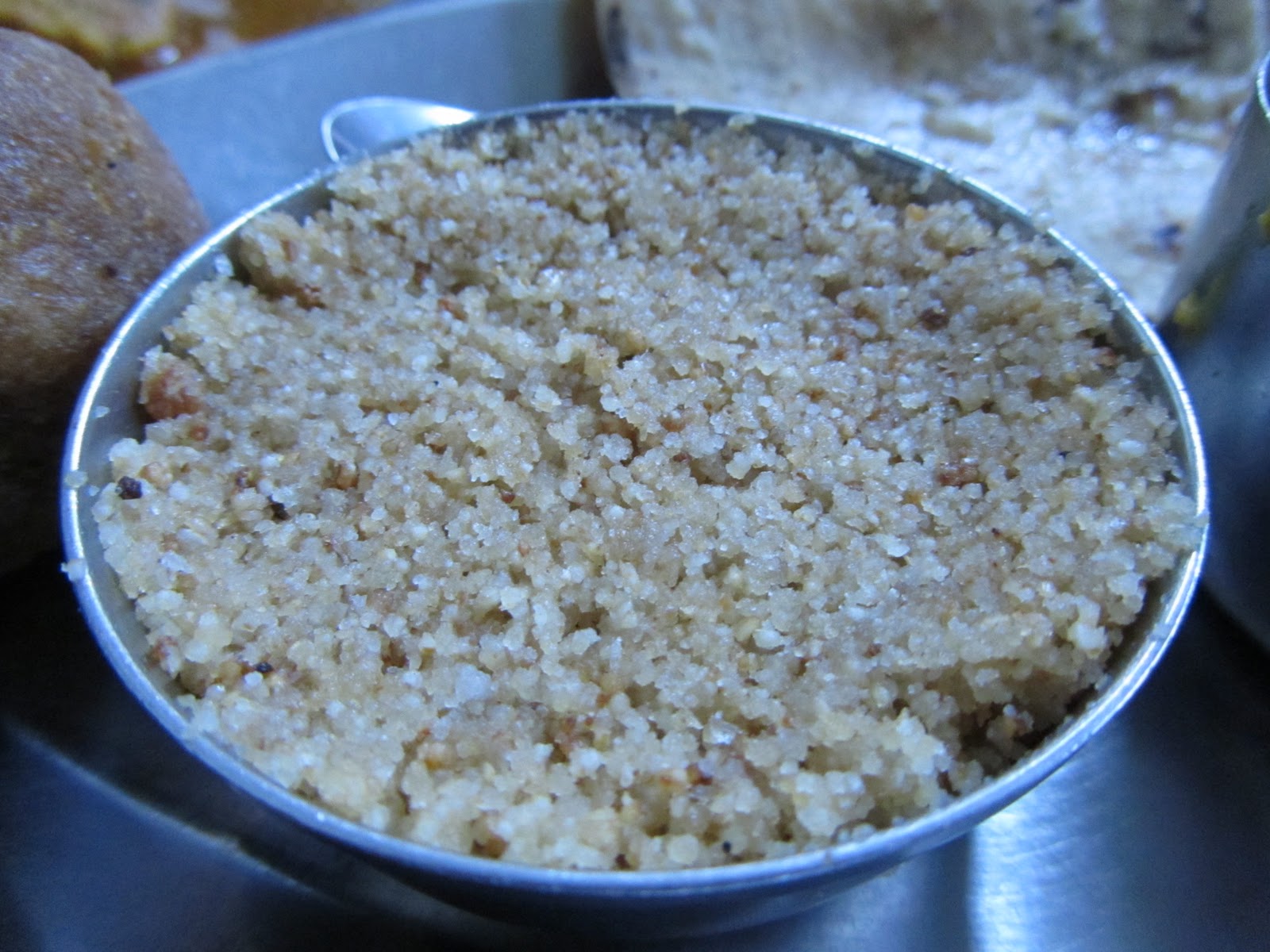

Churma, close up - it's been processed in the mixer!
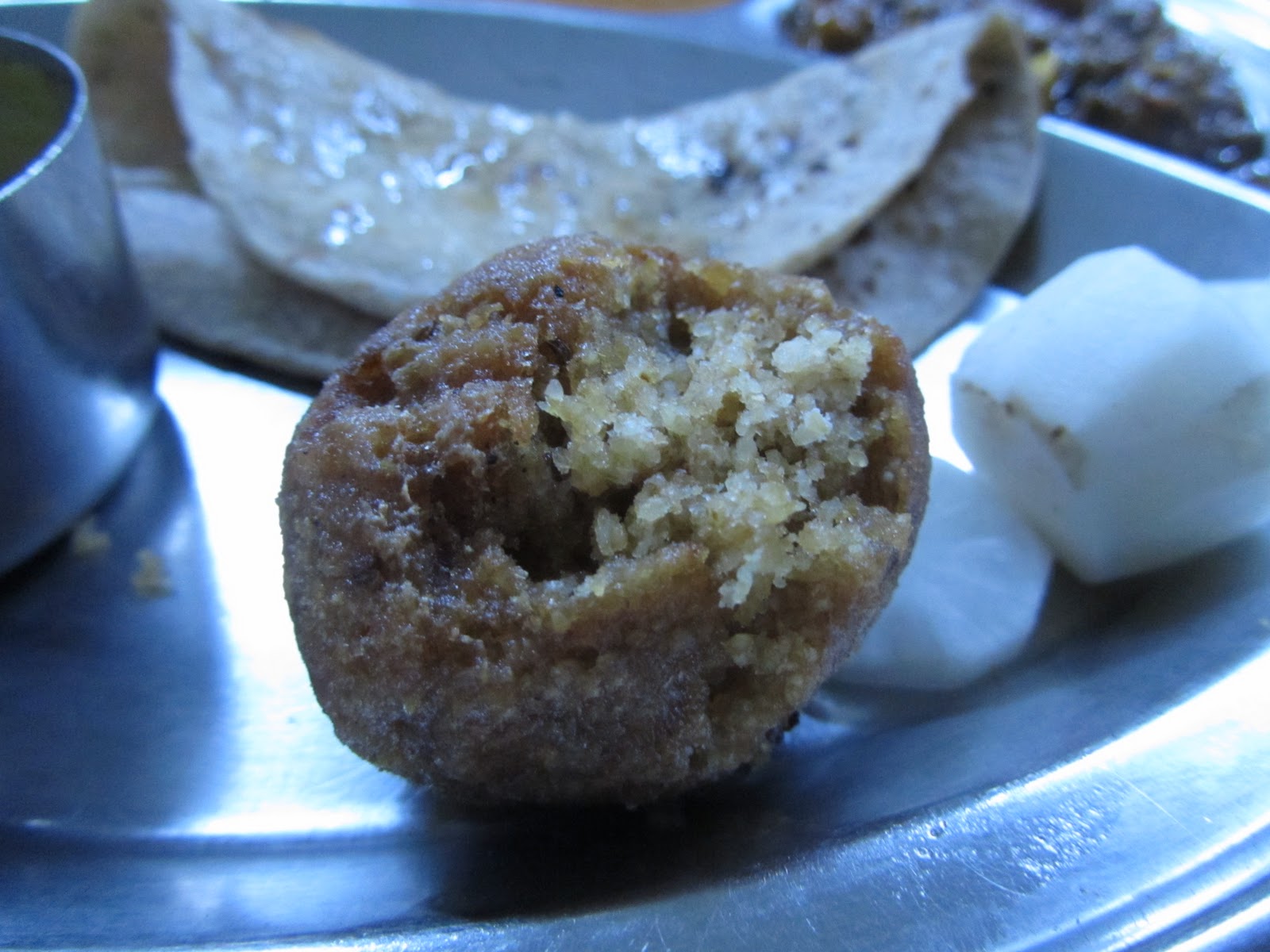

The baati of the classic dal baati churma. After we were served this, a waiter came up with more baatis and ground sugar, crushed a baati in our plates, drenched it in sugar and told us to eat it up with the dal. In a more ignorant past, my first reaction would have been to gag, but I tried it now with a more open mind. Strangely enough, it didn't make a difference or affect me much, so I was content with just a taste.


You can see more pictures from my Rajasthan trip here.

Monday, August 18, 2008

Variety Is The Spice ...

Flavours of the desert, I thought romantically, wondering whether it would make a nice opening line for this post. And the desert came to me indeed, in the form of grit and sand that I found myself chewing mid-chapati-bite.
For a few weeks now, I'd been trying to visit a new shop near my place that promised "different foods", but managed to visit it only last week. It had the usual different foods but what set it apart were the ker (on the right) and sangri (on the left), both dry, desert vegetables that I've not seen sold anywhere else, and two or three different kinds of kokum. In a rare moment of self-control, I let go of the kokum and bought just the ker and sangri. And then scrabbled frantically among my many cookbooks for Tarla Dalal's Rajasthan Cookbook.


I didn't know if I had amchur with me - there was a hazy memory of it being somewhere in the cavernous pit that's my kitchen shelf but after a week of reluctance, convenience vs moral dilemma (why can't I just buy another pack of amchur, why should I look for it), I finally dragged the stool up to the shelf, got on to it and peered into the dark recesses, only to find the packet right in the front, in foil pouch nicely bound with rubber band.

Then I shot off a mail to the hostess, asking her whether amchur would be considered a spice and when she replied in the affirmative, I went ahead with this dish.

But.

After two days of ker sangri-from-the-fridge, I've come to the conclusion that the spice in my preparation was more asafoetida than amchur. Well, this morning there was some amchur, but this evening, I could taste only the asafoetida. As I use neither that often, amchur even less than asafoetida, I've decided I will enter the Think Spice event with both. Well, there's a third spice - red chilli powder - that this dish celebrates (oh yes, it causes tears) but I'm going to recommend lesser.

You need:

1 tablespoon ker
1 cup sangri
1/2 tsp turmeric powder/haldi
3 tsp chilli powder
2 tsp coriander/dhania powder
1-1/2 tsp amchur/dry mango powder
1 tsp sultanas/kismis
salt to taste

For the tempering

2 Kashmiri chillies (I used 1 ordinary red chilli)
1/4 tsp ajwain/carom seeds
1/4 tsp asafoetida/hing
3 tbsp oil

Pressure cook the ker, sangri and salt with 2-1/2 cups of water. Let the cooker hiss thrice.

Let cool, then drain the water and add the rest of the ingredients. Mix well.

For the tempering, heat the oil in a pan and add all the ingredients in that list. When it crackles, pour it over the ker sangri mixture. Mix well and cook for a few minutes. Serve hot with puris, parathas or missi rotis.

I don't think my mushy ker sangri is the real McCoy so I have kindly linked to this.

Here's another recipe with sangri

I liked my ker sangri with a dollop of curds/yoghurt - I found it too intensely dry/dusty-flavoured otherwise - at present, I can't describe it any better.

It did mellow with age.

And for the authentic experience, please have it with homemade rotis, unlike me, whose rotis came from a plastic pack and were warmed in the MW!

This goes to Think Spice's anniversary event.

Valli and I have been in touch regarding some fund-raising for her helper's daughter, Lakshmi, who has a severe heart condition and needs surgery to correct it. You can find the details here, please do your mite.


Thursday, February 01, 2007

Easy Peasy!


As it’s winter, fresh peas are available in abundance and I spent one rather backbreaking night shelling a kilo or more of peas and watching a DVD. I even started out saving the pods for a peel stir-fry but quickly tired of checking each and every pod for a blemish.
Coincidentally, Pooja announced her weekly event would feature green peas and I wanted to participate, but probably the mind-numbing job of shelling so many peas in a single sitting had its effects on me – I couldn’t think of a single unusual recipe featuring peas. Well, it has to be unusual to me, at least, otherwise I’m not too keen on putting it up in my blog.
So I started hunting through my cookbooks and finally settled on this Rajasthani curry featured in Nita Mehta’s book. What I found unusual in this recipe was the addition of mangodi (vadiyalu in Telugu, I think, and the brown bits in the photo above), dried preserves made from flour, usually deep-fried to make crunchy accompaniments to chaaru (rasam/soup). In fact, the ‘vadiyalu’ made from urad daal/black gram are used in a sweet-and-sour tamarind-and-jaggery gravy in the parts I come from, but this one here is a spicy, somewhat tart, thick gravy that is accompanied by other vegetables.

Posted by Picasa


In pic above: Home-made mangodis/vadiyalu

The books informs us that this is a typically Marwari dish and that Marwaris are very fond of mangodis. In their case, they are made from moong daal. The ones I had have been tucked away in the bottomless pit that passes for my fridge for a year or so now, and I’m not sure what daal they are made of, but I used them anyway.
Here’s the recipe adapted from the book:

1 cup mangodi
1 cup shelled peas (you can parboil them ahead)
2 medium potatoes, peeled and diced, mangodi-size
A pinch of asafoetida/hing
1 tsp – cumin seeds
1 tsp or less – chilli powder
½ tsp - turmeric
Salt to taste
1 tsp or less - garam masala/curry powder
A few coriander leaves
Oil – 3 tbsp + 1 tbsp

Grind to a smooth paste:
2 big tomatoes
1 inch piece - ginger
1 cup curds/yoghurt
1 tbsp besan/gram flour OR rice flour

Fry the mangodis till crunchy and brown in the 3 tbsp of oil. Add the peas and potatoes, cover and simmer till done on low flame. The mangodis have to become soft, don’t worry about keeping them crunchy.

In a larger frying pan, heat 1 tbsp oil. Put in the cumin seed, when it browns, add the asafoetida. Then add the chilli powder and immediately add the ground paste. Let it fry/boil for a while, add turmeric and then the vegetable and mangodis. Cover and simmer till you get a thick gravy, or if you don’t have the patience, let it boil and roil till it thickens, finish off with a sprinkle of curry powder and coriander leaves, turn off the fire and get on with the rest of your day!

Tags: