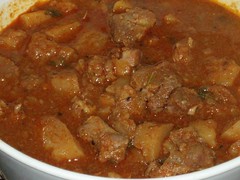
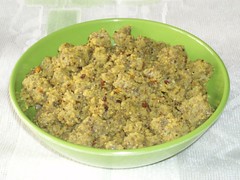
Tuesday, October 02, 2007

Cutlace, Somehow Or The Other!

This is a post inspired by one of the comments from my previous post. I had discussed some of the twists and turns English takes in India on menus across the country, to which some added their inputs. One of them was cut-lace
(aka cutlet, cutless, cutlite – on the train stops at stations, I’ve almost always heard it morph into cutlai…sse, and buttermilk becomes butt-raa-meel…).

As soon as I saw that comment, I knew what the fate of the fenugreek leaves (methi/menthikoora) in my fridge and the potatoes in my storeroom would be. (Oh yes, my potato-methi cutlets had to be a first. At least a third or a fourth – well, I don’t remember seeing such a recipe and don’t correct me if I’m wrong.)


Only, I hadn’t factored in my microwave failing me this time so when I was rewarded with potatoes lumpy in parts that refused to mash, I whizzed them in the mixie. Heh heh, of course, this was a brainwave that wasn’t one, so I was rewarded with a starchy, green paste that refused to cooperate with me in any way.

It wouldn’t form patties, nor would the moisture dry enough on the tawa and form some sort of cutlet. Trying to be innovative, I diluted it with some water and tried making a potato-methi-coriander dosa. No dice. I pressure-cooked another three potatoes and mashed them into it. Didn’t improve.

I refrigerated it and spent the rest of the day wondering how to salvage it – they probably would have made good, freehand, deep-fried treats but I didn’t want those. A friend suggested mixing them up with maida to make chapathis/parathas but we rejected the idea because of the ‘white’ flour.

Then I went in for white bread.

In my defence: It’s easily available, I used only three slices, and the larger, nobler purpose was to not let the potato paste go to waste nor did I want it to hang on in the fridge till the time another brainwave for its judicious use hit me, so here’s how I went about the whole thing, errors and all. This made about 13-14 cutlets.


Big-leaf fenugreek – 200 gm bunch, use only the leaves and tender stalks (sprinkle water on it, microwave this for 2 minutes)

Potatoes: 8 (5 microwaved, 3 pressure-cooked – sorry, can’t tell you the weight as I didn’t check but they were not very big ones)

Onion – 1, chopped

Coriander/cilantro, chopped – 1-1.5 cups

Bread, white – 3 slices (you can use other varieties too, am sure)

Salt – to taste

Chilli powder – 1 tsp

Curry powder/garam masala – 1 tsp

Oil – 2 tbsp

Whiz all these on the highest speed in the blender/mixer for just five seconds and you’ll be rewarded with a thick paste that I haven’t yet discovered an independent use for.

Now, tear three slices of white bread carelessly into the mix and mash as well as you can.

Now you’ll be able to form patties that can hold their shape.


Heat a pan with the oil, place the patties in it.

On medium heat, brown on both sides. (Mine look well-roasted, I know, I know.)

Thank God you were able to save the whole enterprise, put them in a halfway decent dish, start shooting.

Then consume with sauce of choice.

I'm sending this off to Kalyn's Weekend Herb Blogging hosted this week by Haalo of Cook Almost Anything At Least Once.

Wednesday, September 26, 2007

Of Candid Beel & Uncold Water

Add hot pups and fried france to the list. Along with umbercut steak patata. Snakes. And more. And you have a glorious mélange of what’s on offer in the little and not-so-little stores and restaurants all over India.

Those of you from South India must be familiar with hot pups. For those of you who are not, this is the name hot puffs go by in some establishments. Flaky or not-so-flaky pastry filled with a dark mass of spicy curry, with bits of green and orange peeping out if it’s vegetarian. The realization that pups could be a corruption of puffs came about in a rather chastening way – somebody much older than us pronounced it so and it set us sniggering, till they said something that made us realize things like those weren’t important. But they still amuse; though they don’t raise a mocking laugh any longer, they do prompt a gentle one.

Snakes, of course, are snacks. A “pig mutton” stall is a place that sells pork. Candid beel is candied peel - remember the big, sticky glass jars, containing multicoloured pieces of peel, hog plums traditionally coloured red and branded cherries, and the preserved raw papaya we know as tutti frutti? Uncold water is an ingenious phrase to differentiate between refrigerated and unrefrigerated bottled/mineral water that is stocked in the store. Uncold is cheaper, usually priced at MRP (maximum retail price), cold is costlier as the storekeeper has incurred expenses on electricity while chilling it. (I’ve read it’s against the rules to charge more for chilled bottled water, though.)

When I accompanied The Spouse on some official work to a temple town, the aspirational/tourist-pleasing aspect of small town India blended with the constraints of vegetarianism were evident in the restaurant of the hotel we stayed in. There was a variety of mystifying stuff on the menu but what truly perplexed me was umbercut steak patata. What on earth was it? Should I order and find out or safely stick to the less arcane selections on the menu? I stuck to the safe option. But the umbercut wouldn’t leave my mind – I turned it over and over and over till the penny dropped, quite suddenly – it was meant to be hamburger steak with potato! Yes, for the scores of foreign tourists who came to this place with its temple and its world-famous ashram, the hamburger patty, made of potato and not meat, would be the bridge between spirituality and their non-vegetarian homelands!

And with that, I leave you with a recipe for Fried France.


Medium-size prawns, shelled, de-veined: 500 gm
(Paneer/cottage cheese can substitute this)
Onions, minced: 2
Green chillies, chopped: 2
Tomatoes, chopped: 2
Coriander/cilantro, chopped: A cupful
Turmeric: ½ tsp
Salt: To taste
Chilli powder: 1 tsp
Cumin powder: 1 tsp
Coriander powder: 1-1/2 tsp
Oil: 2-3 tbsp (or less)

Heat the oil, fry the prawns till they turn pink and opaque.

Now add the onions, fry till brown.

Add the green chillies, sauté.

Now add the chopped tomatoes, mix well.

Now go in the powdered spices and salt. Mix well and sauté.

Garnish with chopped coriander.

Somebody who tasted this said the prawns were slightly tough, and that could be because they were fried first and continued to cook as the rest of the stuff was being added. However, she said it was tasty.
I even tried a vegetarian version with paneer/cottage cheese a couple of days later, and it worked well.

Sunday, September 23, 2007

Pommelo Memories

This is one of those fruits that’s an old favourite but increasingly, a rare find. Come to think of it, it was always special, we would see it only rarely, but at least every year, in our home. Somebody had it in their yard, somebody would bring it, saying it grew in their home, and we’d tear it apart with relish, getting at the giant sections, peeling off the thick, dry skin that came away easily, and fill our palms with the firm flesh.


Oh, the pommelo (pummelo, pampelmousse, pamparapanasa in Telugu) is a different, delightful citrus altogether. Unlike its smaller cousins, the oranges, tangerines and such, whose interiors are softer, more wet and sections therefore slightly, just slightly, harder to peel without squashing, these are well defined. Unlike them though, this is more difficult to get through, because of its very thick rind and very fibrous interiors, but once you open it, it’s a juicy treat. This citrus fruit is quite an individual, its bittersweet taste sets its apart from the sweet-sour tang of its ilk.


My grandmother had a tree at home which died only in the last couple of years. I remember my aunt bringing it to a friend’s house, where the Aunties, who were making a vegetable salad for lunch, very matter-of-factly cut it up, scooped the flesh and put it in. It made a pretty picture alright, pale pink flesh and all, I remember thinking, but who would ever use that in a salad? (I had yet to evolve, as you can guess.) And how could they mix up such an increasingly rare fruit with plain old vegetables and not savor it by itself? Then came lunchtime, and the salad, with a very plain dressing of olive oil, lime juice, salt and pepper came alive with the texture of these pommelo chunks. What were the rest of the ingredients? Onion, cucumber, carrot is what I remember, and some moong sprouts as well. Well, I may be imagining the sprouts but they go well with citrus fruit, I know that for a fact. I’ve even seen recipes for pommelo salads with shrimp but am yet to try them. There’s a yellowish-fleshed variety as well.


I’ve eaten pommelo marmalade once – that was the first time I got to know the English name of this fruit. My friend’s mother had made it from one fruit and ended up with quite a lot. The little browsing that my lately faulty Internet connection permitted me to do told me this fruit’s rind is better used for candied peel and that it’s native to South-East Asia. I still like it best sans embellishments, in all its natural glory. And I like to have it all to myself.


Last weekend, on a sudden trip home for Vinayaka Chaturthi, I noticed carts selling these. This is the only time I see them in the market. Then they made their appearance on the dining table in a relative’s home. I ate greedily, and was thrilled to carry the leftovers home and eat more. Our hostess sent over one more that evening, and I bought a couple more. One more that miraculously appeared in the fruit bowl at home made its way into my bag, Dad and Mom telling me very graciously that neither of them would eat it when I asked them if they minded. “Keep some for my guide,” said The Spouse, who’s working towards a Ph. D, “at least from my share of the fruit,” only to be told he didn’t have a share. I now have two more left. The first was peeled painstakingly, shapely, for the camera, and a knife plunged and dug through the second to rapidly fill a bowl with the booty, which made a delicious, light chilled dessert after a busy day at work.

This is my submission for Kalyn’s Weekend Herb Blogging this week, hosted by Myriam at Once Upon a Tart this week.

Wednesday, September 19, 2007

Showing You My Cookbooks

Favourites imply choices, and choices imply taking a stand. Does not having one absolute favourite make you an irresolute person, and is that opinion further compounded when I say that even the books I choose to mention here are not my only favourites? Or does it signal my catholic nature and fair disposition :) - a cookbook is chosen to suit a mood, an appetite, a craving; at the very least, it’s chosen for its easy accessibility in a deep bottom shelf filled with rows of several of its ilk, so how can I choose one, or a few, and dismiss the others?

But choose some I must, and I have. As you can make out from the picture, I own many, and only a few have been ignored routinely, principally because the ingredients are hard to come by. I have, on a couple of occasions, lugged a few of them to work and given them away, but am unable to part with the rest even though they are impractical for the Indian situation or my eating habits. All of us own things like that, don’t we?


To get down to the subject, one of my regular books is the Telugu ‘Kantamani Vantakaalu’ – the purplish one on the left, in the foreground. I resort to this most often when I’m beset with doubts about everyday food. Does Bengal gram go into the tempering, or am I imagining it? Do I temper the vegetables going into the chutney and then grind, or do I grind and then temper? This book is good to deal with these doubts.

It’s for similar reasons that I like Cooking At Home with Pedatha. This is the only book I’ve noticed that tells us exactly how to temper a dish – what goes in first, the mustard seed or the urad dal, and it’s fail-proof.

At the back, there’s Hyderabadi Cuisine, by Pratibha Karan. I love it for its looks, and I’d better – I waited years to buy it, mooning over it every time I saw it or went to see it in the store, always reaching out for it but holding back, and finally, buying it. It’s so expensive my lending library still hasn’t bought it, after all these years, and I have. (I’ve bought several other books that the library has resolutely refused to, but that’s another issue altogether.) Anyway, this is a book to possess, and the word is not being used idly, but with most of the associations, connotations and implications that possession denotes. Yes, it’s a trophy book, but not a b/himbo as far as I can see – I’ve tried a couple of recipes from that book, and they work.

Next to that, you see the Readers Digest 30-Minute Cookbook – it has even more h/bimbo appeal, not to mention substance; it’s a pleasure to cook from provided you get all the ingredients in India. And it was gifted to us by an uncle, who seemed to have ordered it with us in mind.

This post is being sent off to Nags of For the Cook in Me for the event Show Me Your Cookbook – I’m certainly not shy, I haven’t shown you myself but I’ve shown you half of my cookbooks, and would show you the rest if only I could figure out a way to take a 360-degree picture of this pile!

Friday, September 14, 2007

A Blog and An Anniversary

The cake crumbled, and the idea is still fuzzy, so I offer you flowers instead, for my big day! One year ago, I set up this blog, and it's been a fun ride all along, with the new food, new friends, new knowledge.


When I stumbled upon food blogs last summer, the discovery was nothing short of thrilling. Here were people after my own heart, gourmets and gourmands all! It reassured me in various ways about an obsession that had been growing steadily – and food blogs were legit places to unabashedly indulge in that craze.

More importantly, they offered a platform and an outlet for the anecdotal writing that I enjoy, not to mention the glimpses into others’ lives and kitchen as well as the good dose of warm-and-fuzzy feelings whenever someone reacts to a post. If this hadn’t been India, where there aren’t too many food bloggers, I’d be probably looking out for people in grocery stores and wondering if I knew them from the blogs!


So here's the cake that didn't make it, and if the idea for a commemmorative event ever shapes up, I'll let you know.


Meanwhile, read on to see how some people react(ed) to my food blog:

Dad: So whose photos are those? Some are really appetizing!
Dad, they’re mine!
Oh, I didn’t understand what you said, good, very nice.
Mom, he missed the whole point!
Mom: He’s a nut!

The Spouse, in a loud don’t-try-to-fool-me tone: You cook for your blog, don’t say you cook for us!

Aunty: Sra, why don’t you think of Aunty too as a blog and write me an e-mail as long as your posts?

Friend: Ohhowcool! (delivered in an I’mtryingtoshowyouI’mexcited tone but failing miserably – Lesson for Sra: Your ego needs to be cut down to size)

Kid brother: Akka, what sort of a dish is that? You call it capsicum? It looks wormy and disgusting! Couldn’t you get a better picture?

Aha, aha, you mean to say you made the paneer yourself? Hyuk hyuk (that typically pest-kid-brother snigger). You bake brownies and stuff, why don’t you post those? (I no longer do; I just did, and it failed.)

Now for the thanksgiving speeches: Thanks all of you, readers, bloggers, family, friends, lurkers, awarders, Asha, my first commenter – it’s been a great year, and I hope there will be more ahead, with all of you around.

PS: The cake is a flourless orange almond cake, recipes for it abound on the Net. Mine tasted good, but the centre didn't bake well, 'twas the pan substitution that did it!

Saturday, September 08, 2007

A Sortie to Mysore

When RCI-Karnataka was announced, I knew what I would make right away. Some time ago, I had made a tamarind rice dish that The Spouse said was just like the Bangalore version – I had then felt all the difference (from the usual Andhra version) came from the sesame seeds that went into it – but try as I might, none of the recipes I located for puliyogare were it, till I found it in a book on Tamil cooking!

Now that wouldn’t do, even though it was a highly practical recipe for a rational, everyday quantity of rice. Karnataka cuisine, bar the Mangalorean/Konkan style, is as undersold as Oriya cuisine so it has to be as authentic as possible, at least in my ’umble blog, so there began the task of preparing myself mentally to soak, squeeze and boil down the 1/4th kilo of tamarind that all the seemingly Karnataka-style recipes called for. (I didn’t want to scale down for authenticity’s sake, am bad at Maths.)


A tad anaemic, but that can be addressed by adding more concentrate/more turmeric during the final tempering!


In fact, I’ve no doubt that this is a Karnataka recipe as it’s called Mysore Puliyogare, and it also says that the author was raised in that State but it shall remain unnamed because the instructions started unraveling halfway through the recipe and it was left to yours truly to take it upon herself to put two and two together and finish it off!

As it happened, the finished product had nothing in common with the other one I mentioned, but was very different from the pulihora we make at home. I had never tried my hand at chintapandu pulihora (tamarind rice), often a dirty yellow-brown whose sourness set my teeth on edge almost everywhere I encountered it, but nimmakaya pulihora (lemon rice) and its mango counterpart were a different kettle of fish altogether (now, fish and pulihora is an interesting thought, but I digress).

The difference between our home’s pulihora and others’ was that we wouldn’t put any nuts in ours, tamarind, lemon or mango, but with this dish, that’s going to change, even though the recipe didn’t mention any. Does that take away from the Mysoreness of the pulihora? I don’t know. I had to ask a friend how to use the puliyogare concentrate, and with a wicked glint in her eye, she explained.

“Spread the cooked rice in a plate and cool it. Mix gingelly (sesame) oil with it, so much that your hand also becomes nice and oily (the glint appeared here), and mix the concentrate with the rice.”

“But what about the nuts?” I asked.

“Well, aren’t they in the concentrate already?” she asked.

No, I said. I still don’t know when to include them in the concentrate but I’m going to fry a bit of them separately, along with some more mustard seed, black gram and curry leaf, and put them in the rice.

Here’s the recipe, then!


The tamarind and coriander powder/seeds are not seen


Tamarind: ¼ kg/250 gm
Coriander powder: 1 tbsp (the book recommended 1 tbsp of coriander seeds, to be fried with the rest of the ingredients in oil)
Peppercorns: 1 tsp
Fenugreek seeds: ¼ tsp
Mustard seeds: ¼ tsp
Asafoetida: A chip/crystal the size of a tamarind seed (could be ¼ tsp, or ½ tsp of the powdered variety)
Salt: 1-1/2 tbsp (I used iodised crystal salt)
Dry red chillies: 30, stalks off
Jaggery: 50 gm (the book recommended 100 gm)
Black gram dal, split, husked: 2 tbsp
Bengal gram dal, split, husked: 2 tbsp
Turmeric: 1 tsp
White sesame seeds: 3 tbsp
Dessicated coconut: 3 tbsp (the book recommended ¼ of coconut but I’ve seen other recipes include dry coconut in Karnataka versions)
Sesame/gingelly oil: 7-8 tsp (the book doesn’t specify)

Wash tamarind. Soak tamarind, salt and jaggery in water an hour ahead.

After an hour or more, squeeze the tamarind to extract the juice, strain into a cooking vessel. Discard the pulp.

Boil this juice – it took more than an hour for all the water to evaporate and the concentrate to thicken. In fact, I kept adding water as I 'kneaded' the tamarind for easy pulp extraction, but if you can do it with less, well and good.

Barring coriander powder, fry all the remaining ingredients in oil till a nice aroma comes off the pan. Make sure the red chillies don’t blacken.

Whiz the fried mixture along with coriander powder to a ‘pasty’ powder (don’t add any water, but the oil will make it wet) in a mixer/grinder.

As the tamarind concentrate begins to thicken, begin to simmer it.

Just before you remove it from the fire, add the spice mix to the pan. Stir well and take off fire.


Glorious, isn't it?


Cool completely and bottle. Put it in the fridge.

This amount was recommended for 3.5 kilos of rice. The rice should be plain, non-Basmati, non-scented rice.

To use the tamarind concentrate, mix it with cooked and cooled rice to which some oil and turmeric powder has been added. Temper it with mustard seeds, some black gram dal, curry leaves and nuts fried in a bit of sesame oil.

My concentrate has a lovely aroma of asafoetida and sesame oil, not to mention the flavour of the dry red chilli!

Here's more info on pulihora/puliyogare.
Here's a rava version and a semia version and a carrot version

Wednesday, August 29, 2007

Paneer Makhmali

All I need to do is enjoy the rain beating an irregular tattoo on my windowsill, revel in my fever for which I took the day off from work and curl up with a mystery under a reading lamp, but here I am at my computer, under the glare of tubelights, trying to post something. It’s not even as if I badly want to post this or that I’m meeting some deadline I set for myself, but sleeplessness and a regularity with which I now gravitate towards the blogs that’s making me do this. Posting doesn’t feel like a chore, though – it’s quite a mixed-up feeling.

From the confusing to the simple: what I have for you today is a paneer/cottage cheese recipe. It’s taken from Nita Mehta’s book Still More Paneer, and the only change I made was to use mango ginger instead of the regular ginger.
That's mango ginger in the photo.


This gravy is a velvety affair (hence the name Makhmal, from the Persian), given that the ingredients are pressure cooked and ground, the base being coconut milk. It’s something of a shocker, essentially being paneer in tomato chaaru (rasam/soup South Indian style, with a dash of tempering), but it’s not as odd a match as it sounds. On to the recipe, then:

Paneer/cottage cheese – 200 gm, cubed

Pressure cook (2 whistles) with ½ a cup of water:
Tomatoes – 4, chopped roughly
Coconut milk – ½ cup
Mango ginger or ginger – 1-inch piece, chopped
Garlic – 8-10 cloves, skinned, chopped
Green chillies – 2, chopped roughly
Salt – to taste

Cool and puree in the mixer.

For the tempering:
Mustard seed – 1 tsp
Red chillies – 2, broken
Curry leaves – a sprig
Oil – 1 tsp

Transfer the puree back into the pressure cooker, bring to a boil.

Add the paneer and simmer for 4-5 minutes. Check for the consistency of your liking. Switch off the heat.

In a separate pan, heat the oil, pop the mustard, add the red chillies. Remove from fire, add the curry leaves, and add to the pressure cooker.

You can find a somewhat similar recipe here.

Saturday, August 25, 2007

Cuminy Cruciferae

It’s difficult to concentrate on a post when the TV is on full blast and the viewer claims he cannot but hear it at that volume. It’s even more difficult to ignore your blog when there’s an event going on but you just can’t summon the time or energy to look for a relevant dish or devise a new one.

I’ve slipped into this uncomfortable habit of being chief cheerleader when a new blog event is announced and not entering! So me tells me: Shall I take any dish and say it contains whichever ingredient is being celebrated? Switch the proportions when you write down the recipe, who’ll know? Then me tells me: “It’s dishonest, it’s dishonest” in an inner voice that grows and throbs louder and louder. Sigh! The next best option is to cook whatever you’re cooking that day, add an extra dose of the ingredient called for, eat it, test for taste and make an entry of it! Which is what I’ve done. As you can expect, a dish that was born out of such soul-searching can only be simple and straightforward, so here it is! It’s an as you like it dish as there aren’t too many ingredients and only cumin is allowed to dominate.


One small head of cauliflower, separated into florets
One small head of broccoli, separated into florets
Tomatoes – 2, chopped
Cumin powder – 1-1/2 – 2 tsp
Oil – 2 tsp
Mustard seeds – ½ tsp
Urad dal/hulled, split black gram – ½ tsp
Turmeric: ½ -1 tsp
Salt – to taste

Heat the oil in a pan, swirl to coat base.

Pop mustard, then add the urad dal.

Once the dal browns, add the broccoli and cauliflower and sauté on high flame for a minute or two.

Lower flame, add turmeric, mix, cover and let cook till the florets are softer. You can sprinkle a little water to hasten the process.

Now add the chopped tomato, cumin powder and salt, mix. Cover and cook till the tomato is cooked/skins start separating from the pulp.

Mix, remove from fire.

This is my entry for Sunita’s Think Spice event.

Friday, August 17, 2007

An Express Purpose

When Mallugirl thought aloud about an express cooking event, I cheered her on, and then sat pretty in contemplation (and blissful ignorance of the deadline) as it approached. Then Mallugirl extended it and I had to challenge myself to come up with a quick meal. Some of these I’ve made from scratch, some I’ve used leftovers, the meal in itself was quickly made with not too much energy spent, but if thinking about something could burn calories, this took the cake!


The first is an almost unbearably tangy Capsicum and Tomato Soup. It started life as a capsicum and tomato salad with lime and honey dressing, but sudden summons to a treat for a friend’s promotion saw me leave the house and forget about if for the next two days. This morning when I saw it stagnant in its juices, my conscience and I battled, and my conscience won.

0-5 mins

What you need:

Yellow Capsicum (Pepper), Red Capsicum, Tomato – 1 each
Lime juice – from 2 limes
Honey – 2 tsp
Pepper, cracked – 1 tsp
Salt – to taste
Water – ½ cup

1-2 mins: Chop vegetables roughly, add lime juice, honey and pepper. Add water.

Microwave veggies for three minutes.
(As they are microwaving, you can wash some rice, place it in the pressure cooker with twice the amount of water and cook it. Or, you can stack four leftover chapattis one on top of another, cut them into small pieces and keep aside.)

Add some salt to the microwaved veggies, puree in the mixer.

Garnish with coriander if you like.


5-8 minutes (next 3 minutes): Scrambled eggs

Oil – 1 tsp
Eggs – 2
Green chillies – 2, slit in half
Salt – to taste

Heat oil in a pan, swirl to let it coat the base.

Crack the eggs, let the whites set a little at the bottom. This takes upto a minute on low flame. Season with salt.

Now add the chillies, mix everything and switch off the flame.

8-20 minutes: Palak Dal and Fried Chapattis

Spinach/palak/palakoora – 1 bunch (about 200 gm)
Toor dal/Yellow lentils/Kandipappu – ¾ cup
Tomato – 1
Turmeric – ½-1 tsp
Chilli powder – ½ tsp
Mustard seeds – ½-1 tsp
Cumin seeds – ½ tsp
Dry, broken red chillies – 2
Garlic – 5 cloves, skinned, crushed
Salt – to taste
Curry leaves – 1 sprig

8-9 minutes: Wash the dal in two or three changes of water, soak (with just enough water to cover and then a little more) in the pressure cooker.

9-12 minutes: Wash the spinach in two to three changes of water, chop roughly, add to the dal.

12-12.5 minutes: Chop or squish the tomato with your hands into the pressure cooker.

12.5 – 17 minutes: Set the dal to cook on the stove. As you busy yourself with the tasks below, don't forget to switch it off when it's done.

Note: Now skin some garlic and crush it under your knife, wash the curry leaves and bring out the mustard, cumin and the red chillies.

Chop up an onion if you want to make the fried chapattis.

In a pan, heat a tsp or two of oil, pop mustard, cumin, red chillies and curry leaves. Add the garlic. Fry for a minute and add to the dal.

Fried Chapattis

This is an optional dish and may take slightly longer than the last three minutes of the 20 minutes I aimed for.

What you need:
Onion – 1, chopped
Oil – 2 tsp
Mustard seeds – ½ tsp
Turmeric – ½ tsp
Chilli powder – ½ tsp
Or
Green chillies – 2, chopped
Salt – to taste
Curry leaves – a sprig

Heat the oil in a pan, pop the mustard.

Add the onion, curry leaves and the green chillies, fry a bit.

Now add the chapatti bits, the turmeric, chillies/chilli powder and salt, and mix well.

Put them into your prettiest dishes, sweat over stray curry or soup spilling over internal or external borders, agonise over the symmetry of the arrangement, photograph it till your arms ache and your head hurts, eat up the portions that are likely to get squished by a lid, stash away in the fridge, ruminate on whether this blog addiction is getting out of hand, and then tell yourself not to think too much, it’s all good fun!

Sunday, August 12, 2007

Painted Black

One of the most curious things I’ve ever eaten was a simple dessert from Myanmar (Burma) made with purple rice. My friend’s mother, one of the nicest local guardians I’ve ever had in my hostel life, was brought up in Burma. She would have a feast waiting for us as we came back from college Friday evening and for the meals the rest of the weekend. Very often, she would have at least one Burmese dish on the menu. The most frequent was san win makin, pronounced sen way mackay, a sweet made of semolina/sooji/rava, coconut milk and poppy seeds. She would also make khauk-swe, the noodle soup, and on one occasion, it was the purple rice.

It was really purple, served with sweetened coconut milk and quite an experience for someone like me who had not seen anything other than white rice and had never heard of purple rice. For me, who started out knowing nobody in that city, it was a really nice thing to have my friend invite me to her home and have her mother write to mine when I told her that my parents would have to approve of my spending the weekends with them.


A few weeks ago, I visited the Khadi Gramodyog outlet near my office for something specific. As usual, I ran my eye over the other shelves idly and when I saw this pack of ‘Original Burma Black Rice’ I had to pick it up for its exotica value, though what I’d do with it, I had no idea. I could only imagine the taste, and I didn’t dare fall back on the memory of that purple (not black) rice because it would have meant a big disappointment if mine hadn’t lived up to Aunty’s. Amidst guilty thoughts of my never-shrinking pantry, I quickly paid for it and scuttled out of there. Then Sharmi announced rice as the ingredient for Jihva, and thus began the frantic trawling of the Internet for various Burmese recipes. Putting two and two together, I later deduced that this is the Kavanarisi that one comes across in Chettinad cuisine – a legacy of the days many in the Chettiar community (among other Indians) lived in Burma for reasons of business and trade.
This rice is mostly used for sweet dishes (including one made in the same way as the purple rice dessert) but in a recipe I saw, neither salt nor sugar was mentioned, and except for rice and water, all the other ingredients were mentioned as ‘optional’! Well, this was my cue – I’d get to make the rice, it wouldn’t have any sugar in it, the coconut was optional and I had the rest of the stuff at home.
But as the night passed, I couldn’t bring myself to do without the coconut so this morning The Spouse was dispatched to fetch one, by which time I had assembled everything else.

This was the hardest dish to photograph so far – the rice didn’t fluff up (it didn’t look fluffy in others’ photos, if that’s any consolation) but I’m hoping it doesn’t look like a soggy mass either, because it wasn’t – it was chewy, sticky and grainy. If that sounds like it went wrong, it’s not meant to – that’s how it’s meant to be. But it was so bland, it had me running to the snacks box for something spicy – it takes a little getting used to. You can add some jaggery for added taste.

I'm not sure it comes from just one country in the Far East, because there are recipes that are claimed by more than one country. Here’s how you go about it:

Burma black rice: 1 cup, soaked overnight
(It will run colour)
Coconut: Shaved/shredded (I shaved off some with a peeler and put the rest in the fridge)
Sesame seeds: 1 tbsp
Peanuts, crushed: 1 tbsp
Salt: ½ tsp at least
Boiling water: Enough to just cover the rice

Drain the water from the rice, wash once.

In a pressure cooker, pour in two inches of water. Using a trivet, place the black rice in a bowl on top of the trivet.

Pour boiling water enough to just cover the rice.

Cook for 3-4 whistles.

Once the pressure drops naturally, put the rice in a bowl, add salt, the coconut, sesame seeds and peanuts and mix lightly.

Garnish with a few coconut shavings.

Here are a few other black rice recipes from the blogs:
From Sig's Live To Eat
From Mallugirl's Malabar Spice
From Freya & Paul's Writing at the Kitchen Table

And here are links to more recipes:
Xoi Nep Than
How to cook purple and black rice
Black Sticky Rice


And now, to spread the joy among everybody in the blog world and pay it forward, as Cynthia of Tastes Like Home so nicely put it, here’s whom I’m picking for the Rockin’ Girl Blogger awards (in alphabetical order)


Archana from Tried and Tested Recipes
Mallika from Quick Indian Cooking
Mallugirl from Malabar Spices
Sandeepa from Bong Mom’s Cookbook
Santhi from Writing on the Mirror
Paz from The Cooking Adventures of Chef Paz
Prema of My Cookbook

Wednesday, August 08, 2007

Palette in pastels


A few years ago, I met a chef who comes from a line of chefs that goes back a few centuries. Amidst talk of how his dad had been too unworldly to patent those recipes and techniques which are now attributed to five-star hotels and their research, I do remember mentioning secret recipes - you know, we always read about how proud family cooks and chefs always hold back revealing the crucial element that gives “that special touch” – and was taken aback by the intensity of his reaction.

“Oh c’mon, there’s a lot of s**t spread about secret recipes and ingredients and stuff – I’ve read interviews with chefs who claim they’ve made a marinade with 120 herbs and spices – what flavour will come through if that’s really so? They don’t know what they are talking about, these jackasses – you really shouldn’t have more than two or three spices, only that will allow the taste to register,” he said with an expression that was a mixture of weariness and impatience. I paraphrase (though I put it in quotes for effect) but I certainly remember jackasses, marinade, 120 herbs and spices, and the profanity could have been different. It was amusing to watch a suave, until-then-cool person say something so spontaneous but it was probably something he needed to get off his chest.

Chef will probably approve of the dish I’m presenting today. It has just three spices and salt, just a teaspoon of oil and uses three rather bland vegetables that amicably cooperate to let the flavours shine through. It’s an Oriya dish called Santula, and like Dalma, there are varieties of it. I also discovered the book, Healthy Oriya Cuisine, by Bijoylaxmi Hota and Kabita Pattanaik (Rupa, 2007) soon after I mentioned in my previous post that I’ve never come across a book on Oriya cuisine in India – I usually make a beeline for the cookery section in any bookshop and regretfully moon over all those books (I have most of them and can’t buy the rest either because the ingredients are hard to find here or I already own a book on the cuisine) but this time, I struck gold – this was the last copy on the shelf and I grabbed it and hung on to it for dear life!

This recipe is also a rediscovery of the bottlegourd – occasionally, I bring it home but end up giving it away because the thought of the insipid/watery fate it meets at my hands enervates me before I even try – it really came into its own and held its own against the sturdy potato and the sweet yellow pumpkin.

This is my second submission to RCI - Orissa being hosted by Swapna of Swad.

What you need:
Potatoes – 2, peeled, diced
Bottlegourd/Lauki/Sorakaya – 4-inch piece, peeled, diced
Pumpkin: 4-inch piece, peeled, diced
Garlic – 15 cloves, skinned
Green chillies – 2
Mustard seeds – ¾ tsp
Oil (preferably mustard oil) – 1 tsp
Salt – to taste

Pound the garlic and green chillies fine. (I took the easy way out and whizzed them in the mixer.)

In a pressure cooker, place the veggies and salt. Cover and simmer till the vegetables begin oozing water.

Now pressure cook the vegetables with just a little more water – for one whistle. Let the pressure drop naturally.

In a pan, heat the oil, pop the mustard. Once it begins to crackle, add the ground paste. Fry well.

Now add the vegetables, mix carefully, cook for 3-4 minutes and take them off the fire.


Your dream in pastel is ready!

Note: There was a little bit of water in the pressure-cooked vegetables but I didn’t bother draining it – you can choose to do so.

Wednesday, August 01, 2007

Going Regional

A good friend’s wedding at Berhampur, Sambhalpuri and Pasapalli weaves, Gopalpur-on-Sea, the priests at Puri, the irritating guide who insisted on explaining only the juicy bits of the Konark sculptures, a cruise on the Chilka lake to see the flying ducks and flamingoes, traditional Oriya meals in Bhubaneswar and Puri and an Oriya colleague’s grievance that Bengal appropriated much of the credit for what was originally Oriya – when RCI-Orissa was announced, I knew I had to participate for all these memories.

It seems to be such a modest State, one that doesn’t thump its chest despite a wealth of treasures. Till I met the two people I mentioned, I didn’t know much about Orissa, except a little bit about its natural resources from Geography text books, Emperor Ashoka and his repentance on realising the gravity of what he had done by waging the Kalinga War, and my mother’s childhood memory of frightening, baton-wielding pandas at the Jagannath temple in Puri. To date, I’ve not seen a single cookbook on Orissa cuisine available in English in India, and even on the Internet, there are just those few recipes circulating in various sources.


Thankfully, though, somebody did write about a restaurant called Dalma in Bhubaneswar and that’s where we went for an Oriya thali. What did we have – we had dalma, which looked nothing like mine, a lovely mustardy fish preparation or two, a raita of fresh curds and banana stem, a santula, which is a mild, vegetable preparation. At a resort near Puri, we had, among other things, a preparation of fried vadis with spring onion and garlic, almost Indo-Chinese in taste (!) and chena poda pitha, that lovely, sweet baked paneer preparation that we saw everywhere we visited in the State!

This is the first of the dalma dishes I am posting – I gather that the vegetables and the lentils can be varied; this version uses yellow lentils, the other uses toor dal!

Here we go, it’s adapted from this http://www.indiacurrents.com/news/view_article.html?article_id=7de1730e53649217dd5e422186f7793b">source

Channa dal/chickpea lentils – 1 cup, pressure cooked till soft
Kala channa (black chickpea) – ½ cup, soaked overnight, pressure cooked for just two whistles
Potato – 1, medium, diced
Sweet potato – 3-4 pieces, each an inch long
(Yellow) Pumpkin – 10 pieces, each an inch long
Eggplant – 1-2, diced (I used the round, small, purple variety)
Turmeric – ½ tsp
Salt – to taste
Garlic – 1-2 pods
Oil – 2 tbsp

Pancha phutana – Cumin (jeera), black mustard, fennel (saunf), fenugreek (methi) and nigella (kala jeera) in the ratio of 4-4-2-2-1

Cumin powder, made from 1 tbsp of roasted cumin
Chilli powder – 1 tsp

In a pressure cooker, cook the cut vegetables, lentils and black chickpea for 5 minutes.

In a pan, heat oil, fry the garlic. Add the pancha phutana, let it pop and add to the vegetable-lentil mixture once the pressure cooker cools down.

Add the cumin and chilli powders, mix. Serve with rice.

RCI - Orissa is hosted by Swapna of Swad.

Sunday, July 29, 2007

Sunshine, And A Bird

I didn’t really intend to post this dish, considering it was just a variation of this, but a few stray photos made me decide otherwise. The colour was so pleasing - all orange and yellow, just like the pictures and photos we see of sunshine - I couldn’t let it go.


Here’s how you make it:

Baby potatoes, scrubbed, halved – 200 gm
Curds/Yoghurt – 1 cup (and a little more, if you want)
Carrots (tiny, scrawny) – 5, cut into eighths
Ginger – garlic paste: 1 tbsp
Onion – 1 big, chopped
Tomato – 2 medium, quartered
Red chilli powder – 1 tsp
Turmeric – ½ a tsp
Salt – to taste
Bay leaves – 2
Garam masala/Curry powder – 1 -2 tsp
Coriander/cilantro – to garnish

Beat the curds. Mix potatoes, carrots, curds, salt, ginger-garlic paste, onion, chilli and turmeric. Let it keep for an hour.

Then, heat half a cup of water in the pressure cooker/pan. Add tomatoes and bay leaves. Cook till the tomatoes are soft.

Add the potato mixture, close the pressure cooker, and once the steam emerges from the vent, put the weight on it. After it hisses once, put it on simmer and cook for about 10 minutes.

*The cooker will hiss a couple of times but don’t switch it off in a hurry. (For those using pans, I would recommend a little more water and simmering the dish with a lid on.)

Once the steam escapes on its own (without you fiddling with the weight), remove the weight, check the consistency of the gravy and cook down till it’s as thick as you like.
*You can crush a few pieces of the potato in the gravy to thicken it.

Finally, add the curry powder. Check the seasoning and adjust it to your taste.

Finish off with a garnish of coriander leaves. Goes well with rice and breads.

This dish had a mildly sweetish taste, maybe from a combination of the fresh curds, the onion and the carrot. I didn’t intend it to, but there it was! Neither The Spouse nor The Cousin found any proof in it of them being guinea pigs in an oil-free experiment but simply lapped it up!

For the non-vegetarians, there’s a bonus in today’s post. It’s Herby Fried Chicken! You can use green chillies, coriander and mint or just the two herbs or just coriander without the green chillies, or just the mint, or … well, you get the drift.


Chicken, cut into medium-sized pieces – 1 kilo
Onions – 3 big, chopped
Coriander/cilantro – chopped, 1 cup
Ginger-garlic paste – 2 tbsp
Salt, to taste
Turmeric – 1 tsp
Chilli powder – 1-1/2 tsp
Garam masala/curry powder – 2 tsp
Oil – 2 tbsp

Smear the chicken pieces with the ginger-garlic paste, salt, chilli powder and 1 tsp of curry powder.

Place the chicken in a pan and boil it – you won’t need to add any water, but if you fear it will stick to the pan, you can add some.

Halfway through the boiling, start frying the onion in another pan, on a slow fire. Let them brown.

Add the chillies and some of the herbs now, if you’re using them.

Once the chicken’s boiled (it took about 15 minutes) and there’s no water left in it, transfer it to the other pan containing the onion. (Of course, the onion have to have fried well by now, and it’s still a slow fire.)

Mix the chicken and onion well, fry for a few minutes and leave it alone, just checking now and then to see that it doesn’t burn. The chicken gets darker and crispier the longer it stays.

Finish off with a sprinkling of the rest of the herbs, the rest of the curry powder, stir once more and take it off the heat. The crisped onions and herbs make a great mix with the rice but in one of those quirky twists of taste, The Spouse likes to savour this with tomato sauce!

I’m sending these dishes off to Kalyn’s Weekend Herb Blogging, hosted this week by Anna of Anna’s Cool Finds.

Wednesday, July 25, 2007

Garlicky Spuds a la Mode


There, the escape clause is in the French. Lazy me doesn’t know the principle nor the reasons why I need to bake them this way instead of directly, so she adds a smart phrase in the title to deflect the questions. Nor does lazy me adhere to quantities, but just throws in whatever she has, into whatever she has (large pan, small pan, whatever).

All I know is that I followed a recipe and the potatoes didn’t bake a whit. So I boiled some water, let the potatoes play around for 5-7 minutes, then transferred them to a greased bowl, put in a couple of spoons of butter, a couple of spoons of olive oil, some salt and fresh cracked pepper, studded some pods and cloves of garlic into them and baked them on 180 C for 20 minutes. Then when I noticed it was time to get going, I tossed them around with a ladle, increased the heat to 200 C and let them bake away till the most pleasant aroma filled the house. I then switched it off, popped as much garlic as I could out of its skin before I could stash it away for dinner, and went on my way.

This is a simple dish to make when you have some time, say about 40 minutes. If the potatoes are dirty, you need to scrub them, of course. But I find it worth the effort. I love them all wrinkled and soft when they are ready, the salt and the pepper not quite crust but somewhat crumbly when you sort of mop the bland spud against the seasoning that’s baked in the butter-oil mixture in the pan.

So here’s the recipe:

One lazy cook
Some baby potatoes, scrubbed, not peeled
Some garlic pods/cloves or both
Salt, to taste
Pepper, cracked, to taste
Butter, to grease baking dish + some more
Olive oil, a couple of spoons

Boil lots of water in a pan that's big enough.

Boil the potatoes for five minutes. They should be firm and hard, but not totally raw.

In greased baking dish, place potatoes and garlic. Add butter, oil, seasoning, mix well.

Bake in a pre-heated oven at 180 or 200 C, turning after 20 minutes.

Makes a nice snack. While the potatoes are quite bland, the garlic is lovely. It slides out of its skin in one fluid, clean movement, and goes down like velvet. Enjoy!

Sunday, July 22, 2007

Tomato - A Rediscovery, & Egg Drop Curry

Does it happen with you that some dishes are so common, once so much a part of your life, so taken for granted that for stretches of time, years even, you go without them, preferring to spend that time and energy in making other things to eat?


It does, with me, and the tomato curry I have here, a childhood staple, happened by chance and not by design. This week has not been one of my best, what with inspiration for the blog not striking, my sofa covers not being delivered on time (“This is the 21st century, you know, Mr Draper, women don’t sit at home waiting for curtains and sofa covers, they go to work, how would you feel if I didn’t pay your bill for the next two weeks?”), the gas cylinder not being delivered on time (“Madam, you booked it on the 10th, it still has not come?” “No, Madam, I booked it only on the 15th and this is only the second reminder, but yes, it still has not come.”), and various other irritants small and smaller. But somehow, I was feeling sunny this Sunday morning — The Spouse had brought stuff for Sunday lunch, and we had planned various things and things were going along swimmingly when we couldn’t find the curry powder and things went rapidly downhill after that.

One of the dishes I had planned was tomato egg-drop curry but after methi dal, the hunt high and low for the garam masala, and the tomato gravy, I suddenly found myself devoid of the energy to crack a few eggs into it. Well, I had to go back from the kitchen to the fridge, open the door, collect the eggs and carry them gingerly back to the kitchen and crack them one by one into the gravy, didn’t I? Nah, too much energy to expend, and I had to go out and shop a bit for the next week, go to the library to see if there were any Harry Potter copies left over (fat chance, so perish the thought) and voila, the tomato curry became a moment of rediscovery!

Not that I hadn’t tried to whip up this on occasion, but I would only be faced with tired old tomato mush, the skins curling up and coming apart, more brownish than red, but today (and this past week, actually, when I had tried the egg-drop curry), I realised the trick to this curry is to add a lot of water, finely chopped onions, and cooking for a long time! (Read about another tomato-ey rediscovery here.)

This is a curry/gravy tailor made for puris and chapattis, tastes great with rice too, and can be the base for several curries. In my home, a favourite variation was to add peeled, diced potatoes to it.

This is an as-you-like-it curry, vary the proportions as per availability and taste, experiment till you arrive at the version you like. This recipe is just a guideline:

Tomatoes: ½ a kilo/ 7 medium, chopped
Onion: 1 small, minced
Ginger-garlic paste: 1 tsp
Cumin seed: 1 tsp
Turmeric: A pinch
Red chilli powder: 1 tsp
Salt: to taste
Curry powder: 1 tsp
Oil: ½ tsp
Water: (Please see recipe)
Curds/Yoghurt: 2 tbsp, beaten

A frying pan with a lid

1. Heat oil in a pan, add cumin seeds.

2. Add onion, saute till transparent.

3. Add the ginger-garlic paste, fry for two minutes.

4. Add the turmeric, chilli powder, salt and the curry powder. Mix well.

5. Now add the tomatoes, mix well with the spices.

6. Add some water, enough to cover the tomatoes.

7. Cover the pan and let the mixture cook on medium heat for more than five minutes. (Keep checking to see that it doesn’t dry out and stick to the pan.)

8. If it’s boiling well and has a nice and healthy volume, gently mash the tomatoes with the ladle. If they mash easily, the curry’s done. If you feel the volume isn’t enough, add a little more water, and simmer. Keep checking for the consistency of your choice – I like it thick.

9. Once you take it off the fire, add the curds to the curry. Do you see the several yellow specks in the curry? That’s the curds, which makes it all tangy and nice. Now fry some hot, calorific puris, dip them into this curry and taste heaven!

I'll post a picture later of the tomato egg-drop curry I made sometime ago, but here's how you make it.


For this, at Step 8, when you have a thick gravy, turn the heat down to simmer, crack a few eggs into it (as many as you think the gravy will hold), cover it and let them set. Resist the temptation to poke the eggs or ensure that the curry covers the eggs – if you are worried that the spices may not reach the top of the egg, sprinkle a little salt on the tops. (In that case, make sure you put in less salt in the gravy earlier.) Here's another variation.

I'm sending this off to Kalyn's Weekend Herb Blogging, hosted this week by The Chocolate Lady of In Mol Araan.

Sunday, July 15, 2007

Me, At Random

I

That’s me.


II

It was a certain boredom that drew me into cuisine’s fold. A break of several months between an MA and an M. Phil found me discovering a few cookbooks lying around the house and trying my hand at the recipes.
Seeing my enthusiasm, my father repaired an old oven that his sister had owned. I only made ‘high-class’ foods – cakes, puddings and such. Who was interested in rice and dal? Certainly not me!
The folks at home were anything but thrilled – my grandparents thought I was wasting my time but were reluctantly indulgent and my mother always feared the mess that would confront her later in the kitchen.
There were other successes but what stood out was a savarin that rose splendidly and soaked up the syrup brilliantly.

III

A friend told me I was considered a snob, and someone who didn’t offer acquaintances more than a reserved smile. I was overjoyed! For someone who is beset with doubts about whether she’s being over-friendly and eager to please, this was reassurance.

IV

In Standard I, a classmate told my cousin and me the secret of making rubber. Here it is: Scribble something with a pencil on a piece of paper, then erase it really hard with an eraser. Gather those grey bits that come off the paper, mix them with wood shavings that come from sharpening pencils, put them into some milk and refrigerate overnight. The rubber will be ready in the morning. (No, I don’t know whether the milk was to be boiled or left raw.)
I still remember the light of the fridge underlining the disgusted look on my grandmother’s face as she opened it to put in not one but two cups of this formula!

V

Years ago, a friend insisted I taste the delicious tea at an Irani café deep in Secunderabad. Though I didn’t drink tea and wasn’t used to it, had no standards to judge it by, I acquiesced because her enthusiasm was infectious.
There we were finally, getting off my bike after a long ride through the city and going into this dingy little café with blue-green walls on a dark and cold evening, full of men staring at us as if we had come off an alien spaceship! I don’t remember the taste anymore, but my friend does. That was an adventure!

VI

I am not good at repartee. My presence of mind is absent. So it was a notable victory when someone tried to do me out of the computer I routinely used for that hour of class. She refused to yield it to me. “I’ll continue to practise on this machine, but come, use this,” she said, patting the seat next to her, “it’s very good.” “If that is so good, why don’t you use it yourself?” I asked her, riled by her manner. Scowling, she picked up her stuff and huffed out and away. Petty, maybe, but I was oh so thrilled that I could retort as I had!

VII

I had to attend a conference and report on the proceedings. At the end of it, I was depressed – I didn’t understand what the point of the meeting was. Why didn't I get it, had I chosen the right profession, should I consider doing something else, how would I handle bigger challenges?
Slowly, I picked myself out of my seat and made my way out. There were two very senior and accomplished colleagues there, one younger than the other.
The younger man asks, with a totally bewildered expression on his face, “But what was the conference about?” And the older man bursts into laughter … I’ve even forgotten his reply but gathered he didn’t think much of it either, but needless to say, that boosted my morale no end!

Thank you, Sunita and Sharmi, for tagging me. I read somewhere that one's required to say seven things about themselves and tag seven others. Most people I know have been tagged. I’m tagging Santhi of Writing on the Mirror, Pooja of My Creative Ideas, Sreelu of Sreelu's Tasty Travels, Prema of My Cookbook and Jyothi of Andhra Spicy for this meme. Only if you're interested, of course, but I'd love to know more about you.

Sunday, July 08, 2007

Mixed Up Fare


This was a post written with a lot of reservations, hence that title! I thought the picture of the mutton curry looked too red and chunky, the picture of the vegetarian dish too undistinguishable, but put it down to addiction to blogging, and hey presto, it becomes a post, deserving or not!


The vegetarian dish further below was an attempt at cleaning out my pantry – it’s made of whole green gram/moong that is at least two years old. Miraculously, it didn’t attract any life forms so I used it to make something called ‘siriyali’ that I found in a Telugu cookbook written by Ms J. Kanthamani. More about that later, on to the curry.

Nigella is a spice I love and use mostly in Bengali dishes, but over the years, have begun using it in others too. In the mutton curry, I threw in a teaspoon of nigella on an impulse and it made all the difference to this dish which didn’t have curry powder or other whole spices beyond the basic tastemakers.

Here’s the recipe:

Mutton: 250 – 300 gm (less than 1 lb)
Potatoes, chopped: 2 big (about 1 lb)
Onion, chopped: 2
Ginger-garlic paste: 2 tsp/1 tsp of each
Chilli powder: 1 – 1-1/2 tsp / as per taste
Turmeric: 1 tsp
Salt: To taste
Nigella/kalonji: 1 tsp
Oil: 1 tbsp
Water: upto 3 cups

Coriander/cilantro: for garnish

Note: I made this in a pressure cooker, I’ve never cooked mutton/lamb otherwise because I’ve known it to take ages without one.

Heat oil, add nigella.

Now add the onions, fry till pink-brown.

Then add the ginger-garlic paste, fry well, till you notice some oil around the edges of the mixture.

Now add the meat, saute till well browned.

Add the turmeric, salt and chilli powder. Mix thoroughly.

Now add the potatoes. Saute well.

Add water to cover the contents and a little more.

Close the pressure cooker and wait for the steam to build up.

Once it comes out of the vent, close it with the weight.

Let it whistle once, turn down to simmer and cook for 15 minutes.

After the pressure drops on its own, check for doneness. If the meat isn’t soft enough, add some more water and cook for a little longer in the way described above.

Garnish with coriander.


Now on to the other dish. The original recipe called for hulled yellow moong dal so you could use that if you like, but I’ve no idea of how that would turn out.

Here’s how I adapted it:

Whole green gram/moong beans: 300 gm
Tamarind extract, watery: 4-5 tbsp
Urad dal/hulled black gram: 1 tsp
Dry red chillies: 2, broken
Curry leaf: 1 sprig
Chana dal: 1 tsp
Mustard seed: 1 tsp
Oil: 2 tsp
Turmeric: A pinch
Salt: to taste

Soak moong for 2-3 hours, wash well and grind it to a grainy mix.

Steam this in idli plates or in an ordinary vessel for 10-12 minutes. It will set, like a cake.

After it cools, cut it into small pieces, or just crumble it.

In a pan, heat oil, splutter mustard seeds, add black gram, red chillies, chana dal, curry leaf, tamarind extract, turmeric and salt.

Add the crumble/pieces and mix. If you’ve cut it into pieces, don’t mix too much as they can break up.

It’s somewhat like a coarse, green upma, not bad tasting at all! Curds/yoghurt went well with it; so did some lime pickle. Could do for breakfast!

Wednesday, July 04, 2007

Purple Passion


Monday, July 02, 2007

Value-Added Mix

I’ve mentioned Sambaar Kaaram a couple of times on the blog and also mentioned that it was different from Saambaar Podi. It’s used to flavour vegetable stir-fries and daals, sometimes I’ve used it with tamarind-based gravies and I once even used it with meat when I ran out of chilli powder.


Over the years, I’ve tried finding out why it’s called Sambaar Kaaram but nobody I know could come up with an explanation, only that it doesn’t have anything to do with Saambaar, something that I faithfully repeat every time I refer to it. I haven’t seen any reference to it on the Net either, well, beyond the first 50-60 results that Google threw up, anyway. I suspect this is what is called koora kaaram though the recipes vary in ingredients and proportions.

This kaaram featured in my previous post, where I showed off all my acquisitions from my recent trip home. It attracted the attention of Mathy, who wanted the recipe for this as well as some other kaarams mentioned there. I was able to provide a link to some of them but for this, had to ask my aunt.


It has a great aromatic smell, reminiscent of that of raw mango smeared with salt and chilli powder, which probably comes from the garlic (now figure that out if you can, that’s the irrational romantic in me speaking) but let me tell you this – its uses do not end with flavouring other dishes – it makes a great accompaniment to idlis with ghee! Let your imagination run riot!

Here’s the recipe:

Dry red chillies: 500 gm (remove the stalks)
Coriander seeds: 250 gm
Fenugreek/Methi seeds: 50 gm
Cumin/jeera seeds: 50 gm
Black gram/urad dal: A little less than 50 gm
Salt, to taste
Garlic: to taste

Dry roast the first five ingredients separately.

Let cool, whiz to a powder in the grinder.

Add salt.

Crush garlic roughly, add to the powder and whiz again. Not too much, though!

Store in an airtight container.

Thursday, June 28, 2007

Shameless Display


Foreground, from left to right: Ginger pickle, Peanut Powder/Spice Mix, Yellow Lentil Powder, Green Chilli Powder, Sun-dried mango pickle
Centre, left to right: Sambaaru Kaaram (a red chilli powder mix for veggies and daals, not to be confused with Saambaar Podi), Fish Curry, Bittergourd Powder
Last row, left to right: Channa Daal Powder, Mango Pickle (two jars). At the back, mangoes.


A short trip home yielded this bounty – pickles, powders and mangoes – see that huge tub at the back?

But before you begin to get jealous, let me tell you that I lost about half a dozen of those beauties – I readied some newspapers on my worktable, a large bowl to slice the fruit into and catch the nectar dripping down, and began to lovingly peel a golden orb, and peel I did, till thin, wiggly white worms came rushing out like they’d been freed from moist mango misery! And another, and another, I lost count after four, but I suspect it ended at six. Three were wormless, but after the events of this morning, which ruined my appetite for lunch and tea, I checked each and every piece I ate at dinner!

Not sure when I'll have my Mother Hubbard moment at this rate (sigh!) but at least one of these powders is galloping towards the finish line.

Cook at home also made and froze a few dishes that will last us till the end of this week, and an aunt gave us that fish curry you see in the steel container in the centre. The mango and other pickles are home-made, so are some of the powders.

This is an impromptu post, otherwise I would have slaved over the containers, tablecloth, photos and what have you, but this trip did yield a planned blog thing – I bought some background. Yes, background. I went to a marble-and-granite seller, turned over several slabs and selected a few pieces, telling the polite but puzzled manager there I am a photographer by hobby and needed some props. You’ll see them by and by, I’ll know if it was a great idea or not only when I begin using them, but tell me, what unlikely things have you done for your blog?

Tuesday, June 19, 2007

A Liteness of Being

When Coffee announced MBP’s theme is Going Lite, several thoughts came to my mind: At last, I can finally buy the stuff but justify the expense as going towards a good cause and make that flourless cake with an expensive pound of ground almonds and orange and pass it off as a somewhat low-carb version; I can finally make use of the nice, thick, glass cake dish I just bought at a 30 per cent off sale; I can use the slowly rotting plums in my refrigerator to make a crumble using up some more of the sturdy oats in my larder …

Then I noticed some channa/chickpeas that were somewhere in the inner recesses of the shelf and I decided to take another shot at salad – I am usually disappointed with my own attempts as the dressing never seems to come together. My friend was coming to lunch so that was motivation enough. It gave me a chance to use up some vegetables from my cornucopious fridge as well. And that was the perfect excuse to boil up some wholewheat pasta and tomato-basil sauce and bake some garlicky potatoes and have ourselves a feast. And another new acquisition from the sale, a pudding bowl, could double up as a salad bowl! I do realize the meal went way past the Going Lite theme but that was lunch, not a theme party, so I suppose we can skip the guilt this time. I’m presenting just the genuinely lite dish here. MBP, here I come!


This salad is inspired by Kalyn’s Kitchen. I didn’t have/use many of the vegetables she mentioned, nor the lime juice, nor the carrot, so I used some dill-chilli vinegar, red pepper and zucchini instead. I wasn’t able to print Kalyn’s recipe, so I just worked from memory and this is what I came up with:

Dry channa/chickpeas/garbanzo: 2 cups, soaked overnight and cooked
Zucchini – Half of a big one, diced small
Red pepper – 2, cut into small pieces

Dressing:
Vinegar – 3 tbsp
Olive oil – 3 tbsp
Garlic – 5 cloves, minced as fine as possible
Cumin/jeera powder – 1 tsp
Chilli powder – ½ tsp
Salt, to taste

Steep garlic and the other spices in a mixture of vinegar and oil for some time.

Put all the vegetables in a salad bowl, add dressing, mix, let chill in the refrigerator.


It wasn’t too bad for me, my friend loved it and praise be to God, it didn’t last beyond a day in my refrigerator because I had the brains to take it to work, where my colleagues too liked it. I’m hoping you will, too!