Showing posts with label weekend herb blogging. Show all posts

Sunday, July 24, 2011

When The Drumsticks Came Home To Curry

My mother is the kind of person who, as a busy doctor without household help, would make a meal of salt, chilli powder and leftover rice. So it comes as a surprise whenever she expresses an interest in a recipe or proffers one herself. Which is why this recipe is very special and unusual, because she told me about this recently when I was stressing out about how to cook a full meal for someone I'd invited home for lunch.


Now invitations from me are rare because I too, though not a busy doctor, have a hectic life, what with my insomnia and harried rising, gym-and-back-from-gym routine, and work and after-work routine, my insomnia and harried rising gym ... you see how it goes.

I have a two-hour window in the morning with which to turn out some stuff to eat and I managed to make this rather swiftly along with some payasam and two other vegetables. Now that's not a spread by any stretch of the imagination but that's what you can expect if I invited you on a weekday and you accepted my invitation. I had tomatoes and with my mother who arrived the previous day, came from my grandmother's garden fresh drumsticks (or saragwa - always reminds me of Sarajevo and Archduke Ferdinand ever since I heard the name not too long ago).


Known as mulagakaya in Telugu, drumsticks are a household vegetable in South India - not only are they popular, many houses have a tree. It's notorious for harbouring furry and itchy caterpillars, but the benefits outweigh that risk, with the leaves being considered extremely nutritious as they are sources of beta carotene, Vitamin C, iron and protein.


They have a taste that I can only describe as delicately pungent, an oxymoron, I know, but really, you have to taste it to know it. They're the kind of vegetable that you appreciate better as a grown-up. Like brinjal/eggplant, for instance. In my house, we've never had the leaves, only the fruit. And now I don't find any in my locality though there are a few saplings struggling to grow in my apartment building. I've even seen recipes using the tree's flowers. Here is more information.

It's pretty much an as-you-like-it curry and it was almost two months ago that I made it so I'll give you the general guidelines about how to make it.

You will need

2-3 tomatoes, chopped
2 drumsticks, cut into 2-inch pieces
Mustard seeds - 1 tsp
Cumin seed - 1/2 tsp
Turmeric powder - 1/4-1/2 tsp
Red chilli powder and salt to taste
Oil - 1-2 tsp

In a pan, heat 1-2 tsp of oil.

Pop the mustard and then the cumin.

Add the tomatoes and cook on medium heat till pulpy.

Now add the spices and cook a little more.

Ensure the tomato isn't drying up - if need be, add some water.

Then add the drumstick pieces, mix well, add just 1/4 cup water if there isn't any already in the pan, cover and cook till insides are soft.

Chew to your heart's content once it's done. My mother's grandfather is supposed to have chewed them so long and hard, with such relish, that they were bleached white!

One more way to cook them.

This goes off to Chriesi at Almond Corner who's hosting Kalyn's Weekend Herb Blogging, now run by Haalo.

Sunday, January 30, 2011

Fancy Fennel, Simple Salad


This past week, I undertook something that I hadn't ever. I invited a large number of people over for dinner. Eight, to be exact. (And yes, that is a large number for me.) I was very nervous as I haven't cooked for that large a number in all these years. It was a day off from work and I spent about 6-7 hours prepping and cooking and assembling, with a break of about two hours for shopping and lunch.

There is a hypermarket at the far end of the road we live on and getting there is a journey. But the reward for it were some small (read relatively inexpensive) boxes of strawberries, good black grapes and a bulb of fennel (which produces the saunf we Indians are familiar with) that I've never seen here earlier. I took the smallest of those, which cost Rs 40, knowing I would make a salad that I'd eaten I don't remember where earlier.

The fennel stayed in my fridge for three days - naturally, I'd forgotten all about it as I'd not opened the vegetable crisper as I hadn't needed to cook because there were lots of leftovers from The Dinner for Eight People - till I remembered about it yesterday. (In the process, I also noticed a big bunch of greens, which I converted into two stir fries, one with the leaves and one with the stalks.) Then I set about looking for recipes and then for sites which would tell me how to process fennel into paper-thin shavings. I realised rapidly it wouldn't be a simple case of taking the peeler and shaving it - it involved 'removing tough outer portions', 'cutting off the stalks and saving them for use in soups later' and such.

I regret to say my fennel didn't come with any 'ferns' or 'fronds' (just a few tiny, ragged, blackening-at-the-tips leaves) and the inner portions seemed as tough as the outer portions. My bulb of fennel was rapidly attenuating as I attempted to remove the Tough Outer Portions, so I simply stopped discarding the T. O. P. after a minute or so and cut it into thin strips.

'Aromatic' is an understatement, and, I think, rather inaccurate. My fennel smelt of an entity that could straddle the paint and petroleum derivatives categories and yet be pleasant - I can't be more accurate than that myself.

I looked for recipes for simple fennel salad and chose this though I didn't have half the ingredients with me. (I had powdered Parmesan cheese in a tin, which I didn't want to risk using.) So I made it with just fennel, lime juice, olive oil, salt and pepper but felt that it lacked something, so added a sliced onion to the mix. It was just right.

Fennel bulb, cut into strips: 150-200 gm
Onion, small/medium: 1, sliced thin and well separated
Olive oil: 2 tbsp
Lime juice: from 1 big lime
Salt and fresh cracked pepper, to taste

Mix the olive oil, lime juice, salt and pepper and whisk a little with a fork till it begins to emulsify. Pour it over the fennel and onion and mix. It tastes good a couple of hours later.

I read that India produces about 30,000 tonnes of fennel (not sure how recent the link is) but I do wonder, what happens to all those bulbs?


I'm sending this off to Astrid who's hosting Kalyn's Weekend Herb Blogging this week, now managed by Haalo.

Saturday, November 13, 2010

Potato Whatchamacallit


I don't know too much Hindi. Yes, I grew up and studied in a State which believed in the three-language formula and went through over eight years of school studying Hindi as the third language but I am still confused about the gender of various nouns and consequently, the propositions that precede them. Most of the Hindi I know comes from watching TV, and the task is made easier nowadays by watching DVDs of Hindi movies with English sub-titles. This also means that I understand more of textbook Hindi than real-world Hindi.

All this goes to say that I can only imagine what Chak De India or Chakh Le India mean. Yes, I have Googled, but when you have answers like this:

"Chak de" is used instead of "chakh de"
Meaning of "Chak De" is Uttah De

Chakna means Uthana
de means Dena

It is oftenly used when calling "Chak De Fatte"
Which means "Duniya ko Utha do Means "Chha Jao"

it's not much help.

Google further, you say.

I did, and it confirmed my assumption that the meaning is something to the effect of "Get going, India!" Or something equally inspirational, like "You rock, India!"

Now, this post has nothing to do with Hindi or Shah Rukh Khan or hockey, but it does have to do with the food show called Chakh Le India on NDTV, which is where I saw this recipe for this potato fry/curry/whatchamacallit.

This was ages ago, and all I remember about its provenance was that it came from a couple who ran a home stay or a guest house somewhere in the hills in North India - I've tried looking for it in the NDTV web site under Himalaya, Himachal, Uttarakhand and such, but it's throwing up 821 recipes and I do NOT have the time to sift through those. So you're stuck with the result of my memory of that recipe. Which is not bad at all, so you're not stuck with it, really.

There's not much to it. The only special thing that you have to do with this is combine a little bit of turmeric, a spoon of chilli powder and coriander powder each, mix it with about half a cup or less of water and leave it to meld for about 15 minutes.

By which time you'd have peeled (perhaps) and cut about three potatoes, sauteed them in a couple of spoons or more of oil with some cumin and maybe some mustard seed (maybe even some wild mustard - which is what jakhya is supposed to be - for a most exciting crunch), and sprinkled some salt over them and stirred to mix.

(Please go through the comments in the post I linked to - they have some information on jakhya.)

Now add the spiced water, cover and cook till they are done.

Your potato curry/fry/whatchamacallit is ready. I love little special touches like the spice water - it makes me feel I've tried something new, even a "simple" dish like this feels "special" and so do I, without the bother of having to use tiresome spice pastes ground in the tiresome mixer or grinder or whatchamacallit.

This dishy dish goes off to Susan at The Well-Seasoned Cook who's hosting Kalyn's Weekend Herb Blogging, now managed by Haalo.

Thursday, September 02, 2010

Eating Out in Taipei


The first stall that I encountered in the Lin Jiang (Tonghua) night market - they were selling pork dumplings and chicken, among other things. The pork dumplings had some black sesame sprinkled on them. The price for five was NT$40.


Steamed shrimp - mild and delicious


This stall had a variety of foods - meats on a stick, tofu, several bowls of broth bubbling away. I didn't know how to eat them but just bumbled along. It turns out that one way of eating them is that you have to choose your meats, tofu and veggies, which are priced separately. Then they will be boiled in a broth and given to you on a plate with some sauce, and the broth, topped with some celery, comes in a cup.


Meats on a stick - a phenomenon that I've seen in Thailand and Singapore as well, and which one can find throughout the other neighbouring countries, which I hope to visit someday soon!


One of the abovementioned assembled meat-veg-soup combinations

Another stall selling food. In the foreground, in those little cups, is what I think is chowanmushi, savoury Japanese custard containing seafood and mushrooms, which I tasted on a trip to Japan.

There are a variety of sweet potato snacks and desserts - I was too full to try any!

Some more, all colourful


And then some!

Sticky rice cakes, with black sesame and peanut powder, being steamed

And they're ready!

Lest you opt for the white sausage, be warned, it has rice and beans in it, not meat!

Name the body parts! Chicken feet, hearts and livers, great delicacies in Taiwan, I'm told!


Look at the stuffed lady's finger/okra. It was tasty - and cold.

Offerings at the Longshan Temple

Many, many more of them


Century eggs on tofu, I think

Shellfish!

I don't even know what this is!

And finally, ending on a pretty note!

To see some non-foodie travel pictures, go here.


Saturday, April 03, 2010

The Nutcracker And The New York Times Natural Foods Cookbook

A short while ago, I wrote a post saying I didn't know if my family/community had many cooking traditions, and what they were. I'm sure they did, just that I never bothered with them that much. But we did have one tradition, no, two, that I remember right now. One was to pour ice cubes into a napkin, gather the ends and clutch it so that none of the ice-cubes fell out, and bang it heartily against the wall. And we would have crushed ice. (Though I no longer remember what it was used for.)

The other, more mine than family's, was this.


The Nutcracker

Don't do that, the doors will get damaged, my grandmother would say, but who would listen to her? (I'm sure one of the adults showed me this trick.) The walnuts, whenever they were available, would be cracked like that in the space between the door and the hinge jamb, and consumed. I wouldn't crack that many walnuts, and never did the doors get spoilt.

A few months ago, my mother sent me a bag of whole walnuts. (Aside: I'm suddenly anxious to buy more whole walnuts even though I have half a bag of them with me still, are they still sold whole?) Anyway, I was more exasperated than happy and I suspected she was getting rid of them (there will be rather indignant recriminations if she reads this, I'm afraid) but managed to sporadically use up about half of them in sundry cakes - I recently went through a baking phase.

They are beginning to smell rather odd from being cooped up inside a plastic packet inside a plastic container, and I despair of using them up before they smell more desperate.

But asides and digressions aside, here's what I rediscovered in my cookbook shelf:

This is The New York Times Natural Foods Cookbook, by Jean Hewitt. How I could have not tried something from this since I bought it a few years ago beats my comprehension (or have I?). It's in excellent condition and the inside cover has 'Senke' written on it. Of the many links that I came across about this book, I read just a few, and all of them related how the writer had stumbled on to this cookbook at a sale. Here is some more information about the book.

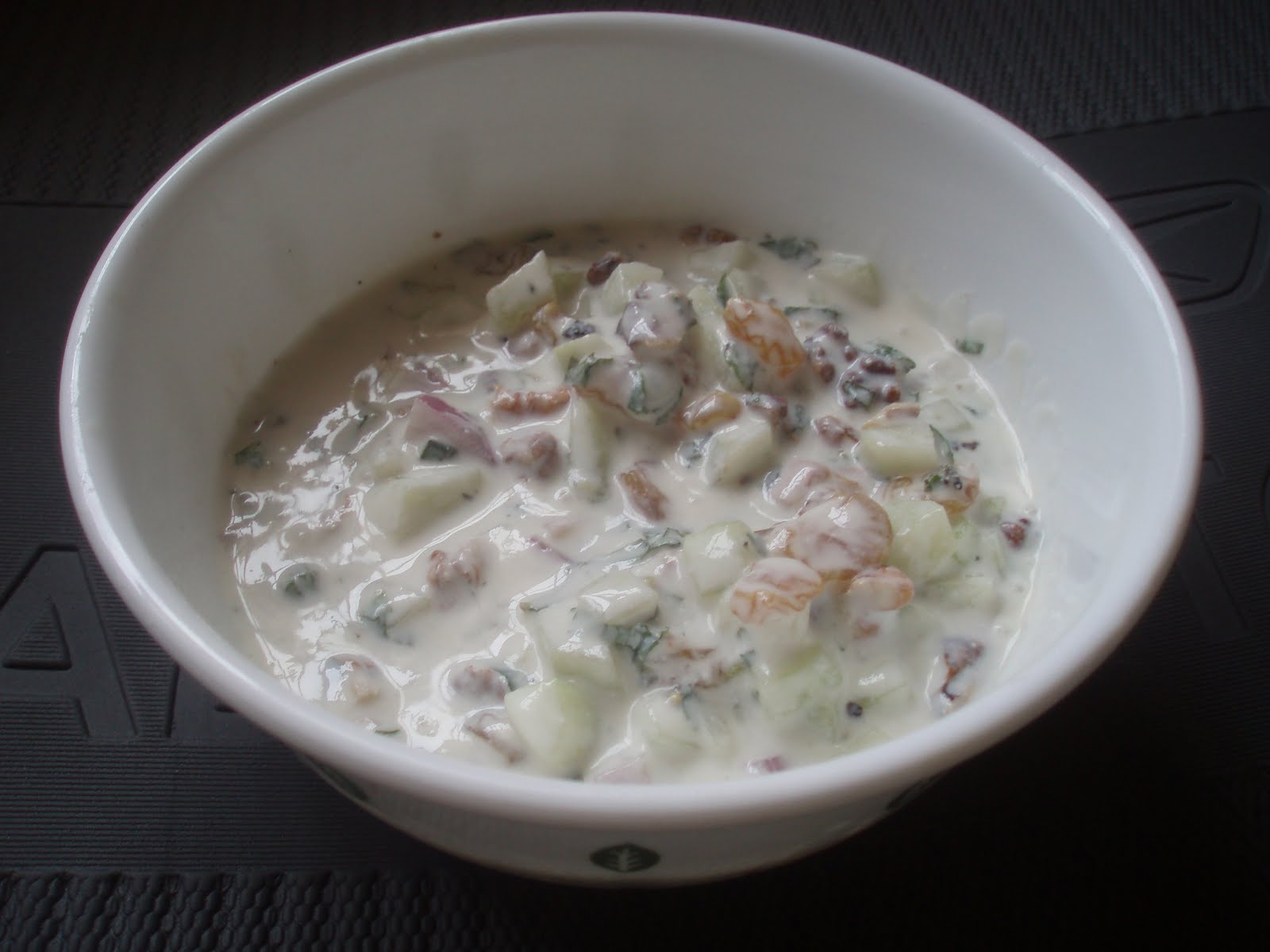
Bereft of a mystery or a sitcom to immerse myself in, I took this book to bed, and came across this Mediterranean Cucumber Salad, which I made today. It was attractive to me because I had all the ingredients, though the cucumber was regular size, not small, and the raisins were not monukka. I let it chill from morning to evening and ate two helpings of it for dinner. The Spouse has promised to have it for breakfast.

I think the raisins did it. Made all the difference, I mean. This recipe was contributed by "Jane Margulies, New York, NY"

Here's what you need:


Cucumber, peeled, seeded, diced: 1-1.5 cups
Curds/Yoghurt: 1 cup
Raisins: 3 tbsp
Onion, chopped: A small fistful
Walnuts, chopped: 1/4 cup
(Sea) Salt and freshly ground black pepper to taste
Mint leaves, chopped: 1 tbsp


Place the cucumbers in a bowl. Add the remaining ingredients and mix well. Chill and serve very cold.


And yes, I've started another tradition here - using my expensive, branded, and very impressionable (read 'not stain-proof'), ab stretch exercise mat as background for my pictures. What crazy traditions did you follow?

This post is off to Haalo who is hosting Weekend Herb Blogging this week, the event started by Kalyn.

Thursday, March 18, 2010

Egg & Spinach Baked With Nut Crust

I'm the Pacman!


Laziness got the better of the scrambled eggs and leeks you wanted to make for lunch.

Later in the evening, you remember a handful of grated cheese resting in the refrigerator for the past few days.

There are over a dozen eggs waiting to be used as well.

Your resolve to eat less, if not lighter, in the nights would be well exercised with a simple combination of the two, you think, the mere thought making you float.

Come home, whip out the cheese and four eggs.

There is three-fourths of a cup of chopped leeks in the refrigerator.

Mince three chillies and two cloves of garlic.

You notice a bunch of spinach as well, so wash it well and chop it, it makes about two cups of spinach.

In about a tablespoon of olive oil, saute the garlic.

Once it's all nice and smelly, add the spinach. Let it wilt well, hurry this along by stirring it. Make sure there's no water left from the spinach.

Now add the leeks and the chillies. Add a little salt. Saute a few seconds. Let cool.

{{Idea!!! There are flaked pistachios and almonds in the pantry, and some broken cashewnuts as well!}}

Meanwhile, beat the eggs with a pinch of salt and half of the cheese.

Mix it with the greens and pour into a greased baking bowl.


Mix the rest of the cheese with the nuts and spread over the eggy mix. Both ingredients should be dry.

Bake at 200 C till a knife inserted in the centre comes out dry.


This eggy delight goes off to Yasmeen of Health Nut who's hosting Kalyn's Weekend Herb Blogging, now managed by Haalo.

Wednesday, March 03, 2010

An Education From Stalks

We all know that a cauliflower is nothing but a cabbage with education, right?

"Training is everything. The peach was once a bitter almond; cauliflower is nothing but cabbage with a college education."


So here's a lot of education for you, about four cups of the stalks.


Waste not, want not, we say. Waste I didn't, but would I want it?


As it turned out, (a resounding) YES!

The recipe is from here. The measurements are mine.

Cauliflower stalks, chopped up: 4-5 cups
Jeera/Cumin seed: 1 tsp
Asafoetida, a pinch
Salt to taste
Turmeric powder: 3/4 tsp
Red chilli powder: 1 tsp
Coriander powder: 1 tsp
Amchoor/dried mango powder: 1 tsp
Garam masala powder: 1 tsp
Oil: 2 tbsp
Coriander leaves: To garnish

Heat the oil in a pan and add cumin seeds. When they change color, add the asafoetida.

Now add the chopped up stalk, salt and all the spices except the amchoor and garam masala. Mix well.

Cook covered on low heat till stalk turns tender.
(When it felt like this was taking ages, I transferred it to a pressure cooker and pressure cooked it for three whistles with half a cup of water.)

When the pressure falls, open the pressure cooker and add the amchoor and the garam masala. Mix well and simmer till any residual water evaporates. Garnish with the coriander.


This cauliflower fed us for three days. Call it kima (mince) or upma, here's another thing I made with it.


The stalks are off to Susan who's hosting Kalyn's Weekend Herb Blogging this week, now administered by Haalo.

Monday, February 01, 2010

Mellow Mallum

There was Baby Bok Choy,
There was Big Bok Choy,
Then there were incessant
Cups of chopped choy.

In went the leek,
Garlic and salt
Green chilli, turmeric
Spicy things all.
Steamed was the mix,
Covered for ten minutes
Stirred now and then
In my li'l kitchen.


Off with the lid
So went the liquid
In went the coconut
Shredded and grated.

Mix it well
Mix it nice
Wait just a minute (or two),
And there's a dish
For your rice!


As in all great literary works, there is much creative licence in this poem too. (One instance of it is that you don't need the rice.) I will not bore you with the technicalities of meter and rhythm, but hasten to assure you that truth has its place in this licentious (poetically speaking) piece.

The weekly shopping expedition resulted in many greens, including a first for me - bok choy. (I've eaten it on the rare occasion, but I have never processed it myself, ever.) I got some fine specimens and though my head told me to search for adequately apposite recipes, my heart immediately knew it would go into only one, a formula I had discovered a few weeks ago when Cynthia wrote about how she made mallum (also mallung, a Sri Lankan dish) for her vegan guests.

The better part of this morning was taken up with cleaning and chopping the bok choy, it came to nearly 12 cups, stalks and leaves together. I had a couple of leeks too, so one of them went into it, sliced. I added some salt, turmeric and five cloves of garlic, minced, mixed it all up and set it to cook, covered, on medium high flame for 10-15 minutes. Stir it every 3-4 minutes. The greens will give off some water so do away with the cover after a while. When the chopped stalks turn a transparent green and the leaves have wilted just enough, add about one-and-a-half cups of grated coconut and cook for another minute or two.


Bok Choy Mallum


Cabbage mallum

In the other mallums I've made, I've used French beans, cabbage and hyacinth beans. With these vegetables, I did not even wait to add the coconut at a later stage, it was a one-shot attempt. With the hyacinth beans, which was more experimental than the rest and did not contain any coconut, I added red chilli flakes (not a cupful, no!), salt and turmeric alone.


French Bean mallum

Truth be told, this is not very different from most South Indian stir-fries but what I'm chuffed about is the absence of oil (other than that contained within the coconut) and water, and the novelty of mixing everything together and letting it cook entirely on/in its own steam!

Your pan needs to be suitably thick-bottomed, or you could end up with some charred coconut and vegetables.

Here are some links I found useful:

Leafy vegetable mallum (mallung)

"Mallum is usually shredded vegetables cooked with spices and grated coconut.

Cabbage is commonly used to make mallum, but Sinhalese also use jackfruit, breadfruit, ash plaintain and unripe papaya."
- From here

"Mallum combine one of any number of vegetables (on Sri Lanka, we most often encountered carrot mallum and green bean mallum) with chiles, onions, coconut, and turmeric. Once the ingredients are mixed together in a heavy pot they're steam-cooked over medium heat. Mallum require minimum attention once they're on the fire, and make an excellent side dish."
- From here

This goes to Simona of Briciole, who is hosting this week's Weekend Herb Blogging, created by Kalyn of Kalyn's Kitchen and administered now by Haalo of Cook (Almost) Anything At Least Once.

Wednesday, August 19, 2009

'Shrooms With A View, Sage & Rosemary Too

Once, not long ago, I ranted about dry herbs here. I'm not about to eat crow (now that's another post) or my words, or even dried herbs, but as some of you pointed out in that post, dried rosemary is an exception, as I discovered today.

My aunt in the US, with whom I stayed in July, has several herbs in her garden - sage, rosemary, French tarragon, two kinds of basil, chives, mint and a few others. I would often pick a few leaves off the plants and pop them into my mouth, enjoying the fresh and spicy feel. When I was leaving, she picked some fresh sage for me, which held up rather spotlessly till today, and gave me her stash of dried sage and rosemary. A creative cook, she uses permutations and combinations of these herbs to flavour all her cooking, even Indian food, and I decided to do the same, though I did not employ any logic except that of the palate.

After years, I bought mushrooms recently and they blackened only a little bit after two days, unlike earlier when they would do so very rapidly. I also had two slabs of paneer/cottage cheese that needed to be used up fast so I decided to throw it all into a big stir-fry and flavour it with these herbs.


Here's what you need:

Onion: 1 big, thickly sliced
Button mushrooms: 2-3 cups, halved
Paneer/cottage cheese: 2-3 cups, cubed
Red chilli flakes: 1-2 tsp
Garlic: 10 cloves
Sage: 6-7 leaves
Olive oil: 2 tbsp + 1 tsp
Salt: To taste
Rosemary: A sprig or two

Grind the garlic, red chilli and half of the sage roughly with 1 tsp of olive oil - I did this with a stone pestle and mortar.

In a large wok, heat the olive oil and add the above ground mixture. Saute for a few seconds.

Now add the onions, saute for a minute on high flame, then the mushrooms and the cottage cheese.

Saute again for a minute, and add salt.

Lower flame.

The mushrooms give out some water, let this dry up but keep turning constantly so as not to burn the dish.

You can choose to let some oily juice remain - good to mop up with bread - or dry it completely.

Now crumble some dried rosemary over the top and mix it lightly. Serve.

This goes off to Weekend Herb Blogging, Kalyn's event, managed by Haalo and hosted this week by Prof Kitty at The Cabinet of Prof. Kitty.

Wednesday, December 17, 2008

Biriyani Turns Over A New Leaf


Every year, when Id comes around, a friend of the family sends over biriyani and other festive delights for us to consume. He usually calls to tell us not to cook anything for the day as the amounts he sends are huge. One year, the call hadn't come yet, and Dad, who was eagerly looking forward to it, got antsy.

This friend is my grandfather's friend. My grandfather's name ended in Rao. "How about we give our friend a reminder?" Dad suggested. "We call him, chant 'Pulao, pulao, X X Rao, Pulao pulao X X Rao' and hang up?" Naturally, that led to a lot of giggles, but happily, the friend called soon after and we had ourselves a feast as usual.

That was a very involved biriyani which spared no effort, I'm sure, but this biriyani/pulao that I made the other day was chosen for its no-fuss method. The inspiration came from another recipe which I will post and acknowledge as soon as I make it, but the tweaking I did with the herbs and spices is all mine.

Chicken: 500 gm (Vegetarian can subsitute chicken with potatoes, peas and carrots)
Basmati Rice: 550 gm (note the volume)

Curry leaves: A handful (Read more about curry leaves here)
Crushed peppercorns: 1.5 tbsp
Thick coconut milk: 200 ml
Water: 1/2 cup + twice the volume of the rice
Coriander powder: 1.5 tbsp
Turmeric powder: 1/4 tsp
Powdered cinnamon and cloves: 1/2 tsp each


Cinnamon sticks: 3
Cloves: 4
Marathi moggu, crushed a bit: 3
Whole pepper: 1.5 tsp
Ghee/Oil/Mix of both: 75 ml/4 tbsp
Salt to taste


Soak the rice for 10 minutes and strain.

Wash the chicken and set aside.

In a heavy bottomed pan or pressure cooker, heat the fat and fry the cinnamon, cloves, Marathi moggu and pepper.

Add powdered cinnamon and cloves.

Add coriander and turmeric powders and fry again for a couple of seconds.

Add the curry leaves and the chicken pieces, sauté well. When the chicken changes colour, add salt and crushed peppercorns.

Add the coconut milk plus the 1/2 cup of water and cook the chicken for a couple of minutes.

Now add enough water (If the rice came to 3 cups, add 6 cups of water)and allow it to boil.


Add rice. Cook till done after sealing the lid. In a pressure cooker, let it cook for 5 minutes on simmer after two or three whistles.


One eater said it was alright, but that it didn't taste of anything in particular.

Another liked it, but that the whole pepper interfered with the eating. I liked it for that very reason. And the fragrance imparted by the spices boiling in the coconut milk - that was Joy of Discovery.

Yet another, bless his kind soul, said it was tasty, and served himself twice.

I made a raita to go with it but it wasn't really necessary - I've never really felt the need for any accompaniment to biriyani, though that's not to say I don't like them. I even believe it robs the biriyani of its taste. Have any of you felt this way?

As I believe curry leaves in biriyani are unusual, and this would make a great main dish for Christmas or any other festival/event where biriyani or pulao could be the main attraction, I am sending this off to Kalyn's Weekend Herb Blogging, organised and hosted by Haalo.