Or red amaranth, but then there wouldn’t be many buyers, or in this context, readers drawn to this post! There’s a story behind the headline, though.

The Indian readers among you will know of an old Hindi movie called Disco Dancer, a big hit which spawned a number of similar movies/dance sequences in other Indian languages. Anything shiny and sparkly came to be called ‘Disco …’ after that, be it clothes, costume jewellery, stationery, and as I was to find out a few years ago, vegetables as well.
That day, I had gone shopping for vegetables and spied these gleaming, red bunches with a wizened old woman selling a variety of greens. I knew what they were, of course, but keen to know what they were called in Tamil, the local language, I asked the lady.
With panache and authority, and a look that said she needn’t explain more, she said, “Disco Keerai,” stunning me into inexplicable repulsion … and departure in search of better, and less ostentatious, acquisitions.
My repertoire of dishes with leafy vegetables was restricted to a rather single-formula daal (lentil preparation), stir-fry and chutneys. I don’t make too much more even now but since then, was lucky to find a book called Green Leafy Vegetables by Shyamala Kallianpur, published by the author in 1997. There are several recipes for the most popular/commonly available greens and fewer for the not-so-well-known ones.
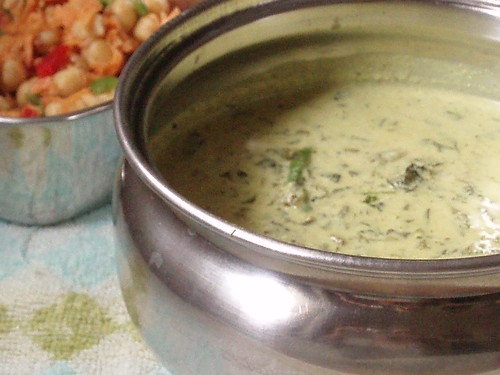
This recipe is the only one in the book for red amaranth. (The sample in my photo is cold and sad, do excuse, but gives you an idea of its looks.) I’m sure it has done the rounds of the blogs, especially those specializing in Saraswat cuisine, but whenever something is a new discovery to me, however old and traditional to others, it seems to go into my blog nowadays.
I don’t often see red amaranth in the market and it’s been ages since I last cooked/ate it so I don’t remember the taste, but the book, the blog and the anecdote were too great a combination for me to resist. As was the opportunity to play heroine and rescue the grated fresh coconut I bought a few days ago from its inevitable destination – the dustbin. (Just as death is life’s only certainty, my friends, so is my trashcan my vegetables’ only certain fate.) And so, here comes the dish, which the author calls Bhajji Amshi. I omitted the jaggery the author mentions, but the rest of it remains.
Red amaranth with tender stalks, chopped – 8 cups
A 2 cm cube of jaggery (optional, I would say, but probably not traditionally omitted)
Salt to taste
Water – 3 cups
Grind together to a paste:
Freshly grated coconut – 1 cup
Raw rice, soaked in water for 10 minutes – 1 tbsp
Tamarind, soaked for a while – a lime-sized ball
Green chillies – to taste (she recommends 8-10, I used 5)
Tempering:
Oil – 2 tsp
Garlic, peeled and bruised – 8-10 cloves
Wash the amaranth leaves well. Chop along with the tender stalks. Put it in a pan, add three cups of water, salt and jaggery, if you’re using it. Cook covered on low heat – this will take a while – make sure the leaves wilt and some water evaporates.
Add the ground paste to the cooked amaranth and bring it to a boil.
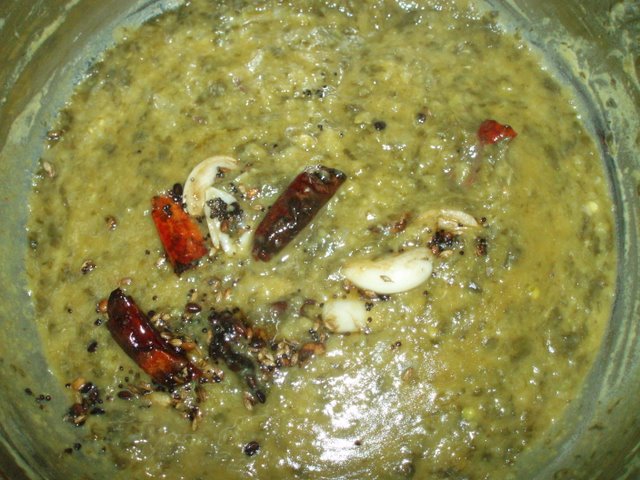
Heat the oil in a small frying pan and fry the garlic slightly. Put this in the curry and immediately cover it so that the flavour permeates the dish. Serve with rice.
Amaranth is full of goodness, and makes for some interesting trivia. To read up, go
here and
here.
This is my submission for
Weekend Herb Blogging, hosted this week by Anna of
Morsels and Musings.
Tags:
Greens Red Amaranth Coconut Vegan Weekend Herb Blogging Thotakoora