*******************************************A slice of life - pith, zest and pits all******************************************
Showing posts with label musings. Show all posts
Monday, December 26, 2011
Of Just Desserts and Going Bananas
My first memories of eating out date from the time I was seven. I was visiting my parents in the US and I know we ate out more often than we did in India, where I don’t ever remember being taken to a restaurant except when we went to Madras as it was then known to see off parents and aunts and uncles to the US and stayed in hotels. (My favourite then was a green pea soup at a hotel that is still around and popular.) In the US, some of the places we ate out at were Kentucky Fried Chicken and McDonald’s. I tried spaghetti and meatballs. I tasted pizzas, French fries and other legendary junk food I don’t remember now.
Later we went on an extended road trip of both the US and Europe. I remember being not too fond of the new food. (Could that really have been me?) I was always looking for rice and other familiar food. The one time my parents did locate some rice dish, in some place we had halted for lunch in FRG, as West Germany was known then, it was ice-cold and strange and I threw a tantrum. My father was annoyed, my mother more patient – I’m sure one of those two poor souls downed it so as not to waste resources. (I also made them buy me rolls of coloured wool in some other country though neither they nor I had the faintest idea of what I would do with it, despite my father protesting we were “on a budget” and we couldn’t afford to waste money.)
During that time, I remember, my father would always ask me, “Do you need help?” and lean over and relieve me of a bit of whatever was sitting on my plate. That joke continued throughout the trip and after. I didn’t think it was a big loss unless I liked the food.
It just struck me that the tables have now turned – whenever I visit my parents, my father opens the fridge to find that his nightly dessert of cream, curds (yoghurt) and bananas is halved or wiped out. A fortnight ago, after it happened a couple of times, he factored me into the scheme of things and started adding one more banana and some more cream and curds.
My father seems to have discovered a way to add more taste – and where taste lies, calories follow – to this nightcap. This visit, he told me that the inside of a kajjikai (karanji) crumbled over the curds-banana concoction is a great addition. It seemed interesting, but where would I find kajjikai with the same filling here? As I was mulling the possibilities, the brain in me ticked off the idiot in me (the morning diet of soaked almonds must be working) and told me I didn’t have to go searching for a kajjikai, deconstruct it, extract the filling, crush it and sprinkle it on the dessert. I could simply make the filling myself.
The pictures that you see are my father's, photographed at my request, but in the interests of his diet, I didn't ask him to add the topping, so there is no picture of that.
Banana: 2, sliced (I prefer the chakkarakeli variety, seen in picture above, the second and third from left)
Cream from the top of curds: 2-3 tbsp
Note the layer of cream on top - this is home-made curds/yoghurt.
------------
Topping
------------
Dessicated coconut: 1 tbsp
Semolina/rava/sooji: 1/8 cup
Sugar: 1/8 cup
Cardamom powder: A smidgeon
Chopped cashew: 1 tsp
Raisin: 1 tsp
Ghee: 1 tsp
In a pan, heat the ghee and toast the coconut in it on medium flame for a few minutes. Remove, keep aside.
In the same pan, add another ½ tsp ghee and roast the semolina 7-8 minutes.
Powder sugar, mix with the sooji, coconut, cashew, raisin and cardamom powder.
To assemble: Put the sliced banana in a bowl and top with the cream. Mix lightly. Sprinkle with topping.
Bananas Curds/Yoghurt Humour Nostalgia
Wednesday, October 05, 2011
Kitchen Under The Stairs
Ever since this kitchen came into being, I've wished I had something like it. My own small kitchen is bigger than this but it's inside an apartment and I feel hemmed in when I'm inside it for various reasons - too many things in too little space, not enough ventilation, not enough light.
I love the al fresco feel, not to mention the fact that it seems so compact. This is at the back of the house, which has a bigger kitchen inside. The stairs lead to the terrace. The windows you see jutting out belong to a room where the cook of this kitchen stays.
I want lots of light, some greenery (though you can't see it in the photo, there is some - a neighbour's tree hangs over the stairs) and some open space in my life.
This goes off to Black & White Wednesday.
Black & White Wednesday Musings
Wednesday, September 14, 2011
Of Birthdays, In Real Life & Blogwise
I don't usually celebrate personal milestones in public but religiously put out blog anniversary posts every year, today being the fifth year since I started writing this blog.
I want to indulge in some birthday memories, though, real-life birthday ones. The only cakes we got in our town were the brown, fruit cake kinds with hard icing, hard pink, green and purple roses, silver balls and twisty little candles. In the absence of mothers, aunts and grandmothers who did not make cakes but only Indian sweets and "hots" (savouries), I suppose we looked forward to this cake. Even if the flowers were solid enough to have claimed a tooth or two, that's what we had and cherished.
Those were the days when a 'return gift' wasn't known, and asking a guest to the birthday party, "What gift have you brought me?" would result in a slap, never mind you were only five or six or that it was your birthday. Grandmothers would kit us out in embroidered frocks and there would perhaps be a trip to the temple.
At school, the only time we were allowed to wear "colour dress" (not the uniform) was on Saturdays and birthdays. At Assembly, the teacher presiding would ask if there were any birthday girls or boys and one, two or three, sometimes urged by their friends, would stand up hesitantly and make their way to the stage, upon which the Music Master would begin strumming his guitar and all of us would sing "Happy Birthday to You!" I remember not owning up to a birthday one year, my cousins who studied in the same school telling my Grandmother about it, and my Grandmother scolding me for it. Why had I been so shy? Was it also the birthday I wore a white dress with blue, red and yellow clowns all over? Maybe. I couldn't be sure.
Stage or not, the 'distributing sweets' routine was all-important, and after the first period began, the birthday girl or boy would distribute sweets to the entire class, to the teacher, and then accompanied by another, go and give the headmistress some, and maybe the other teachers too. A classmate's birthday was also the first time I saw a pink guava - her folks brought guavas in big baskets and distributed them to the entire school, and one of them was pink. The popular sweets distributed were "Goldspot" sweet (orange hard-boiled candy) or a green-wrapped toffee. The thing to do, after you'd popped the sweet into your mouth, was to twist the wrapper into what was supposed to be a dancing girl. The green wrapper was particularly prized. For one birthday, I remember asking everyone to give me back their wrappers. (I'm cringing, childhood is no excuse for such behaviour.) One boy refused, I prepared to cry, and our teacher stepped in, saying she would give me hers. I don't know what I did with them. Not all could refuse a birthday girl, however ungracious, could they?
In the evening was the party, with the cake, streamers, balloons, friends, cousins, uncles, aunts, neighbours. There were home-made sweets and savouries, or some would be ordered from the Udupi hotel in the town centre. There was jelly and ice-cream in little globe-shaped containers. There were no games, no party hats, and gifts brought could be as simple as a packet of biscuits. The cake was cut, food eaten, and everybody went home after an hour or two. Till one was eleven or twelve and deemed old enough for the parties to stop. Truly old, because at thirteen, I had just one friend over and that was to pour my heart out to her over an evil classmate.
And now from nostalgia to the Oscar speech: Thank you, readers, bloggers, family, friends, blog aggregators. You keep this blog going, and this blog keeps me going.
Here's my first anniversary post, and here's another nice post on how children celebrated their birthdays in the Seventies and Eighties.
Blog anniversary Musings/Nostalgia Humour
Sunday, July 24, 2011
When The Drumsticks Came Home To Curry
My mother is the kind of person who, as a busy doctor without household help, would make a meal of salt, chilli powder and leftover rice. So it comes as a surprise whenever she expresses an interest in a recipe or proffers one herself. Which is why this recipe is very special and unusual, because she told me about this recently when I was stressing out about how to cook a full meal for someone I'd invited home for lunch.
Now invitations from me are rare because I too, though not a busy doctor, have a hectic life, what with my insomnia and harried rising, gym-and-back-from-gym routine, and work and after-work routine, my insomnia and harried rising gym ... you see how it goes.
I have a two-hour window in the morning with which to turn out some stuff to eat and I managed to make this rather swiftly along with some payasam and two other vegetables. Now that's not a spread by any stretch of the imagination but that's what you can expect if I invited you on a weekday and you accepted my invitation. I had tomatoes and with my mother who arrived the previous day, came from my grandmother's garden fresh drumsticks (or saragwa - always reminds me of Sarajevo and Archduke Ferdinand ever since I heard the name not too long ago).
Known as mulagakaya in Telugu, drumsticks are a household vegetable in South India - not only are they popular, many houses have a tree. It's notorious for harbouring furry and itchy caterpillars, but the benefits outweigh that risk, with the leaves being considered extremely nutritious as they are sources of beta carotene, Vitamin C, iron and protein.
They have a taste that I can only describe as delicately pungent, an oxymoron, I know, but really, you have to taste it to know it. They're the kind of vegetable that you appreciate better as a grown-up. Like brinjal/eggplant, for instance. In my house, we've never had the leaves, only the fruit. And now I don't find any in my locality though there are a few saplings struggling to grow in my apartment building. I've even seen recipes using the tree's flowers. Here is more information.
It's pretty much an as-you-like-it curry and it was almost two months ago that I made it so I'll give you the general guidelines about how to make it.
You will need
2-3 tomatoes, chopped
2 drumsticks, cut into 2-inch pieces
Mustard seeds - 1 tsp
Cumin seed - 1/2 tsp
Turmeric powder - 1/4-1/2 tsp
Red chilli powder and salt to taste
Oil - 1-2 tsp
In a pan, heat 1-2 tsp of oil.
Pop the mustard and then the cumin.
Add the tomatoes and cook on medium heat till pulpy.
Now add the spices and cook a little more.
Ensure the tomato isn't drying up - if need be, add some water.
Then add the drumstick pieces, mix well, add just 1/4 cup water if there isn't any already in the pan, cover and cook till insides are soft.
Chew to your heart's content once it's done. My mother's grandfather is supposed to have chewed them so long and hard, with such relish, that they were bleached white!
One more way to cook them.
This goes off to Chriesi at Almond Corner who's hosting Kalyn's Weekend Herb Blogging, now run by Haalo.
Weekend Herb Blogging Vegan Gluten-free musings
Thursday, February 17, 2011
Mixed Vegetable Kachri
Scene1
Spouse, Sra having dinner
Spouse: Uncle just didn't like this dish, you know, he found it too sour, but I loved it, of course, because I love sour stuff.
Sra: Hmm.
Scene 2
Dinner next day
Spouse: Hey, there's brinjal (eggplant/aubergine) in this!
Sra: No, there isn't.
Spouse: Come on, I can see the pulp, all squishy.
Sra: Yes, it's there.
Spouse, Sra continue with their dinner
And so there was, the brinjal pulp. But it wasn't any ploy to get the Spouse to eat something-that-he-doesn't-which-is-good-for-him, just a way to include more vegetables into a mixed vegetable dish and include him in the process of cleaning it out faster!
Most of the vegetables are stuff that the Spouse won't even deign to look at when their identity is clear - yellow pumpkin, beans of the country variety, small gourds further cut up, you get the picture ... It did have something the Spouse took a liking to, though - kachri powder from my recent trip to Rajasthan.
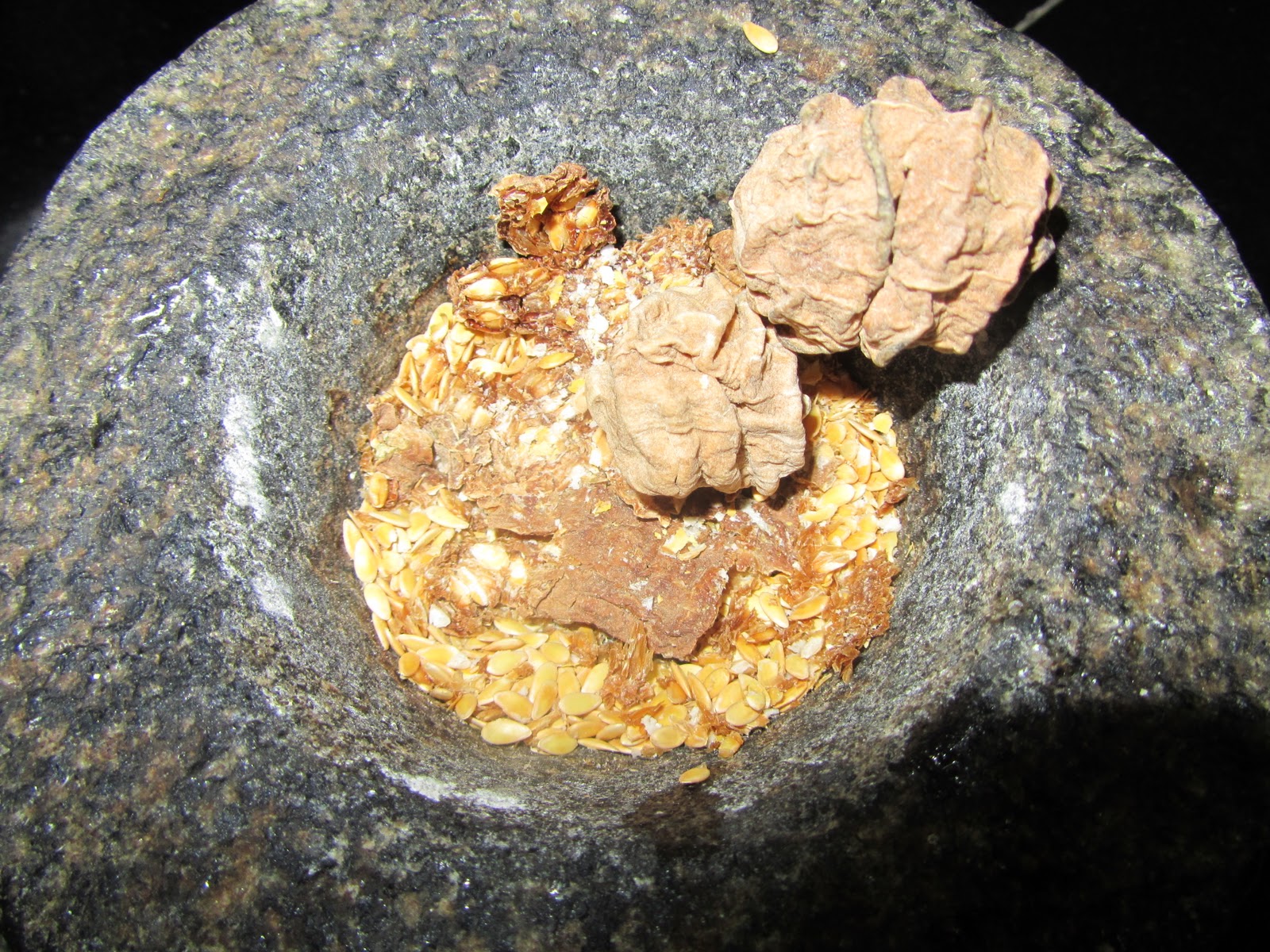
See that wrinkly little thing there, looking like a bleached walnut, a crumpled dead leaf? It's actually a gourd itself, like a small, tiny watermelon. My friends and I visited the market near our hotel in Jaipur at about 8 p.m specifically for this - I bought about half a kilo of the fresh ones and during the vegetable seller's patient description of how it could be used in a chutney, lost patience but kept nodding, so naturally, I did not know what to do with it when I got back home. More frustratingly, peeling it didn't help - it depleted the gourd of three-fourths of its substance and I was left with very little to use - the peel was quite tough and took much of the flesh with it!
I probably didn't know how to do it right, because there's a picture below from my trip that shows that someone in Rajasthan got it right!
I put it in dal and it tasted very much like dosakai (melon cucumber). But I got tired of it after two dals and gave it away. Perhaps there is a recipe for fresh kachri chutney on the Net, but none else.
Then I launched into the dried kachri that I had bought in Jaisalmer (which is also where I saw the fresh kachri first). It needs to be pounded to powder, a chore I somehow enjoy. Perhaps pervertedly, but I do.
I used Tarla Dalal's recipe at first but two tries on, I've developed my own mix of vegetables with whatever's available, and spices. In doing so, I'm probably violating some hallowed rule about amounts and proportions or ratio of hard to soft vegetables and non-includables, but that makes it an ever-original, and evergreen recipe, doesn't it, with surprises at every stage! Most recently, I used a combination of yellow pumpkin, brinjal, dondakai/tendli/coccinea and I forget what else, with this recipe.
What you need:
Assorted vegetables, chopped - to make 3-4 cups
Garlic: 5-10 cloves, minced (optional)
Shah jeera/jeera/caraway/cumin seed: 1 tsp
Plain chilli powder/mixed up chilli powder: 1-2 tsp (I use the latter)
Turmeric powder: 1 tsp
Tomato: 2-3, diced
Kachri powder: 1 tbsp
Lime juice: To taste
Salt: To taste
Oil: 2-3 spoons
Temper heated oil with the cumin/caraway and the garlic.
Add the vegetables and the turmeric and chilli powder and mix well. Cover and cook on a slow flame till the vegetables are cooked, ensuring they aren't sticking to the bottom of the pan.
Add the tomato and salt and cook for a few more minutes.
Add the lime juice and kachri, and mix well.
This is a very popular meat tenderizer. See a pretty picture and more info here.
And here's more info from Tarla Dalal herself!
Quite a few recipes mention amchur as a substitute and I've made similar curries with both - the tastes are very, very different.
Here's a post that attracted my attention and two more discoveries and experiences of kachri from the blog world.
This post goes off to Graziana of Erbe in Cucina who's hosting Weekend Herb Blogging now run by Haalo and created by Kalyn.
Weekend Herb Blogging Mixed vegetable Vegetarian musings
Sunday, January 30, 2011
Fancy Fennel, Simple Salad
This past week, I undertook something that I hadn't ever. I invited a large number of people over for dinner. Eight, to be exact. (And yes, that is a large number for me.) I was very nervous as I haven't cooked for that large a number in all these years. It was a day off from work and I spent about 6-7 hours prepping and cooking and assembling, with a break of about two hours for shopping and lunch.
There is a hypermarket at the far end of the road we live on and getting there is a journey. But the reward for it were some small (read relatively inexpensive) boxes of strawberries, good black grapes and a bulb of fennel (which produces the saunf we Indians are familiar with) that I've never seen here earlier. I took the smallest of those, which cost Rs 40, knowing I would make a salad that I'd eaten I don't remember where earlier.
The fennel stayed in my fridge for three days - naturally, I'd forgotten all about it as I'd not opened the vegetable crisper as I hadn't needed to cook because there were lots of leftovers from The Dinner for Eight People - till I remembered about it yesterday. (In the process, I also noticed a big bunch of greens, which I converted into two stir fries, one with the leaves and one with the stalks.) Then I set about looking for recipes and then for sites which would tell me how to process fennel into paper-thin shavings. I realised rapidly it wouldn't be a simple case of taking the peeler and shaving it - it involved 'removing tough outer portions', 'cutting off the stalks and saving them for use in soups later' and such.
I regret to say my fennel didn't come with any 'ferns' or 'fronds' (just a few tiny, ragged, blackening-at-the-tips leaves) and the inner portions seemed as tough as the outer portions. My bulb of fennel was rapidly attenuating as I attempted to remove the Tough Outer Portions, so I simply stopped discarding the T. O. P. after a minute or so and cut it into thin strips.
'Aromatic' is an understatement, and, I think, rather inaccurate. My fennel smelt of an entity that could straddle the paint and petroleum derivatives categories and yet be pleasant - I can't be more accurate than that myself.
I looked for recipes for simple fennel salad and chose this though I didn't have half the ingredients with me. (I had powdered Parmesan cheese in a tin, which I didn't want to risk using.) So I made it with just fennel, lime juice, olive oil, salt and pepper but felt that it lacked something, so added a sliced onion to the mix. It was just right.
Fennel bulb, cut into strips: 150-200 gm
Onion, small/medium: 1, sliced thin and well separated
Olive oil: 2 tbsp
Lime juice: from 1 big lime
Salt and fresh cracked pepper, to taste
Mix the olive oil, lime juice, salt and pepper and whisk a little with a fork till it begins to emulsify. Pour it over the fennel and onion and mix. It tastes good a couple of hours later.
I read that India produces about 30,000 tonnes of fennel (not sure how recent the link is) but I do wonder, what happens to all those bulbs?
I'm sending this off to Astrid who's hosting Kalyn's Weekend Herb Blogging this week, now managed by Haalo.
Weekend Herb Blogging Vegan Salad Fennel Fennel
Tuesday, November 02, 2010
The Laksa That Took A Detour
It doesn't take much to feel connected to someone or something. Not years, not weeks. A few forays are enough. That's how I feel about South-East Asia.
First, there was Thailand, then Japan (not strictly SE Asia, but close), Singapore, then recently I went to Taiwan, and on my way back, to Thailand again. Recently, I made plans for a trip to Malaysia and Indonesia but they fell through. With all this, I feel extremely connected to the region :) despite the trips being rather fleeting.
When I first visited Thailand, I could not stomach the smells of food wafting off the carts on the streets. Trying to spend prudently in Chiang Mai, my friend and I opted for the plain (and not the spicy) sausage and divided it into two. We immediately spat it out because it was sweet, so unlike what we expected from a sausage that we told ourselves not to be cheap and then bought the spicy, herbal one which cost 20 Baht. Thankfully, it was delicious. We tried much other street food, but the smell would get to us, and in Bangkok, we ate at a Lebanese restaurant close to our hotel for two days. Even the famous Thai yellow curry was relished in the sanitised confines of our hotel's restaurant, and the som tam was had trying to forget that the vegetarian version I wanted was made in the same mortar and pestle that had, for the previous customer just moments ago, mashed tiny crabs that looked like upturned dead frogs (which was why I had opted for vegetarian).
More travel exposed me a little more to sushi but I think I will stick to the vegetarian version, substitute though it may be. Walking in the hot sun in Singapore only made us thirsty, not hungry, and we didn't eat much. The one day that we could have, we were whisked off to the local branch of a well-known Chettinad restaurant by our well-meaning Indian friends - neither my attempts at deflecting the invitation nor my request for local food were comprehended.
By the time I went to Taipei, Taiwan, and visited its street markets, I didn't smell anything anymore. I didn't even remember there would be a smell. I tasted century eggs and the seafood dumplings that tasted of an unidentifiable ingredient went down my throat without any hesitation. I would have probably tried stinky tofu had I known how to identify it, but all the tofu looked benign to me. (There's no reason why the stink should reflect in the looks, is there? Some of the most snazzy and snotty characters I've come across used to reek, and wouldn't wash their hands after using the toilet.) But I digress - I don't mean that I liked everything I ate, but didn't feel so strongly about it either.
Researching Malaysia reminded me of Laksa. I wasn't very disappointed when the plans fell through but soon after, Aparna's post on a vegetarian laksa had me itching to make it soon. I finally made it yesterday. I was tired of meat and seafood so I too made it vegetarian. I went to the original recipe that she had mentioned, Ottolenghi's, and took it from there. By the time it was finished, it was laksa more in spirit and less in, well, the flesh, in a manner of speaking.
I used an onion instead of shallots. I used the notoriously hot red chilli pickle from Andhra Pradesh instead of sambal oelek. I used dry lemongrass bought in Thailand three years ago.
At first, I didn't have any bean sprouts, and substituted the tofu puffs with paneer/cottage cheese (a bad idea). I ignored the sugar but finally used a spoon of jaggery when the sourness set my teeth on edge.
And though I initially planned to use up a packet of soba noodles, I decided to go with rice. Short grain matta rice. You see, I just bought a 5-kilo bag because the one-kilo ones were no longer to be found, and as the other food in the house would go better with rice, I decided to use a bit of that for the laksa as well.
It was good, but something was missing. I added some salt, it made it better but that was not it. This was the vegetable-paneer-rice-laksa-lime combination
Then for the next meal, to the above, I added a hard-boiled egg and topped it with some sprouts and used lots of pepper. The lime wedge was there but I forgot to add extra. It was great!
For tonight's meal, I fried some tofu with a tablespoon of white flour mixed in water, and ate it with rice and sprouts and pepper - this time, the lime was forgotten, and the vegetables were given a go-by. Not so great, and more filling than I would have liked it to be!
I was tempted to use white rice for this meal as we needed to cook some rice and matta rice takes much longer to cook, but The Spouse said white rice would be overwhelmed by the laksa, and that the plump and sturdy matta would hold its own, so I went with matta again.
I would go for the second option - the one with the egg, sprouts, rice and vegetables. Next, I'm looking forward to making khaw suey - now if only I'd known I could look for it in Chiang Mai ...
Laksa travel Laksa Rice soup musings
Friday, April 09, 2010
Of Lucky Escapes, Quinoa & The Past Week
The week started off with what was meant to be a spouse-pleasing biriyani, but the dustbin, not his stomach, became its receptacle instead. Don't try to imitate the dum action by weighing down a light and unsteady lid with a heavy stone mortar and pestle. They will overturn the lid and fall inside the biriyani if you're lucky, otherwise spill the biriyani all over the stove and under the microwave, in which process you would burn your arms too.
I was lucky.
After fishing out the hot mortar and pestle from the hot biriyani and washing your arms to make sure the experience doesn't leave any scars, a most familiar fire and brimstone smell (well, not really, it smelt like well done kababs) tells you your biriyani is going going gone to hell anyway - that you should have trusted your gut instincts and added some water to the meat underneath the rice in the heavy-bottomed pan despite the instructions in the fancy cookbook.
Cook in its own steam? Hah!
It's a few days later and you remember having soaked some dried cranberries overnight a few days ago, forgotten that you drained and stored them in the fridge. You have an hour before work starts, why don't you set about making the salad as planned with quinoa, that wonder grain with all the eight essential amino acids, among other goodnesses?
Step 1: Retrieve the cranberries. Reach in, pluck that dish out and realise it was the milk after it spills all over the fridge and under. There's some on your feet too - rub it in for a free beauty treatment! Clean up the mess (the bonus is that the dust bunnies under the fridge come out).
Step 2: Set to making the salad on the dining table with the TV news on in front of you. Topple the basket of TV remotes over, fix all the loosened parts and leave it in the same precarious position.
Mince, chop, boil, grind.
Chill.
The salad, that is.
Meanwhile, YOU can go have the third bath of the hot, humid summer's day that it is, sit under the fan a while to try and calm and cool the tortured spirit and flesh and give thanks that bigger misfortune hasn't befallen you.
Get through the day thinking of this new, never-before-in-your-experience salad.

Here's the original recipe, or is it from here? (And below is how I made do.)
1 cup quinoa
2 cups water
4 tbsp honey
1 tsp finely chopped garlic
1 1/2 teaspoons minced green chillies
1/2 cup dry cranberries, soaked overnite, drained
Juice from 2 big limes
1 tbsp finely chopped fresh mint
1 tbsp finely chopped fresh coriander
1/4 cup finely chopped red onion
Salt to taste
Rinse quinoa several times. Boil water, add quinoa and simmer 20 minutes or until all liquid is absorbed. Let rest, cool a bit. Add some salt, fluff.
Meanwhile, combine half the honey, garlic and green chillies in a bowl.
Whiz the cranberries and remaining honey and lime juice in a mixer.
When quinoa has cooked and cooled a little, stir in both mixtures.
Add the mint, cilantro and red onion to the quinoa and mix thoroughly, but not with a heavy hand.
Chill.
This goes off to The Cabinet of Prof Kitty who's hosting Kalyn's WHB this week, now administered by Haalo.
Weekend Herb Blogging Quinoa Salad Vegetarian
Monday, March 15, 2010
Not Going By The Book
Two months ago, Jayashree tagged me in a meme, asking some of us to show off our favourite books/cookbooks. Very honestly, I can't home in on just one and say it's my favourite because I approach different books for different cuisines.

Very often, though, I find myself turning to Aharam which is a nice combination of the traditional cuisines of Tamil Nadu. It also makes an effort to highlight the non-Brahmin vegetarian cuisine of the State, unlike many books on vegetarian South Indian cuisine, known and little known, which seem to say vegetarian and Brahmin cuisine is one and the same thing.
There are some interesting recipes in this book. Snake gourd cutlets, for instance. Radish-chickpea curry, another. I've never made those. I've tried out some non-vegetarian recipes but not too many, because many of them call for coconut. Which I do not have on call. And I am lazy. Unless I find it ready-shredded. Then I am just a little less lazy about grinding it to a paste. Aside over, yesterday, I made this Kaikari Pulav (Vegetable Pulav) with my own twists and departures - it brought back my rice-eating days to me and made me feel accomplished, if not tired, because I slaved over it for 90 minutes.

That is nothing to do with the recipe, but everything to do with my small kitchen. Have you ever felt hampered by the lack of space in your kitchen? I have to shift things around everyday to be able to find space for the chopping board, the various bowls, water bottles, the spice jars ... ugh!
Anyway, here's my version of the original recipe.
Rice (I used a mixture of Basmati and ordinary): 1.5 cups
Potatoes, cubed: 2 cups
Peas: 1 cup
Shallots, chopped: 10
Big onion, chopped: 1
Grind to a paste
Cloves: 4
Cinnamon stick: 1.5-inch
Cardamom seed: from 4 pods
Green chillies: 4
Ginger-garlic paste: 1 tbsp
Fennel seed: 1 tsp
Poppy seed: 2 tsp
Seasoning
Ghee: 2 tsp
Bay leaf: 1 big or 2-3 small
Oil: 2 tsp
Mint: 2 tbsp (I used the spicy mint chutney that I had)
Chopped coriander leaves: 3 tbsp
Salt to taste
Clean and wash the rice. Soak it in water.
Heat the oil and ghee in a pressure cooker and season with bay leaves.
Add onions and shallots and fry till they are a light brown.
Add the ground masala and fry for a few minutes on low heat. Add the mint chutney and coriander leaves.
Add 3 cups of water, mix well and add the salt. Add drained rice and vegetables. Close the cooker and after the first couple of whistles, turn down the heat and let cook for 4-5 minutes.
The author suggests a garnish of boiled and halved eggs and fried cashew nuts and coriander leaves, and to serve it with a raita and egg curry. She also prescribes some chilli powder, turmeric and coriander powder in the 'grind to a paste' list which completely skipped my eye. We enjoyed the outcome though, and it was spicy without being hot, spicy without causing heartburn.
Weekend Herb Blogging Curds/Yoghurt Gluten-free Potatoes

Very often, though, I find myself turning to Aharam which is a nice combination of the traditional cuisines of Tamil Nadu. It also makes an effort to highlight the non-Brahmin vegetarian cuisine of the State, unlike many books on vegetarian South Indian cuisine, known and little known, which seem to say vegetarian and Brahmin cuisine is one and the same thing.
"Indeed, the non-Brahmin vegetarian cuisine from Tamil Nadu is totally different from the delicious sambhars, kootus and poriyals that are part and parcel of Brahmin diets. Most of the curries with green masala, red masala and pepper masala double as vegetarian curries, potatoes being added instead of meat, accompanied by any other vegetable of your choice, like knolkhol, carrots, beans, cabbage or peas."
There are some interesting recipes in this book. Snake gourd cutlets, for instance. Radish-chickpea curry, another. I've never made those. I've tried out some non-vegetarian recipes but not too many, because many of them call for coconut. Which I do not have on call. And I am lazy. Unless I find it ready-shredded. Then I am just a little less lazy about grinding it to a paste. Aside over, yesterday, I made this Kaikari Pulav (Vegetable Pulav) with my own twists and departures - it brought back my rice-eating days to me and made me feel accomplished, if not tired, because I slaved over it for 90 minutes.

That is nothing to do with the recipe, but everything to do with my small kitchen. Have you ever felt hampered by the lack of space in your kitchen? I have to shift things around everyday to be able to find space for the chopping board, the various bowls, water bottles, the spice jars ... ugh!
Anyway, here's my version of the original recipe.
Rice (I used a mixture of Basmati and ordinary): 1.5 cups
Potatoes, cubed: 2 cups
Peas: 1 cup
Shallots, chopped: 10
Big onion, chopped: 1
Grind to a paste
Cloves: 4
Cinnamon stick: 1.5-inch
Cardamom seed: from 4 pods
Green chillies: 4
Ginger-garlic paste: 1 tbsp
Fennel seed: 1 tsp
Poppy seed: 2 tsp
Seasoning
Ghee: 2 tsp
Bay leaf: 1 big or 2-3 small
Oil: 2 tsp
Mint: 2 tbsp (I used the spicy mint chutney that I had)
Chopped coriander leaves: 3 tbsp
Salt to taste
Clean and wash the rice. Soak it in water.
Heat the oil and ghee in a pressure cooker and season with bay leaves.
Add onions and shallots and fry till they are a light brown.
Add the ground masala and fry for a few minutes on low heat. Add the mint chutney and coriander leaves.
Add 3 cups of water, mix well and add the salt. Add drained rice and vegetables. Close the cooker and after the first couple of whistles, turn down the heat and let cook for 4-5 minutes.
The author suggests a garnish of boiled and halved eggs and fried cashew nuts and coriander leaves, and to serve it with a raita and egg curry. She also prescribes some chilli powder, turmeric and coriander powder in the 'grind to a paste' list which completely skipped my eye. We enjoyed the outcome though, and it was spicy without being hot, spicy without causing heartburn.
Weekend Herb Blogging Curds/Yoghurt Gluten-free Potatoes
Wednesday, March 10, 2010
What's Your Tradition?
This is something that has been on my mind for a while but reading Indo's and Sandeepa's latest posts, I decided it's time I did some musing too, though my post is not directly related to theirs.
As bloggers, and those who write mostly about food, there's a lot we write about 'the tradition in my family'. We romanticise (me included) how our mothers and grandmothers made this or that, how a recipe is traditional, peculiar to our homes, or twisted (you know what I mean - with a twist in it), etcetera etcetera. In my case, it's not only the loss of these treats that makes me nostalgic, it's also that I sometimes cannot bear to face what I've cooked myself that makes me miss them, the people and the dishes, all the more.
I would even go so far as to say that I really don't know much about my community's special culinary tradition, if it has one, or that in the home I grew up, we just didn't discuss food much (unless it was to tell me to eat less of it). It was there, it was tasty and varied enough to make us look forward to it and we ate it. Of course, if there was some new-fangled dish, like cauliflower pickle, it would be discussed and perhaps forgotten promptly, I really don't know.
My mother works, and so doesn't have any time to spend in the kitchen unless the cook takes a day off. My grandmother cooked for us as long as she could, and then a cook took over. Excited about a new cook, who came from a canteen, we asked him to make something special, and he was handed the vanilla essence when he asked for something that sounded like essence. We had chilli chicken flavoured with vanilla essence that day.
None of the women on either side of my family were taught to cook. It was always 'Study, study, knowledge and career aren't as easily achieved as cooking'. In fact, an aunt says she would often wish her mother had taught her how to cook - when she migrated to a new country, she found herself at a loss, not knowing what to make or how to make it. Perhaps my grandmothers' unfulfilled dreams for their own lives made them decide their children shouldn't end up just cooking and planning meals day after day. Some of my aunts are great cooks but I think it was their own interest and circumstances that helped, but no one, not even my great-grandmothers, as far as I know, said anything about it.
It's a life skill, of course, but to women who were immersed in housekeeping, probably not one of great consequence. One of my great grandmothers, who passed away just 12 years ago, would always ask me if I'd got a raise, but never a traditional question. At the most, she would tell me to spend well and eat well, but that's it. And some of the aunts were so uninvolved with food that after a hard day's work, they would heat up cold rice, mix it with salt and chilli powder and make a meal of it.

I don't know what I'm trying to achieve through this post, probably trying to say how 'traditional' isn't always traditional. And that perhaps, 'no tradition' is a tradition all its own. I'm no authority on anything but it is generally agreed that the 'masala box' is quintessentially Indian. But in fact, we never had one at home. I do, but not my parents. Even if they do, it's probably tucked away somewhere in the storeroom. My grandmother, and the cook after her, mix up the mustard, cumin and the urad dal in a jar and just throw in a bit of it when they need to temper something. The cardamom and cloves are in the storeroom as they aren't used as much as the other spices, and the salt, turmeric and chilli powder are in their own containers. So strange, and novel, was the discovery of a masala box to me - everything in one place, in plastic, steel and even Tupperware (not that I possess the very latter).
Then there's the spice level. Just as Sandeepa gets "Rosshogulla" each time she tells someone she's a Bengali, I get "Oh, spy-sssee! (spicy)" or "I love the avakai pickle you guys make!" I have to confess we are a great avakai family, with vats of it being made every year for our own consumption as well as that of aunts and uncles living overseas, but the funny thing is, we don't call it avakai. We just call it 'mamidikaya pachchadi', avakai coming from the mustard powder that goes into the pickle.
And I don't ever remember eating food so spyzee (spicy) that it would have you burn and bleed over the toilet the next day - that was more or less the odd case, it's not as if we Telugus uniformly make that kind of spicy food. And I hate it when 'Andhra restaurants' paint their food in red (chilli powder) just so that they can keep up with the popular image of the mouthwatering, and yes, eyes-watering food the State is supposed to produce!
Am I giving you the idea of a very practical, even boring, family kitchen? Practical, maybe, but not boring. The cooks themselves (grannies) did not go into raptures over this recipe or that, they must have had enough for a lifetime, or perhaps believed in the 'eat-to-live' principle. (Two generations later, younger now than they were then, and on a bad day, I feel the same way.) But parties always saw cocktail sausages and French fries on toothpicks, pressure cooker caramel custard; festivals saw the traditional pulihora and payasam. And to me tradition and habit were as much those as rice and curd and pickle as well as ootappam with tomato ketchup, milk without sugar, and tiffin with anything but coconut chutney.
Musings Humour
Saturday, February 13, 2010
To Market, To Market ...

I've done a guest post on Bong Mom's Cookbook. You can read it here.
Travel Humour Musings Vegetable market Pune wholesale market
Wednesday, January 06, 2010
Hosting, Feasting
When was the first time you cooked a meal for someone? What were the reactions? Humour, encouragement, sarcasm, mute acceptance?
Probably the first time I invited someone formally was in the summer holidays during college. In those days, I would only bake though I don't remember why I made a meal too. Maybe it was to make recipes other than the traditional dal and gravies we ate routinely at home, maybe it was to impress my friend - I don't remember. My grandmother kept saying why do you have to bother with it, let the cook do it, but I told her the cook could do the meat, and I would do the vegetable, and I made stew. There was other stuff too, and I must have baked or made some dessert, because I don't believe in putting my guests on a diet, I just don't remember the details after all these years.
My friend came and we sat at the table. I must have told her only then that I had cooked most of the meal, and I received one of the most incredulous looks I've ever come across. (My friend is good at looking outraged.) "Nuvvu chesava?"("YOU made it?"), she asked me, one eyebrow rising rapidly, but she seemed to like the food and we had a good and uneventful time, gossiping over the meal.
At around the same time, perhaps, I made something completely my own, something I conjured up myself - stuffed ridge gourd (beerakaya). I think it was also the time I was experimenting with some make-up, because I remember Kid Brother making the usual aggravating cracks, the rest of the family ignoring him (and me) and my father piping up, amidst the mild clatter of ladles and steel plates, "What is this Beerakaya Horrible?"
The name had such a comical ring to it that I probably took it in good humour though I remember explaining what it was, and of course, Kid Bro latched on to this for the rest of the meal. As I write this, I find many recipes for stuffed ridge gourd on the Net but most of them involve peeling the gourd. Mine didn't, and I must have chanced upon particularly tough-skinned specimens for my venture, which, as my dad's reaction reveals, must have added to the horror. Or caused it.
Last night at dinner in a restaurant, we asked what 'Special Sindhi Chapati' entailed, and the waiter, who seemed to be in an unholy hurry, smiled extremely tolerantly and thin-lipped, and said, "It's phulka." The Spouse wanted paneer so we ordered Seyal Paneer from the list of 'special Sindhi dishes' and I waved off The Spouse when he began to ask what it was, saying it must be just as special as the Sindhi chapati. It was - what else - an oily mix of tomato and onion, but the real surprise was the Hariyali Naan from the Tandoor section. I imagined from the name that it would come flecked with coriander and mint and fenugreek; the waiter said there was spinach in it, but we didn't bargain for this:

Now would you go for this, my stew or even my Beerakaya Horrible? In any case, don't forget to answer the question I asked at the beginning of the post!
I didn't make any lofty resolutions for the New Year, but I did set myself a goal and a mission. Wish me luck! There's a link at the top of the sidebar too!
Musings Humour
Tuesday, October 06, 2009
A Mixture Of Memories
The Listerine was always perched on top of the mesh cupboard in the kitchen. We, my cousin and I, would return from school and head straight for the kitchen, pour some Listerine into a glass, gargle and ... I don't remember what we did next. Study? Play? Possibly. But of course! We'd have a glass of hot, boiled milk, and perhaps something to eat.
I do remember, though, that my grandmother wouldn't usually make hot evening tiffin for us. I've mentioned how unorthodox she was in some of her food choices, so this non-tiffin habit was probably a manifestation of that. (Though an aunt tells me that she did do some of the conventional things when they were younger, but that's another story.) There was fruit to eat, and various savoury snacks (chakkidalu/chakralu/karappusa) that she made herself periodically, pressing the dough out of a heavy brass cylinder in a circular motion into a deep and large cast iron kadai full of hot oil. It would be a delight to watch all those twisty, twirly, rough and smooth treats coming up all brown and gleaming, resting on the sieve-like ladles for a few seconds before being deposited into a gleaming steel can next to the stove. Perhaps there were also biscuits to eat.
But once in a while, as a treat, perhaps, she would make this tasty mixture as a special evening snack and it would be done in a jiffy. I haven't made this in years, wouldn't even have thought of it had it not been for IFR Memories and the bag of puffed rice I was given during the recent Durga Pooja celebrations. I thought of making a 'mixture' with that for this post but I couldn't honestly tell myself whether my grandmother made this or I was imagining it simply because there was an event to enter and write for, but luckily, the thought process tripped the right wires and here is that simple, but great treat my grandmother would turn out in minutes.
My grandmother didn't particularly care for the recipes published in the magazines. She thought they only pretended to be novel and excelled in exaggeration. She would be quite scornful about recipes that claimed to be new just because they had some cosmetic element to it - like a fruit salad being called a pomegranate fruit salad merely because some arils were sprinkled on it. I wonder what she would make of me blogging, all the more so as she (nor my grandfather) never liked me pottering about the kitchen.
But I digress. On and off, it hits me that here's a dish I used to have when my grandmother was around, and haven't had or enjoyed properly since she passed away - it's not always something exotic or special or unusual, just that it's unavailable to me for various reasons, one of them being a slowing memory.
There are many mixtures like this - in fact, the onion, the coriander, lime, chilli powder, green chillies are constants, the main ingredient is the variable (V). Make V peanuts, and it's an appetiser or accompaniment to drinks at the club; make it puffed rice, and it's delivered to you in a soggy cone of newspaper outside the office; use boiled peas and it comes out in little tubs or katoris out of carts or from a roadside stall. This version uses roasted chana dal/chutney dal.
Roasted chana dal/chutney dal/veyinchina senagapappu: 1 cup
Salt, red chilli powder: To taste
Green chillies: Half of one, sliced thin (optional if using red chilli powder)
Onion, chopped: A small fistful
Oil: 1-2 tsp
Lime juice: From 1 or two limes, as you wish
Mix the dal, spices, onion, oil and lime juice well.
Consume.
This post goes to Manisha's event IFR Memories.
A reminder: There's just a little over a week left for your entries for The Write Taste, on till October 15, 2009. Details in the sidebar too.
Memories Chana dal Event Mixture Musings
I do remember, though, that my grandmother wouldn't usually make hot evening tiffin for us. I've mentioned how unorthodox she was in some of her food choices, so this non-tiffin habit was probably a manifestation of that. (Though an aunt tells me that she did do some of the conventional things when they were younger, but that's another story.) There was fruit to eat, and various savoury snacks (chakkidalu/chakralu/karappusa) that she made herself periodically, pressing the dough out of a heavy brass cylinder in a circular motion into a deep and large cast iron kadai full of hot oil. It would be a delight to watch all those twisty, twirly, rough and smooth treats coming up all brown and gleaming, resting on the sieve-like ladles for a few seconds before being deposited into a gleaming steel can next to the stove. Perhaps there were also biscuits to eat.
But once in a while, as a treat, perhaps, she would make this tasty mixture as a special evening snack and it would be done in a jiffy. I haven't made this in years, wouldn't even have thought of it had it not been for IFR Memories and the bag of puffed rice I was given during the recent Durga Pooja celebrations. I thought of making a 'mixture' with that for this post but I couldn't honestly tell myself whether my grandmother made this or I was imagining it simply because there was an event to enter and write for, but luckily, the thought process tripped the right wires and here is that simple, but great treat my grandmother would turn out in minutes. My grandmother didn't particularly care for the recipes published in the magazines. She thought they only pretended to be novel and excelled in exaggeration. She would be quite scornful about recipes that claimed to be new just because they had some cosmetic element to it - like a fruit salad being called a pomegranate fruit salad merely because some arils were sprinkled on it. I wonder what she would make of me blogging, all the more so as she (nor my grandfather) never liked me pottering about the kitchen.
But I digress. On and off, it hits me that here's a dish I used to have when my grandmother was around, and haven't had or enjoyed properly since she passed away - it's not always something exotic or special or unusual, just that it's unavailable to me for various reasons, one of them being a slowing memory.
There are many mixtures like this - in fact, the onion, the coriander, lime, chilli powder, green chillies are constants, the main ingredient is the variable (V). Make V peanuts, and it's an appetiser or accompaniment to drinks at the club; make it puffed rice, and it's delivered to you in a soggy cone of newspaper outside the office; use boiled peas and it comes out in little tubs or katoris out of carts or from a roadside stall. This version uses roasted chana dal/chutney dal.
Roasted chana dal/chutney dal/veyinchina senagapappu: 1 cup
Salt, red chilli powder: To taste
Green chillies: Half of one, sliced thin (optional if using red chilli powder)
Onion, chopped: A small fistful
Oil: 1-2 tsp
Lime juice: From 1 or two limes, as you wish
Mix the dal, spices, onion, oil and lime juice well.
Consume.
This post goes to Manisha's event IFR Memories.
A reminder: There's just a little over a week left for your entries for The Write Taste, on till October 15, 2009. Details in the sidebar too.
Memories Chana dal Event Mixture Musings
Monday, September 28, 2009
Attaining Geekdom Amidst Idli-Dosa
I've never been a geek, gadget freak or a nerd. In fact, I'd rather buy some clothes or something exotic to eat given the opportunity, not a mobile phone. Quite unlike The Spouse who looks to change his, and like a true doer, creates those opportunities.
Of late, though, my rather low-tech mobile developed a purple blemish that kept spreading but I hung on to it because I give more importance to character and less to good looks. But then, it gave up character and started switching itself off quite arbitrarily. Just like you'd want to forgive a dear one's bad behaviour despite having to grit your teeth and bear it, I persevered. It continued its caprices and I decided it was time I stood up for myself.
When I exchanged it for a new one, all I was particular about was the number of contacts I could accommodate in the new mobile phone. And maybe a more sophisticated camera that came with a straightforward camera-computer transfer cord rather than some infra-red gobbledygook that my previous mobile was equipped with but that my computer wasn't and I didn't know how to use. Sale concluded, I came back home with my not-so-expensive, still not-so-sophisticated gleaming black mobile phone, and sent off a text message to a friend.

Voila! The font was so nice, the text so clear, and all these were helped by the fact that the screen was bigger. It was as if I was seeing it through a pair of spectacles after being diagnosed for myopia. I toyed with the idea of sending off a few more messages but told myself not to be silly, and sent off just a couple more.
Over the next few days, I fixed the ring tone, its volume, began the task of cleaning up my contacts' list, and gazing at the smileys the phone provided. And sending more text messages. Then, on the fifth or sixth day, I undertook a 6-hour journey to my parents' home, with a big fat murder mystery for company. "Apres le petit dejeuner," I told myself, waiting for the packets of biscuits and chips that are usually sold on the chair car. They never came, and in deference to my sluggish metabolism, bought a cup of what passed for coffee. As I struggled to finish it so that I could stuff the paper cup in the magazine pouch and not have to go to the wash basin to pour it out, I began fiddling with my mobile. And discovered I could acess the Web without having to have it specially activated.
The connectivity was spotty, but I managed to access a few favourite sites, post a status update on one, and surfed some more. All around me, people were busy unpacking foil packs of idli and vada, trying carefully to not let the sambar slosh from the plastic pouches it came in. The smell is usually a big put-off but with my new toy, metabolism, breakfast and big fat mystery were forgotten, and not even the messages telling me I'd been charged a certain amount for a certain quantity of KB could deter me from experimenting with it.
While I'm off to commune with my mobile and discover more about its mult-faceted personality, don't forget to participate in The Write Taste, on till October 15, 2009. There's just two weeks left for you to participate!
Musings Travel
Wednesday, September 02, 2009
Snap, Pop and Muse
Remember this post? Some of you couldn't believe I'd given it such a title, and even I've been wondering at my own sense of humour ever since. In the quest for attractive headlines, I seem to have attracted an entire category who, in all likelihood, had cooking and humour far from their minds.
But, again, this is literally about the same thing. To do my bit to throw such abovementioned seekers off track and get the right seekers here, I will refer to this vegetable now as okra.
Yesterday, there were two urgent (well, consecutive) calls from my friend V, so I terminated the conversation I was having and called her, wondering what was up. "I'm so irritated," she said. "Last night, I went shopping for vegetables, and all the okra were mutilated. What do these old people hope to achieve by snapping each and every one of them? All you need to do with okra is touch them, and you'll know whether they are tender or not." (At this point, I had to interrupt the conversation and hurriedly own up that I too, young as I am, am a compulsive okra snapper; and V being my friend, dismissively excused me for my behaviour and continued venting.) "And everytime I go to XYZ (a certain shop that sells vegetables), there are hordes of them, old men and women, holding bags, feeling up these vegetables, discussing them endlessly, choking up the aisles. There was one such group yesterday, discussing turnips, and they didn't even buy them ultimately! They didn't even know the vegetables they were calling turnips weren't turnips. Why do they even come there? Can't they find another place to socialise?"
Most importantly, she said, people don't want to listen to loud recipes which are supposed to be proven aphrodisiacs (V, you could be wrong there!); or how you can shame your mother-in-law into oblivion with your baingan bhartha recipe; or the boring bottlegourd for oedoematous feet. She would, however, appreciate a recipe to lower the blood pressure caused by all this banality. Bloggers and non-bloggers alike, please feel free to leave your tips here in the comments section. As these cannot be tried and tested immediately, I'm not offering any prizes for the best tip.
She'd wanted to get this off her chest since the previous night, she said, and rang off. That left me wondering - what other behaviour during vegetable shopping gets your goat? If merely touching okra can tell you whether it's worthy of you or not, I thought, I've failed miserably in the Department of Vegetable Choosing. But on prolonged reflection, I think V does have a point - even I seem to understand how I can assess the okra.
When I started everyday, well, not everyday but routine, home cooking, I found out my uncle could tell whether the food cooking on the stove was salted enough or not by the smell. Not having any previous experience, I was amazed and even wondered if Uncle was pulling a fast one on me. But believe it or not, nowadays I am able to suss it out myself occasionally! Incidentally, I've also seen a few men of the older generations, who have probably never cooked in their life, hold forth on how a particular taste can be achieved or enhanced or altered. If only they'd played their part in the kitchen!
That brings me to another subject that's often on my mind: the joy - or not - of cooking. For many women (and men) who do it regularly, as well as us bloggers not excluding me, it is often a tiresome chore. See the discussion in this post. I've always wanted to bring to your attention a wonderful poem, Vantillu (Kitchen) by a Telugu poet, Vimala, on how kitchens and cooking sap women of their personality, dreams, joys, how such tasks are chores unwept and unsung. The poem also highlights the role of the omnipresent male dominance and chauvinism that contributes to these situations. For me, the most powerful part is when the poet points out (and I'm translating and paraphrasing here) 'how even the jasmine has begun to reek of the kitchen, damn it, let's destroy these kitchens now!'
Many of us, bloggers or not, are privileged in that we are able to enjoy cooking and write about it, take pictures of it, celebrate it. For some, the kitchen could even be a refuge. But just imagine how wearying it must be to make and plan meals every few hours of the day! How could it have been enjoyable, unless you were a strong-willed woman who decided that you would have fun no matter what?
Musings Blogging Humour
Thursday, May 21, 2009
The Onerous Task Of Consuming My Own
This evening, when I came home at the end of the day, I found The Spouse had retired for the day early but had left the food out on the table for me, along with a samosa from somewhere. These little bits on the side are making their way to our table with alarming frequency. I ate, dipping the samosa in the mango-drumstick dal I'd made yesterday, enjoying my first experience ever of samosa soaking up thin and tangy dal. But then, not only is it disheartening to have three different kinds of home-made dishes go virtually uneaten, it's worse to have to eat it steadily every day and night till it finishes so that you can make something more interesting the next time you have to cook. Especially when your own cooking has begun to bore you with the unfailing regularity of a ... {clever comparison to be added later, whenever it occurs}
I could give it off to S, the lady who helps me at home, but she also doesn't seem very enthused by my cooking. Moreover, she laughs at my having a cookbook constantly by my side.
I could give it to an uncle but he either doesn't like "squishy vegetables" or has already got an invitation for the day.
I could employ a cook, but that's an experiment I've tried with mixed success - The Spouse enjoyed the food, I didn't really care, and we had loads and loads of leftovers. I was relieved when she quit for her own reasons.
I wouldn't cook at all but get a dabba delivered instead, which would make our meals infinitely interesting, and this blog very, very finitely appealing.
Sometimes I can't bring myself to eat the things I've made (and even put up on this blog - but that was because somebody or the other liked it). A lot of people I know would love to have someone else cook for them. "Doesn't matter if it isn't tasty, it's enough that it's not mine," is how we feel. How do all of you retain interest in your own cooking?
Musings Food Cooking - own Humour
Monday, April 13, 2009
A Time For Rediscovery
By some strange and interesting twist of fate, the year so far has been full of getting in touch with old friends and classmates. One of them left a comment on my other blog last summer. I don't subscribe to comments by e-mail as I find that the comments come into my Inbox only after I've read them on the blog, and as that blog is dormant, I've missed the two or three comments that have been left there since I last checked, which is probably well over a year ago. I only noticed them last month. Another friend, whom I've known since I was four or five, and who I'm in touch with occasionally but haven't seen in some 13 years, came and stayed with me last weekend.
It's fun to see what these old friends are like now, as adults, professionals, householders. It is a fascinating journey of discovery and rediscovery. As is the recipe that's being featured here today - drumsticks in a milk gravy.
I rarely cook with drumsticks as The Spouse doesn't like them and I don't care to eat the leftovers for days on end but when these came from home, so fresh and tender and unblemished, I couldn't bring myself to give them away. I had been thinking of making this curry for a while so I guess it was a matter of things falling into place by themselves as I discovered a bit of leftover gram flour (besan/senagapindi) in my kitchen and I had everything else necessary on hand.

I also had a Telugu cookbook to guide me but I find that the editing leaves a lot to be desired. My pet peeve with this class of cookbooks, often expressed in these posts, is that items in the recipe make a sudden appearance or disappearance, and very often, we just have to make the most of it. So the cookbook shall go unnamed but here's how I made it.
Drumsticks/mulakkaya: 4, cut into 2-inch pieces
Besan/Gram Flour/Senaga pindi: 1 tsp
Mixed well with
Milk, boiled, cooled: Approx 1.5 cups
Onions: 2, chopped
Green chilli: 2-3
Red chilli powder: 1/2-1 tsp
Salt: To taste
Turmeric: A pinch
Oil: 2 tsp
Tempering
Dry red chillies: 2-3, broken into bits
Mustard seed: 1 tsp
Curry leaf: A sprig
Urad dal/Black gram, hulled: 1 tsp

Heat the oil in a pan and temper with the ingredients listed under 'Tempering'..
Add the onions, green chillies and saute well.
Now add the drumsticks, mix well and season with salt, turmeric, chilli powder and cook covered till the vegetables are soft.
Reduce the heat to the lowest and add the milk-besan mixture to the curry. Mix gently.
Simmer till the mixture thickens a little and remove from fire. It's usually eaten with rice. I ate it for four glorious days, for once not feeling the burden of its leftoverness.
Drumstick/Mulakkaya Paaluposina Koora Vegetarian Rediscovery Musings
It's fun to see what these old friends are like now, as adults, professionals, householders. It is a fascinating journey of discovery and rediscovery. As is the recipe that's being featured here today - drumsticks in a milk gravy.
I also had a Telugu cookbook to guide me but I find that the editing leaves a lot to be desired. My pet peeve with this class of cookbooks, often expressed in these posts, is that items in the recipe make a sudden appearance or disappearance, and very often, we just have to make the most of it. So the cookbook shall go unnamed but here's how I made it.
Drumsticks/mulakkaya: 4, cut into 2-inch pieces
Besan/Gram Flour/Senaga pindi: 1 tsp
Mixed well with
Milk, boiled, cooled: Approx 1.5 cups
Onions: 2, chopped
Green chilli: 2-3
Red chilli powder: 1/2-1 tsp
Salt: To taste
Turmeric: A pinch
Oil: 2 tsp
Tempering
Dry red chillies: 2-3, broken into bits
Mustard seed: 1 tsp
Curry leaf: A sprig
Urad dal/Black gram, hulled: 1 tsp
Heat the oil in a pan and temper with the ingredients listed under 'Tempering'..
Add the onions, green chillies and saute well.
Now add the drumsticks, mix well and season with salt, turmeric, chilli powder and cook covered till the vegetables are soft.
Reduce the heat to the lowest and add the milk-besan mixture to the curry. Mix gently.
Simmer till the mixture thickens a little and remove from fire. It's usually eaten with rice. I ate it for four glorious days, for once not feeling the burden of its leftoverness.
Drumstick/Mulakkaya Paaluposina Koora Vegetarian Rediscovery Musings
Wednesday, March 25, 2009
Goan Interlude
This past week, I was in Goa, mostly on work. For the most part, I was confined to the hotel and its surroundings so there aren't too many photos. The real treat came at the end of the week when I spent a day with Aparna and she treated me to some delicious food from her diverse kitchen. Too bad there aren't any pictures of that - I was too busy wolfing it all down and revelling in really homely cooking that wasn't my own!

This was in the shop outside my hotel! Who would you trust - God or (Wo)Man? :-)

The road as it progressed outside my hotel. I went for a long, long walk and took these pictures.

Lanes on the road kept turning off and ending at points from where I could see the Fishermen's Wharf. This is one of those.

A jackfruit tree in one of the hotels on that road - there were so many trees all over the place with tonnes of jackfruit.

The Fishermen's Wharf, from another point off that road. It was a hot and humid evening but that was only to be expected. That didn't spoil my enjoyment.

En route to Margao in lazy bus on lazy morning. Not for these schoolchildren, though!
Goa Travel Musings
This was in the shop outside my hotel! Who would you trust - God or (Wo)Man? :-)
The road as it progressed outside my hotel. I went for a long, long walk and took these pictures.
Lanes on the road kept turning off and ending at points from where I could see the Fishermen's Wharf. This is one of those.
A jackfruit tree in one of the hotels on that road - there were so many trees all over the place with tonnes of jackfruit.
The Fishermen's Wharf, from another point off that road. It was a hot and humid evening but that was only to be expected. That didn't spoil my enjoyment.
En route to Margao in lazy bus on lazy morning. Not for these schoolchildren, though!
Goa Travel Musings
Tuesday, May 27, 2008
Heritage Comes Cheap?
Whenever there’s a reference to Andhra food, mentions of ‘gongura’ or ‘vankai’ are inevitable. Gongura is a sour, leafy green vegetable and vankai (or vankaya) is eggplant/brinjal/aubergine. Gongura is considered typically Andhra, and many people from Andhra Pradesh consider the eggplant the State’s very own special vegetable and believe they can use it in a variety of ways that others cannot. A friend’s father says tongue-in-cheek that many people in Andhra were named Venkayya (no longer fashionable) after the eggplant! Both gongura and eggplant can be curried, added to dal, ground into chutneys, pickled and what have you, each mode in a variety of ways. I’ve even heard of an eggplant halwa, but let’s get on with what I have to say.
Very often, and more so in a generation which has now reached a certain age, if something had to be dismissed voice and expression dripping with ample scorn, “Aa, gongura! D’you really believe her?” or “Vankai! As if …!” would be the choice of words for many!
I don’t know which came first, the expression or the film song, but if you want to taunt someone saying “What do you know anyway? Squat!” ‘squat’ would translate into “nimmakaya pulusu*” or “vankai pulusu”.
Are there any such expressions in your language? What are they?
It just struck me that something we exalt and proclaim as our own, peculiar to our roots and our State is also the metaphor for something we choose to dismiss. Is it because vegetables like gongura, eggplant and even lime were kitchen garden staples, there for the asking? We didn’t have to shell out anything, or much, for them; we could get some from the neighbour and maybe not have to even give something in return; if we had to buy them, we probably had to spend only a few paise for a bunch as big as a bush. Or is it that they are exalted only now as we leave home and scatter far and wide, routine, everyday, garden-variety vegetables receding into the realms of the rare, prompting us to grow all mushy and patriotic and discuss them in our blogs using terms such as “rediscovery of my culinary heritage/roots/humble Andhra food/quintessentially Andhra” or … well, you get the drift.
I’m quite one of those who has been rediscovering the food I’ve grown up with so here’s a dish with the not-so-dismissable gongura – it’s a favourite accompaniment to mutton and chicken but I decided to try it with eggs. My new early morning gym routine promises to give me the opportunity to take a detour to the market and buy fresh greens regularly and I’m quite thrilled about it.
Here’s what you need for the gongura-egg curry:
Gongura – 1 bunch weighing ½ a kilo (500 gm)
Onion – 1, chopped
Ginger-garlic paste – 1 tsp
Turmeric – ½ tsp
Green chillies – 2, slit
Red chilli powder – ½ tsp
Boiled, shelled and scored eggs – 4
Salt, to taste
Oil – 1-2 tsp
Garam masala/curry powder – 1 tsp
Pick the leaves off the bunch of gongura. Wash the leaves in several changes of water.
Put the gongura in a pan with the chillies, salt, turmeric and red chilli powder.
Boil with a little water till it wilts and becomes a rather unified mess – what I mean is that the leaves sort of meld with each other and it’s just a little short of a paste.
Mash it with the back of the ladle.
In a pan, heat the oil, fry the onion and then the ginger-garlic paste well.
Saute the eggs lightly.
Now add the cooked gongura and mix it well with the onion and ginger-garlic paste.
Let the whole thing cook together for a while.
Sprinkle garam masala on top.
Enjoy!
I have to acknowledge three more awards. One is from Lakshmi of Yum Blog, who's given me the Witty Blogger Award and another is from Pratibha and Jigyasa of Pedatha.com who passed on the You Make My Day Award. Siri of Siri's Corner also gave me the Good Chat Blog award. Thank you!
*(The film song I refer to is “Neekemi telusu, nimmakaya pulusu …” – incidentally, 'nimmakaya' is Telugu for lime, and 'pulusu' can refer to the juice extracted or any gravy using lime).
Gongura Eggs Eggplant Humour Telugu Musings
Tuesday, February 19, 2008
No Queer Fish This!
I was the kind who had waist-length hair, two plaits and liked wearing strings of jasmine in them. At least, I think I enjoyed wearing the flowers, because I’ve been missing that ever since I cut my hair, which was quite a long time ago.
The rigours of adolescence, studies and hostel connived to reduce my hair to a rat’s tail, and the best option to make it look better was to cut it. Off I went to the hippest saloon on a day we could get away from hostel for a couple of hours. The stylist, who to me looked really exotic for various reasons including her nose ring, her looks, the scarf wrapped around her head, and her unusually spelt usual name, held up my hair, took one look at it and pronounced it was full of split ends. There was no use cutting it if she didn’t hack it off right from the top, she said, warning me my hair would become pretty short then.
I told her to do the needful, and she gave me a step cut which, later, an aunt who lived in the West told me was called a shag, or a shake. Well, between Aunt and I, one had the former, and the other had the shake – I don’t remember who had which.
How I also bought the hairstylist’s specially formulated oil to restore my hair to its former splendour and used up exactly half of it the next day in post-haircut trauma is a tale for another day, but my hair has gotten progressively shorter since then, and poses a problem for many people who try to guess which part of India I come from. I would have thought it was a cinch to guess, given the rest of me, but it’s as much not, as I was to discover.
While Telugus who know I’m from Andhra Pradesh ask me if I can speak/read/write Telugu before proceeding to speak to me in English, others take it for granted that I hail from Punjab or West Bengal or Kerala, because of whatever aspect of my form they associate with these States. My name, and I’m not telling you what it is, is often taken for Bengali, and if I fib that I am, I’m asked to bring Sondesh (unfailingly pronounced the Bengali way) the next time we meet. My full figure is often mistaken for Punjabi but it really entertains me that people discount my height and my colouring when they make their stereotype-based assessment. And Kerala, I am not sure why. Maybe my colouring, and the fact that most Malayali women in their know sported short hair, probably.
I really don’t know, but I had the amusing experience of stepping off a train in Coimbatore and having a woman speak to me in Malayalam, asking me if I wasn’t Rega of Palakkad when I looked uncomprehending. At a meeting in Paris, an Indian colleague comes up to me and says something I don’t understand – when we introduce ourselves moments later, he says he had spoken in Bengali, and my name is further proof of my putative Bengaliness.
Then there was the friendly co-passenger in the train home, who declared that however much I had my hair shorn, my face made it quite plain I was typically Telugu. And there are others who say, “Ah, I didn’t say it but I guessed you were Telugu,” like it’s a fact better kept hidden, a truth they intuited but mutely conspired with me to keep silent! And there was the staff nurse at the hospital my Dad consulted who said she thought I was born during my parents’ years “in America because you are “little bit healthy” (yeah, that’s kind for “fat”).
This amuses me no end, and while I'm glad to look a bit of all these, I respectfully deny my name is typically Bengali, my figure is Punjabi and my hair is Malayali – my looks could be resoundingly Telugu, I suppose; I’m glad I reflect my heritage in some small way or the other. So in celebration of the number of States I could well hail from, let’s tuck into some fish, which is dear to all these ethnic groups.
The recipe is Tomato Fish, based on one from Nita Mehta’s Punjabi Khana.
Fish – 500 gm, cut into 2- or 3-inch pieces (preferably boneless/skinless)
Oil for frying
Marinade:
Salt – to taste
Red chilli powder – 1 tsp
Lemon juice – 2 tbsp
Coriander powder – 1 tsp
Cumin powder – 1 tsp
Combine all these ingredients and marinate the washed fish in the mix for 15 minutes.
Gravy:
Ripe red tomatoes – 500 gm, pureed (The author recommends blanching them first)
Oil – 1 tsp (she recommends 5-6, but the fish has been fried, so I didn’t go by the book)
Garlic – 5 cloves, skinned
Red chilli powder – 1 – 1-1/2 tsp
Salt – to taste
Garam masala – 1 tsp
Coriander powder – 1 tsp
Sugar - 1-1/2 tsp (I left this out)
Kasoori Methi – 2 tbsp
Coriander – to garnish (and green chillies too, the book says)
Heat oil in a shallow pan and fry the fish lightly. Do not make it crisp. Remove and keep aside.
Heat the 1 tsp of oil in a pan. Add the garlic and fry till light brown.
Add tomato puree and the other seasonings including the kasuri methi. Let it boil once, as your stir continuously.
Slide in the fish pieces and let them boil for 4-5 minutes.
Serve hot, garnished with the coriander.
Please don't forget AFAM-Pomegranate (link in the sidebar or further down) - the deadline of Feb 25 is fast approaching!
Fish Tomatoes Telugu Andhra Pradesh Kerala Malayali Punjab Humour Musings Kasoori Methi
The rigours of adolescence, studies and hostel connived to reduce my hair to a rat’s tail, and the best option to make it look better was to cut it. Off I went to the hippest saloon on a day we could get away from hostel for a couple of hours. The stylist, who to me looked really exotic for various reasons including her nose ring, her looks, the scarf wrapped around her head, and her unusually spelt usual name, held up my hair, took one look at it and pronounced it was full of split ends. There was no use cutting it if she didn’t hack it off right from the top, she said, warning me my hair would become pretty short then. I told her to do the needful, and she gave me a step cut which, later, an aunt who lived in the West told me was called a shag, or a shake. Well, between Aunt and I, one had the former, and the other had the shake – I don’t remember who had which.
How I also bought the hairstylist’s specially formulated oil to restore my hair to its former splendour and used up exactly half of it the next day in post-haircut trauma is a tale for another day, but my hair has gotten progressively shorter since then, and poses a problem for many people who try to guess which part of India I come from. I would have thought it was a cinch to guess, given the rest of me, but it’s as much not, as I was to discover.
While Telugus who know I’m from Andhra Pradesh ask me if I can speak/read/write Telugu before proceeding to speak to me in English, others take it for granted that I hail from Punjab or West Bengal or Kerala, because of whatever aspect of my form they associate with these States. My name, and I’m not telling you what it is, is often taken for Bengali, and if I fib that I am, I’m asked to bring Sondesh (unfailingly pronounced the Bengali way) the next time we meet. My full figure is often mistaken for Punjabi but it really entertains me that people discount my height and my colouring when they make their stereotype-based assessment. And Kerala, I am not sure why. Maybe my colouring, and the fact that most Malayali women in their know sported short hair, probably.
I really don’t know, but I had the amusing experience of stepping off a train in Coimbatore and having a woman speak to me in Malayalam, asking me if I wasn’t Rega of Palakkad when I looked uncomprehending. At a meeting in Paris, an Indian colleague comes up to me and says something I don’t understand – when we introduce ourselves moments later, he says he had spoken in Bengali, and my name is further proof of my putative Bengaliness.
Then there was the friendly co-passenger in the train home, who declared that however much I had my hair shorn, my face made it quite plain I was typically Telugu. And there are others who say, “Ah, I didn’t say it but I guessed you were Telugu,” like it’s a fact better kept hidden, a truth they intuited but mutely conspired with me to keep silent! And there was the staff nurse at the hospital my Dad consulted who said she thought I was born during my parents’ years “in America because you are “little bit healthy” (yeah, that’s kind for “fat”).
This amuses me no end, and while I'm glad to look a bit of all these, I respectfully deny my name is typically Bengali, my figure is Punjabi and my hair is Malayali – my looks could be resoundingly Telugu, I suppose; I’m glad I reflect my heritage in some small way or the other. So in celebration of the number of States I could well hail from, let’s tuck into some fish, which is dear to all these ethnic groups.
The recipe is Tomato Fish, based on one from Nita Mehta’s Punjabi Khana.
Fish – 500 gm, cut into 2- or 3-inch pieces (preferably boneless/skinless)
Oil for frying
Marinade:
Salt – to taste
Red chilli powder – 1 tsp
Lemon juice – 2 tbsp
Coriander powder – 1 tsp
Cumin powder – 1 tsp
Combine all these ingredients and marinate the washed fish in the mix for 15 minutes.
Gravy:
Ripe red tomatoes – 500 gm, pureed (The author recommends blanching them first)
Oil – 1 tsp (she recommends 5-6, but the fish has been fried, so I didn’t go by the book)
Garlic – 5 cloves, skinned
Red chilli powder – 1 – 1-1/2 tsp
Salt – to taste
Garam masala – 1 tsp
Coriander powder – 1 tsp
Sugar - 1-1/2 tsp (I left this out)
Kasoori Methi – 2 tbsp
Coriander – to garnish (and green chillies too, the book says)
Heat oil in a shallow pan and fry the fish lightly. Do not make it crisp. Remove and keep aside.
Heat the 1 tsp of oil in a pan. Add the garlic and fry till light brown.
Add tomato puree and the other seasonings including the kasuri methi. Let it boil once, as your stir continuously.
Slide in the fish pieces and let them boil for 4-5 minutes.
Serve hot, garnished with the coriander.
Please don't forget AFAM-Pomegranate (link in the sidebar or further down) - the deadline of Feb 25 is fast approaching!
Fish Tomatoes Telugu Andhra Pradesh Kerala Malayali Punjab Humour Musings Kasoori Methi
Labels:
Andhra Pradesh,
fish,
humour,
kasoori methi,
Kerala,
Malayali,
musings,
Punjab,
Telugu,
tomatoes
Subscribe to:
Posts (Atom)