Showing posts with label curds/yoghurt. Show all posts

Saturday, April 03, 2010

The Nutcracker And The New York Times Natural Foods Cookbook

A short while ago, I wrote a post saying I didn't know if my family/community had many cooking traditions, and what they were. I'm sure they did, just that I never bothered with them that much. But we did have one tradition, no, two, that I remember right now. One was to pour ice cubes into a napkin, gather the ends and clutch it so that none of the ice-cubes fell out, and bang it heartily against the wall. And we would have crushed ice. (Though I no longer remember what it was used for.)

The other, more mine than family's, was this.


The Nutcracker

Don't do that, the doors will get damaged, my grandmother would say, but who would listen to her? (I'm sure one of the adults showed me this trick.) The walnuts, whenever they were available, would be cracked like that in the space between the door and the hinge jamb, and consumed. I wouldn't crack that many walnuts, and never did the doors get spoilt.

A few months ago, my mother sent me a bag of whole walnuts. (Aside: I'm suddenly anxious to buy more whole walnuts even though I have half a bag of them with me still, are they still sold whole?) Anyway, I was more exasperated than happy and I suspected she was getting rid of them (there will be rather indignant recriminations if she reads this, I'm afraid) but managed to sporadically use up about half of them in sundry cakes - I recently went through a baking phase.

They are beginning to smell rather odd from being cooped up inside a plastic packet inside a plastic container, and I despair of using them up before they smell more desperate.

But asides and digressions aside, here's what I rediscovered in my cookbook shelf:

This is The New York Times Natural Foods Cookbook, by Jean Hewitt. How I could have not tried something from this since I bought it a few years ago beats my comprehension (or have I?). It's in excellent condition and the inside cover has 'Senke' written on it. Of the many links that I came across about this book, I read just a few, and all of them related how the writer had stumbled on to this cookbook at a sale. Here is some more information about the book.

Bereft of a mystery or a sitcom to immerse myself in, I took this book to bed, and came across this Mediterranean Cucumber Salad, which I made today. It was attractive to me because I had all the ingredients, though the cucumber was regular size, not small, and the raisins were not monukka. I let it chill from morning to evening and ate two helpings of it for dinner. The Spouse has promised to have it for breakfast.

I think the raisins did it. Made all the difference, I mean. This recipe was contributed by "Jane Margulies, New York, NY"

Here's what you need:


Cucumber, peeled, seeded, diced: 1-1.5 cups
Curds/Yoghurt: 1 cup
Raisins: 3 tbsp
Onion, chopped: A small fistful
Walnuts, chopped: 1/4 cup
(Sea) Salt and freshly ground black pepper to taste
Mint leaves, chopped: 1 tbsp


Place the cucumbers in a bowl. Add the remaining ingredients and mix well. Chill and serve very cold.
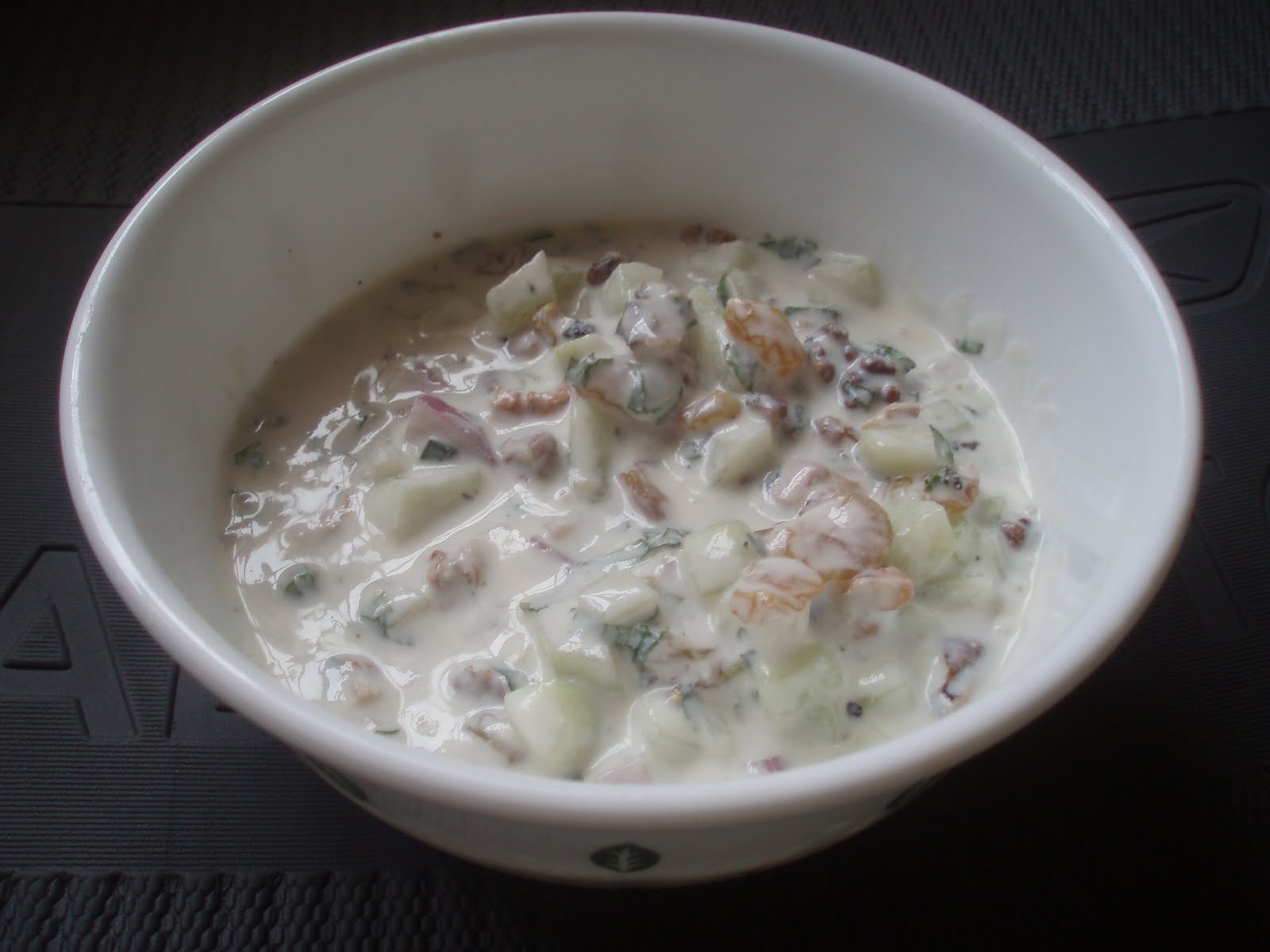

And yes, I've started another tradition here - using my expensive, branded, and very impressionable (read 'not stain-proof'), ab stretch exercise mat as background for my pictures. What crazy traditions did you follow?

This post is off to Haalo who is hosting Weekend Herb Blogging this week, the event started by Kalyn.

Friday, January 15, 2010

As Nutty As Ever


My first ever blog post was about breakfast which could double up as dessert. It was a mixture of several nuts and dry fruits. I was inspired by something I saw in a boutique that positions itself as selling healthy food. All for a very high price tag, of course. Apart from the vegetarian protein that it offered, there would be the odd creepy-crawly in the pack, which I did not care for; neither did I care for the odd wheat pop and jaggery that was added to it.

One fine day, I bought all the ingredients necessary for this and made my own breakfast mix. I dry-roasted everything I bought (including the fruit), put it in a tin and then in the fridge. There were toasted sesame seeds, walnuts, raisins, dates, almonds. It was a very satisfying breakfast and used to satisfy my need for a non-oily beginning to the day. I would even have this for dessert if I couldn't ignore the call of the sweet tooth. It left me feeling very virtuous, if not thin. (With all that concentrated sugar in the dry fruit, it's a wonder I didn't gain weight.) The sesame seed would add a nice, nutty feel and the curds the right amount of tang.

This post went ignored for a long, long time (about a week, actually) - My parents tried to comment on it but they couldn't get through, and my father said make sure the curds aren't sour. My first ever comment was on the second post. "Bring on more crazies," it said, and that's exactly what I've been doing these last few years.

Thanks to Jaya's repost event, I get a chance to resurrect that post, and redeem the picture with a better one. The breakfast (I had it for lunch, actually) in this picture is a many-layered affair of cashews, flaked almond and pistachio, raisins and a couple of apricots and curds. I haven't had this in a while, but thanks to this post, might make a batch again.

Monday, August 18, 2008

Variety Is The Spice ...

Flavours of the desert, I thought romantically, wondering whether it would make a nice opening line for this post. And the desert came to me indeed, in the form of grit and sand that I found myself chewing mid-chapati-bite.
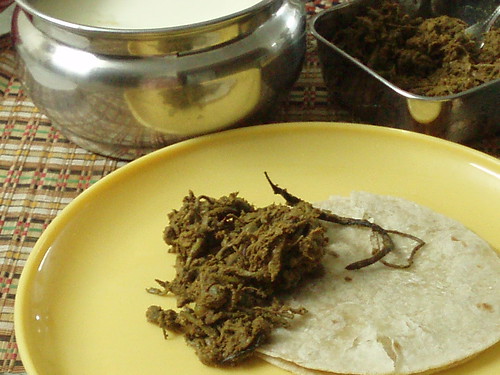
For a few weeks now, I'd been trying to visit a new shop near my place that promised "different foods", but managed to visit it only last week. It had the usual different foods but what set it apart were the ker (on the right) and sangri (on the left), both dry, desert vegetables that I've not seen sold anywhere else, and two or three different kinds of kokum. In a rare moment of self-control, I let go of the kokum and bought just the ker and sangri. And then scrabbled frantically among my many cookbooks for Tarla Dalal's Rajasthan Cookbook.


I didn't know if I had amchur with me - there was a hazy memory of it being somewhere in the cavernous pit that's my kitchen shelf but after a week of reluctance, convenience vs moral dilemma (why can't I just buy another pack of amchur, why should I look for it), I finally dragged the stool up to the shelf, got on to it and peered into the dark recesses, only to find the packet right in the front, in foil pouch nicely bound with rubber band.

Then I shot off a mail to the hostess, asking her whether amchur would be considered a spice and when she replied in the affirmative, I went ahead with this dish.

But.

After two days of ker sangri-from-the-fridge, I've come to the conclusion that the spice in my preparation was more asafoetida than amchur. Well, this morning there was some amchur, but this evening, I could taste only the asafoetida. As I use neither that often, amchur even less than asafoetida, I've decided I will enter the Think Spice event with both. Well, there's a third spice - red chilli powder - that this dish celebrates (oh yes, it causes tears) but I'm going to recommend lesser.

You need:

1 tablespoon ker
1 cup sangri
1/2 tsp turmeric powder/haldi
3 tsp chilli powder
2 tsp coriander/dhania powder
1-1/2 tsp amchur/dry mango powder
1 tsp sultanas/kismis
salt to taste

For the tempering

2 Kashmiri chillies (I used 1 ordinary red chilli)
1/4 tsp ajwain/carom seeds
1/4 tsp asafoetida/hing
3 tbsp oil

Pressure cook the ker, sangri and salt with 2-1/2 cups of water. Let the cooker hiss thrice.

Let cool, then drain the water and add the rest of the ingredients. Mix well.

For the tempering, heat the oil in a pan and add all the ingredients in that list. When it crackles, pour it over the ker sangri mixture. Mix well and cook for a few minutes. Serve hot with puris, parathas or missi rotis.

I don't think my mushy ker sangri is the real McCoy so I have kindly linked to this.

Here's another recipe with sangri

I liked my ker sangri with a dollop of curds/yoghurt - I found it too intensely dry/dusty-flavoured otherwise - at present, I can't describe it any better.

It did mellow with age.

And for the authentic experience, please have it with homemade rotis, unlike me, whose rotis came from a plastic pack and were warmed in the MW!

This goes to Think Spice's anniversary event.

Valli and I have been in touch regarding some fund-raising for her helper's daughter, Lakshmi, who has a severe heart condition and needs surgery to correct it. You can find the details here, please do your mite.


Friday, June 27, 2008

Not Unholy Combinations

My grandmother, who brought us up, would serve us food which, only much later, I realised, was not the norm. If I was offered milk at someone else's home, I would wrinkle my nose at the smell or taste because it contained sugar, and I grew up thinking tomato sauce was the traditional accompaniment to crisp-edged ootappams. (Naturally, I thought tomato sauce was Indian in origin.) Neither would my grandmother offer salt when curds was served.

Though the main breakfast was traditional, the accompaniments were not. Coconut chutney was rarely served with anything - rava upma was accompanied by some slices of lime or mango pickle, semiya upma with fresh ginger chutney, idli with various spice powders or other chutneys (one's here), dosa with lime pickle - so for me it's really no fun to go in for South Indian food and find myself stuck with coconut chutney and sambar. When we had chapatis for breakfast, thick, well browned, square and well fried, they were accompanied by a sweet and sour onion gravy made with jaggery and tamarind. I don't think we were familiar with the word kurma. My grandfather would eat his chapati with a fried egg, sunny side up, dipping pieces of the chapati in the runny yolk - not something I've done or see myself doing. And pesarattu was never accompanied by upma, its traditional mate.

Though my aunt says they were familiar with it, we were never served poori with sugar. Nor upma, nor idli. Nothing was served with sugar, in fact, and I didn't see this in anybody else's house, either, until I went to college and joined the hostel, in a different State. I was both repelled and fascinated when I saw all conceivable manner of tiffins being downed with sugar, chapatis with jam (which I took to; only, the hostel chapatis were so bad, even jam couldn't redeem them) and bread with pickle (good, a favourite midnight snack). I even spread green chilli pickle on Marie biscuits and made a snack/meal of them at times - they are a great combination but I'm not sure that green chilli pickle is available any more. I guess the only sugary breakfast we had at home was what we called toast - of the French variety. Of course, I thought that was Indian too. No wonder very few of my friends and classmates knew about it.

What unusual combinations are you fond of?

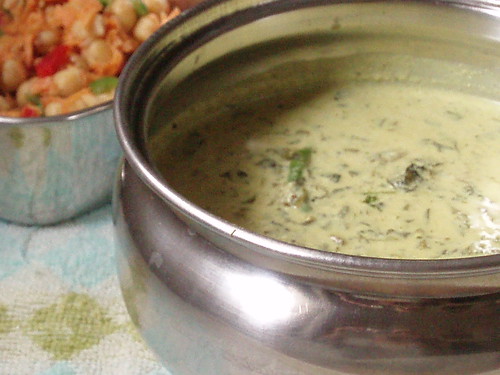
It's funny how what we take for granted at home is completely alien to others. Peanut chutney was never, ever made at home; it's so common in others'. Eggplant is combined with milk and curds in some homes, not so in mine. And I did not notice the amaranth-curds combination till recently in a relative's home, which I took to instantly. I am used to a lot of curd-based dishes with different vegetables, but none with greens. I don't often remember to make this but when I do, I always ask myself why I forget - it's so good. I was flipping through the pages of Cooking At Home With Pedatha recently and was reminded of it. This version is less elaborate than hers and doesn't contain the coconut or the daal that she included in the recipe.


Here's the recipe:
Curds/yoghurt: 3 cups, well churned
Amaranth/thotakoora: Chopped, 2 cups
Tamarind pulp: 1 tbsp
Turmeric: 1/2 tsp
Green chilli: 1, slit
Curry leaves: A few
Dry ginger powder: 1-2 tsp
Oil: 1 tsp
Salt: to taste


Grind to a fine paste
Coriander: 1/4 cup
Green chillies: 2

Tempering
Mustard seeds: 1 tbsp
Red chillies: 4, stems removed, broken into two

In a pan, heat the oil and pop the mustard. Lower the flame and add the red chillies.

As they turn colour, add the amaranth. Cover and simmer till well done, stirring now and then.

Add the turmeric, curry leaves, chilli powder and tamarind pulp. Cook for a few more minutes.

Turn off the heat and stir in the curds.

Chill, and enjoy!

This is going off to Siri for her Frozen Yoghurt event.

Tuesday, May 20, 2008

The Maximum Convexity of the Butt

Is this the maximum convexity of your butt?” she questioned, holding measuring tape around such named part.
“Eh?” was my response.
“Is this the maximum convexity of your butt?” she repeated.
I confessed I did not understand. (Physics (and Chem, and Maths) left me scarred and I gave up ‘convex’ and ‘concave’ soon as I left school, and hearing those words after all these years set off those familiar, unwelcome palpitations.)
“I mean, is this where your butt is the most … how to put it, standing out?” she said.
“Judge for yourself,” I said, turning away to give her a better view.

I didn’t make up that question – those were her exact words. I was in the gym, an agonised weightwatcher going back to those confines after a break of more than six months. Other than the fact that most of me is at its maximum convex now, what struck me was how a simple question was rendered rather baffling because it was put across so bookishly.

People seem to have forgotten simple English, methinks. The need to appear oh so smart and polished, business-like and tech-savvy, and Westernised, too, is what drives this painful turn of phrase.

The other day, I got an e-mail from someone from whom I needed information, saying, “Get in touch with so-and-so – he will give you a good download.” Really?
And then there was the person who called and asked if he could “have access” to so-and-so. As if so-and-so was a vault and you could turn a key in his back and open him up!
There are the publicists who urge you to meet so-and-so “just for a relationship meeting, Madam” – their way of saying that it’s just a preliminary meeting, and that there are no expectations lurking anywhere. And the newbie, fresh out of college, who obviously had not mastered how, when and where to say “Fair enough.” To everything I said, he kept saying “Fairly good” with a wise and understanding expression on his face and never was I more tempted to correct a total stranger!

Rant over, I now focus on a recipe that hasn’t got much to do with any maximum convexity, unless you drench it in ghee and bury it in a mound of rice to get rid of the sting.

But before that, some acknowledgements. The blog header you’re seeing is courtesy Sandeepa. Thank You, Sandeepa.

Then, Nirmala gave this blog the Yummy Blog Award and Kalai gave me the You Make My Day award. Thank you both.

Now the Yummy Blog Award mandates that I reveal the desserts I like the most. Here they are:

Angoori Rabdi (At a restaurant, as part of a Gujarati thali)

Bread pudding (my own, that’s right, no humility!)

Khubani ka Meetha with cream, in a Hyderabad restaurant

One grandma’s laddu, another’s palatalikalu

Panna cotta with vanilla bean

Then, Lavi tagged me for a meme – I told her I’d do a truncated version. Here goes:

Last movie you saw in a theatre
Taare Zameen Par

What book(s) are you reading?
A Prisoner of Birth

Favourite board game
Scrabble

Favourite smells
Lavender, vetiver, jasmine, herbal soap

Favourite sounds
Birds chirping in the morning

Worst feeling in the world
Anxiety

First thing I think of when I wake
Did I have to wake up already?

Storms – cool or scary?
A nuisance, at the very least

Favourite drink?
Lime-ginger

Finish the statement – If I had the time, I would …
Look for ways to spend it!

One nice thing about the person who sent it to you.
She has big, beautiful eyes.

Morning person or night owl?
Night owl.

Eggs over easy or sunny side up?
Over easy

Favourite pie?
Apple

Favourite ice-cream
Vanilla choco-chip

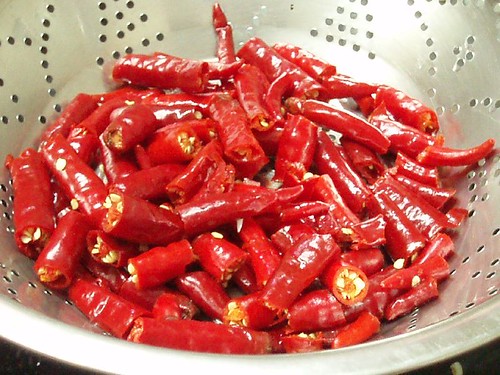
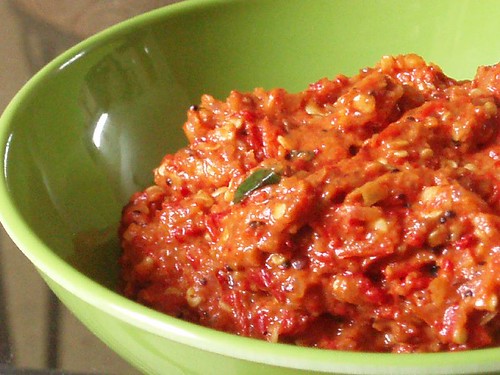
The recipe I have today is a fiery and simple one. I received a present of ripe red chillies and didn’t know what to do with them for two weeks. Finally, I used them for a chutney.


Ripe red chillies: 200-250 gm, chopped
White onions (or any colour): 3, quartered or cut into eight pieces each
Tamarind – lime-sized (Wet in a little water much ahead, no need to soak it in a lot of water)
Salt, to taste
Garlic – 5-6 cloves, skinned

Tempering
Mustard seed – 1-1/2 tsp
Cumin seed – 1 tsp
Hulled, husked and split urad/black gram dal – 2 tsp
Curry leaves – a few
Oil – 2 tsp

Heat oil, temper with the black gram. As it begins to turn brown, add the mustard, cumin and curry leaves.

When they pop and the gram turns a nutty brown, add the chillies, garlic and onion. Fry them till they become glossy and onions become translucent.

Cool, add salt, tamarind and grind in a mixer. Beware, it’s really hot.


For a variation, you can mix a bit of this well with some curds/yoghurt, temper this again and eat it with rice or use it for idlis, dosas and the like.

I have since been enlightened about how chillis and raspberries belong to the same family, so this is my submission to Dee for AFAM-Raspberry.

Saturday, May 10, 2008

Reliving Rajasthan

A train journey of over two days, sights to remember for a lifetime: Brown earth, bright yellow fields of mustard; a tableau of camels placidly bobbing alongside turbaned masters; peacocks, tails sweeping and brilliant; women in the brightest clothes; spicy samosas and tea in earthen cups at stops along the way; a nip in the air; and then ker sangri for dinner at aunt’s place; bales of block-printed fabric; daal-baati churma in a busy part of town; peacocks freely wandering in and out of houses, even in the midst of a bustling neighbourhood; tourists gasping with amazement and delight as a guide lights a candle in a room full of tiny mirrors; the horror and tears shed over Roop Kanwar ...

When Padmaja announced RCI-Rajasthan, it was time for me to dig out Tarla Dalal’s Rajasthani cookbook from the innards of my bookshelves and look for an unusual recipe to highlight. The gravy base is a traditional Rajasthani one of curds and chickpea flour (Bengal gram flour/besan), but what struck me was the addition of red chana, which the author describes as whole red gram.


Now I’m not sure if this is the same as kala chana or black chana, having never seen anything labeled red chana before (but red gram is Bengal gram, I know), I used the black chana, which is actually a reddish brown, for this dish.

This dish is also called Chane Jaisalmer Ke (a city I did not visit, incidentally) and traditionally served with missi roti but goes well with rice or bajra rotis, the author recommends. A cupful or two sans either rice or roti makes for a filling meal, as I discovered.

Black chana/chickpeas, soaked overnight and drained
Cumin seed – ½ tsp
Mustard seed – ¼ tsp
Bay leaves – 2
Red chillies, whole – 4
Asafoetida – 1/8 tsp
Dry ginger powder/sonth – ¾ tsp
Green chilli – 2, slit
(The author recommends 1 tsp of ginger-green chilli paste but I didn’t have fresh ginger on hand.)
Red chilli powder – 1 tsp
Turmeric – ¼ tsp
Curds/yoghurt, beaten – 1 cup
Bengal gram flour/besan – 2 tsp
Chopped coriander – 4 tbsp
Oil – 1 tbsp
Salt to taste

In a pressure cooker, heat the oil, temper with the cumin and mustard, bay leaves, red chillies and asafetida.

When the seeds pop, add the black chana, ginger powder, green chillies, red chilli powder, turmeric, salt and 2 cups of water. Pressure cook for about 2-3 whistles till the channa is cooked. Wait for the pressure to escape.

(The chana will take considerably longer if you’re not using a pressure cooker – you can follow the same sequence even with a pan or a wok.)

Whisk the curds and the flour together. Add it to the cooked chana and bring to a boil stirring continuously. Simmer for 5 minutes.

Serve hot, garnished with coriander.

My observation – the gravy was rather watery, despite the flour, and despite my boiling it down for a while. I’m not sure what the consistency is meant to be. Tasty, anyhow!

Friday, March 28, 2008

In a Pearing Hurry!

My creation for AFAM-Pears looked like sludge, though a rather pinky, pretty version, and it held great literary possibilities for my blog. The dramatic sentence that was supposed to be the opening line of this post crumpled and withered under the pressures of the day, and I had reckoned without that great leveler and humbler – the Internet.

The Net seems to beat you to every smart, original thing you wanted to say or write or cook up. If Slush can be something edible, so can sludge, I told myself, thinking it was a sentence with great potential that would develop during the day. Sludge, I thought, was my creation, the name, at least, but Google ‘Sludge Recipe’, and voila, there’s a multitude leaping out at you.


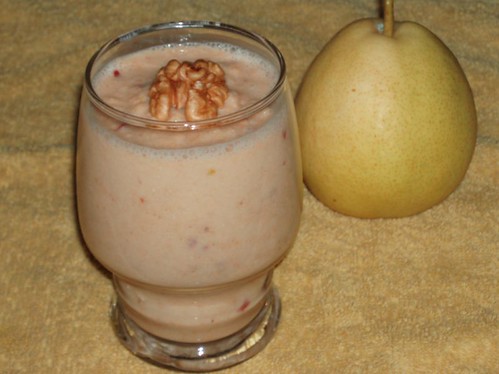
This was intended to be a pear-apple-oats-and more smoothie for breakfast but I was too lazy to reach for the oats, so I cored a pear and an apple and whizzed them in the mixer with four tablespoons of curds/yoghurt and a spoon of honey.

Once I tasted it, I decided it needed more texture and added a few broken walnuts to it. (I didn't whiz it then - the broken walnuts stayed whole, if you know what I mean.)

Then I photographed it for a while.

Then I slurped it up with a spoon.

Friday, December 21, 2007

A recipe and a reminder

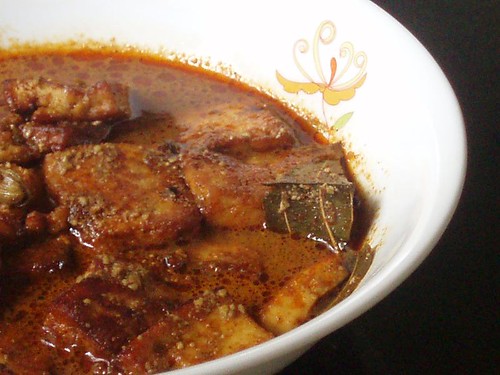
Remind me to never, ever fry paneer. I never do, even when it's recommended, but did that in the interests of authenticity as I make Kashmiri dishes so rarely, but it just made the entire thing rubbery even though I kept it soaked in some water.

Even a half measure like shallow-frying it robbed it of its texture, something The Spouse demonstrated long ago. But the gravy was quite a scorcher if you could discount the oily blobs that overran it. This is my third Grindless Gravy for the event, and it just makes the deadline. What's happening with your entries? If they're sitting in your drafts, please rush them as the deadline ends today.


On to the recipe now, adapted from The Pleasures of Kashmiri Cookery by Anu Wakhlu.

Cottage Cheese/Paneer - 500 gm, cut into 3-cm squares.
Red Chilli Powder - 1 tbsp
Aniseed Powder - 1 tbsp
Ginger Powder/Sonth - 1/2 tbsp
Curds/Yoghurt - 2 tbsp, beaten
Black Cardamom/Badi Elaichi - 2
Regular Cardamom (Green) - 2
Cloves - 3
Peppercorns - 2-3
Bay leaves - 2-3
Oil - 2 tbsp
Water - 2 cups
Salt - to taste

In a pan, heat the oil. Add the red chilli powder and a little water and heat till bright red.

Add the beaten curds and fry for a few minutes. Add all the spices and salt and mix well.

Add 2 cups of water and let it boil.

Add the cottage cheese pieces and cover and cook on a slow fire for about 20 minutes till the gravy thickens.

According to the book, the paneer has to be deep-fried beforehand. Also, once the curry is done, it's finished off with a splash of ghee and shahjeera (caraway) for garnish - I only shallow-fried the paneer, which was bad enough, and didn't have the ghee so didn't use that, or the shahjeera.

PS: Anita has a tip on frying paneer in the comments, take a look.

Saturday, October 27, 2007

Lessons from a Spud


It’s funny how some pretty common dishes escape your notice. Even now, despite the blogs. You think you’ve invented, innovated, tweaked, customized but there always seems to be a post somewhere that’s beaten you to it. Not that it’s a race, but that oh so slight sense of the smug rapidly melts away as a search throws up at least 20 variations in the first few pages.

I did that with a beetroot chutney. I saw my friend’s grandmother make it and marveled at her inventiveness. A few years later, it emerged from my mixer and uploaded itself on to my computer. Waiting for its moment in the sun, it found itself among a rash … er … slew of beetroot chutneys that populated the blogs in close succession. As this blog has often told whomsoever it may concern, it will only carry recipes that the writer finds unusual or unprecedented – that doesn’t exclude those that are a discovery to her but routine to others – but it’s no fun when they abound.

So why is she posting this confessionist, self-deprecating piece? Obviously, she’s never been on Oprah, let alone a chat show, but could that be all? Or is it that she slaved over this photo as well, decorated it with borders and scripts and was pleased with the result. Bad enough that it didn’t have the mild, mellow taste she expected it would have. Worse that it tasted like some other chutney altogether. Then why?

For one, with her avowed intention of not wasting anymore, and in her perpetual quest for novelty, she put it to use which she thought was rather a first. That’s one reason – if you have too much mashed potato left over, this is one solution.

Second, though she didn’t like the texture, or the combination, others did. And let it sit in the fridge till they finished every soured blob of it.

Third, because this is a blog not just about the victoires and the histoires but about a slice of life as well.

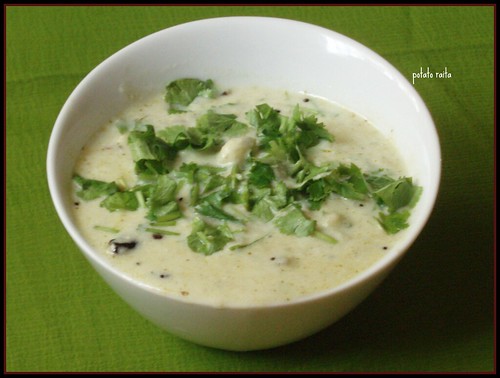
And, of course, it’s been ages, or it feels like ages, since she’s posted something on her blog. So here’s to the humble, humbling, potato raita.

Potato, boiled and mashed: 1, big
Curds/yoghurt: 1-2 cups, beaten (go by the amount of mashed potato, and whether you want a runny raita or a thick one)
Mustard seed: 1 tsp
Cumin seed: ½ tsp
Salt, to taste
Coriander, chopped: A little, to garnish
Savoury mint chutney, Indian style: 1 tsp (optional)
Oil: 1 tsp

Mix the mashed potato with the mint chutney.

Add it to the curds.

Season with the salt.

Heat the oil, pop the mustard and then the cumin. Add this to the curds.

Garnish with the coriander.

Another raita recipe here.

This goes to Weekend Herb Blogging hosted this week by Pille of Nami-Nami.

Sunday, July 29, 2007

Sunshine, And A Bird

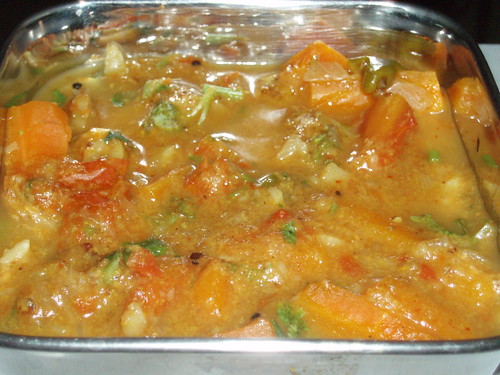
I didn’t really intend to post this dish, considering it was just a variation of this, but a few stray photos made me decide otherwise. The colour was so pleasing - all orange and yellow, just like the pictures and photos we see of sunshine - I couldn’t let it go.


Here’s how you make it:

Baby potatoes, scrubbed, halved – 200 gm
Curds/Yoghurt – 1 cup (and a little more, if you want)
Carrots (tiny, scrawny) – 5, cut into eighths
Ginger – garlic paste: 1 tbsp
Onion – 1 big, chopped
Tomato – 2 medium, quartered
Red chilli powder – 1 tsp
Turmeric – ½ a tsp
Salt – to taste
Bay leaves – 2
Garam masala/Curry powder – 1 -2 tsp
Coriander/cilantro – to garnish

Beat the curds. Mix potatoes, carrots, curds, salt, ginger-garlic paste, onion, chilli and turmeric. Let it keep for an hour.

Then, heat half a cup of water in the pressure cooker/pan. Add tomatoes and bay leaves. Cook till the tomatoes are soft.

Add the potato mixture, close the pressure cooker, and once the steam emerges from the vent, put the weight on it. After it hisses once, put it on simmer and cook for about 10 minutes.

*The cooker will hiss a couple of times but don’t switch it off in a hurry. (For those using pans, I would recommend a little more water and simmering the dish with a lid on.)

Once the steam escapes on its own (without you fiddling with the weight), remove the weight, check the consistency of the gravy and cook down till it’s as thick as you like.
*You can crush a few pieces of the potato in the gravy to thicken it.

Finally, add the curry powder. Check the seasoning and adjust it to your taste.

Finish off with a garnish of coriander leaves. Goes well with rice and breads.

This dish had a mildly sweetish taste, maybe from a combination of the fresh curds, the onion and the carrot. I didn’t intend it to, but there it was! Neither The Spouse nor The Cousin found any proof in it of them being guinea pigs in an oil-free experiment but simply lapped it up!

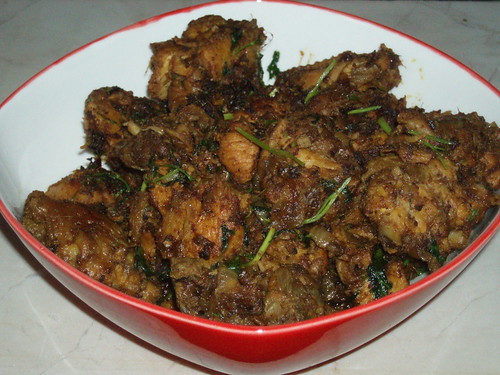
For the non-vegetarians, there’s a bonus in today’s post. It’s Herby Fried Chicken! You can use green chillies, coriander and mint or just the two herbs or just coriander without the green chillies, or just the mint, or … well, you get the drift.


Chicken, cut into medium-sized pieces – 1 kilo
Onions – 3 big, chopped
Coriander/cilantro – chopped, 1 cup
Ginger-garlic paste – 2 tbsp
Salt, to taste
Turmeric – 1 tsp
Chilli powder – 1-1/2 tsp
Garam masala/curry powder – 2 tsp
Oil – 2 tbsp

Smear the chicken pieces with the ginger-garlic paste, salt, chilli powder and 1 tsp of curry powder.

Place the chicken in a pan and boil it – you won’t need to add any water, but if you fear it will stick to the pan, you can add some.

Halfway through the boiling, start frying the onion in another pan, on a slow fire. Let them brown.

Add the chillies and some of the herbs now, if you’re using them.

Once the chicken’s boiled (it took about 15 minutes) and there’s no water left in it, transfer it to the other pan containing the onion. (Of course, the onion have to have fried well by now, and it’s still a slow fire.)

Mix the chicken and onion well, fry for a few minutes and leave it alone, just checking now and then to see that it doesn’t burn. The chicken gets darker and crispier the longer it stays.

Finish off with a sprinkling of the rest of the herbs, the rest of the curry powder, stir once more and take it off the heat. The crisped onions and herbs make a great mix with the rice but in one of those quirky twists of taste, The Spouse likes to savour this with tomato sauce!

I’m sending these dishes off to Kalyn’s Weekend Herb Blogging, hosted this week by Anna of Anna’s Cool Finds.

Sunday, April 22, 2007

No Couch Potato This!


It was a shot in the dark. I vaguely remember reading somewhere or someone telling me that you could marinate potatoes in curds/yoghurt and fry them later so when I found some nice-looking spuds in the store, I brought them home as they held out the promise of lasting long. Well, that was not to be, as they started sprouting no sooner than they went into the storeroom so last night found me scrubbing and peeling and dicing rather than turning into the couch potato that I love to be at that time of the day!

Potatoes processed, I marinated them in a mixture of curds and spice powders, stuck them in the fridge and went off to the Land of Nod. This morning found the marinade had become pale yellow buttermilk (well, that’s the consistency) – though it looked pretty, I was rather dismayed because I had no clue how to use it in the stir-fry I’d planned these potatoes for, until the Spouse said we could use it in the lamb he was cooking for lunch.

I acquiesced, but as things progressed, knew it wouldn’t gel with that dish as it already had gravy of its own. By this time, I had picked the potatoes out of the marinade, stir-fried them on high heat, then turned it down to simmer, covered them and softened them. I hated the idea of pouring the marinade down the drain so in sheer desperation, I poured the marinade into the potatoes and let it take its own course!

And wonder of wonders! The curds did not disintegrate into a million particles as usual but went on to thicken ever so slightly into gravy of the perfect consistency that I’ve only ever seen in other people’s homes! What an accomplishment!

Here’s how you go about it:

Potatoes – 500 gm, peeled, diced into 1-inch pieces
Mustard powder – 1-1/2 tsp
Cumin/jeera powder – 1 tsp
Coriander powder – 1 tsp
Chilli powder – 1/2-1 tsp
Turmeric – a pinch
Salt – to taste
Curds/yoghurt – 1 cup
Oil – 2 tbsp

Beat the curds, add the spices. Add it to the potatoes, marinate overnight in the refrigerator.

Pick the potatoes out of the marinade. Reserve marinade.

In a pan, heat the oil, stir fry potatoes on high. Turn heat down to simmer mode, cover and let the potatoes cook till half done – they should yield when you try to cut through, but grudgingly, not too easily.

Then add the marinade, mix, and cover the dish again. All through, make sure the dish is only simmering, never on high or even moderate heat.

I'm sending this off to Kalyn's Weekend Herb Blogging hosted this week by Sher of What Did You Eat.


Check for done-ness and turn off the fire. Enjoy!

Thursday, April 05, 2007

Rai-ta!


I like 'punny' headlines and give them a fair bit of thought. Though I'd been racking my brains since morning to think up a witty title for this raita, I didn't realise the pun was staring me in the face. For my dish in this post is a mustard raita, and in Hindi and possibly certain other languages, mustard is known as 'rai'.

Well, actually it's a tomato raita but the predominant flavour is that of mustard. The idea struck me when I visited a supermarket that stocked hulled, split mustard and methi, rarities in a South Indian kitchen. The methi met its inevitable fate of infestation and dustbin before I could get myself to explore what to do with it but the mustard lent itself beautifully to this unusual raita.

So without further ado, here's the recipe, it's pretty fluid, experiment with whatever vegetables you want, proportions too. I've tried this with cucumber and grated carrot as well. Be warned, though, that it can be pretty pungent.

2-3 tomatoes, chopped
1-1/2 cups curds/yoghurt
1-2 tsp of split mustard
A pinch of salt
1 or 1/2 of a green chilli, chopped, de-seeded if you like

Beat the curds, season with salt, mustard, add the green chilli and vegetable. Let it rest for a while, chilled if you like. Consume! This tastes great by itself but will probably go well with a mild rice preparation or even a bland variety of bread.

Sunday, November 26, 2006

A Random Chicken and ... Ohmigourd!


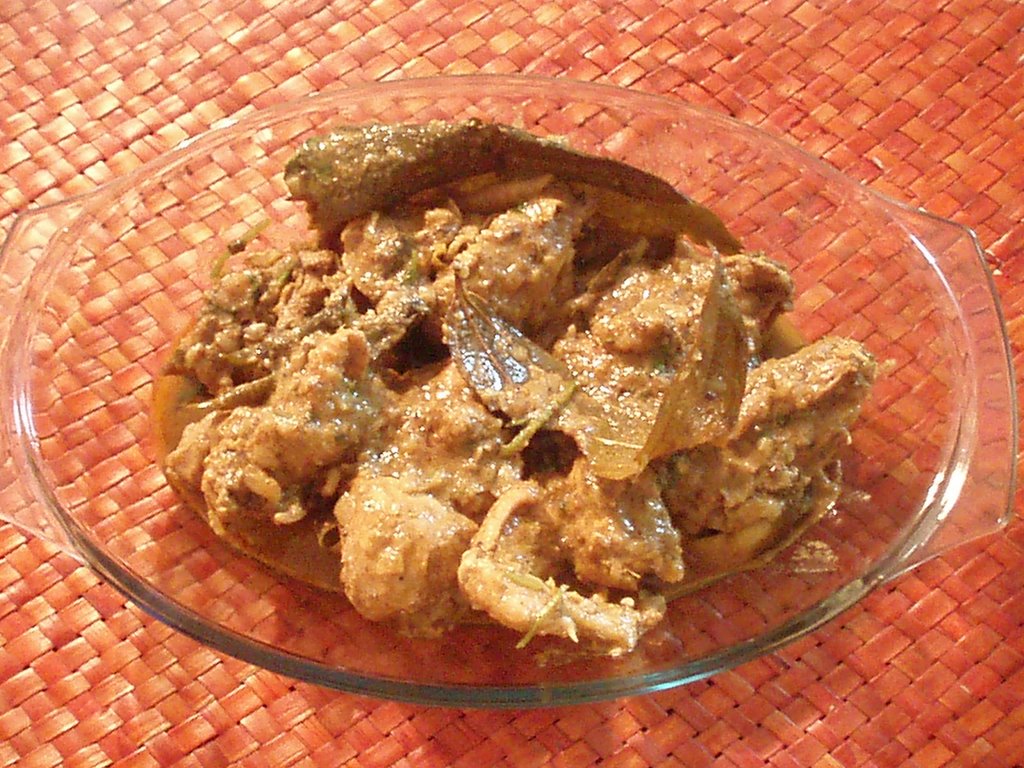
This chicken was an afterthought. It’s been ages since we summoned up the energy to buy and cook any meat at home — it involves a long, smelly, unhygienic and fly-ridden wait at the butcher’s, and the only time we have is Sunday mornings. Go a little late and you have to come back empty-handed. However, having found it in our weekly shopping expedition all nice and wrapped up sans the usual puddles and sticky splotches of bloody ooze on the shelves of the chiller (another big put-off), we bought it and turned it into one of the tastiest chicken curries we’ve ever made. Now I know how to make a South Indian ‘military’ hotel-type chicken curry – it may not be the exact recipe, I may not ever make it again, but it smelt just like it and I know how to do it, isn’t it thrilling? All those days of wondering why we never ever get that rich brown colour, that thick gravy, that flavour – well, all will be revealed soon!
(For those who don’t know what a military hotel is, it’s the term used in South India (in North too?) by a non-vegetarian hotel to distinguish itself from a meatless one – probably because of the belief that soldiers in the army eat a lot of meat everyday to gain and keep up their strength. It also serves very well to keep vegetarians from straying into its precincts!)

I’ve called it Random because I just threw in whatever I had by way of marinade, there was no recipe and the measures were slapdash:
Two ladles of fresh curds
Two fat pinches of turmeric
A tablespoon of ginger-garlic paste
Some Sambaar kaaram (a chilli powder mix with garlic, salt and coriander, NOT to be mistaken for saambaar podi/powder)
A really hefty pinch of curry powder/garam masala
Some more salt and coriander powder
I mixed in the marinade really well and sat the whole thing in the refrigerator for about three hours.

Siesta over, here’s what you need to do:
Chop two onions
Slit three green chillies (one of mine had turned a ripe red)
Fry them in three tbsps of oil
Throw in some leftover mint leaves (mine were 10 days old) and a few coriander leaves/cilantro
Add a couple of bay leaves
Fry this till all of it wilts
Then put in the chicken with the marinade, pour a little more water and cook covered on medium fire. Throw in a fistful of curry leaves, stir. (Voila, this is what gives it that military hotel taste!) Keep turning every five or seven minutes. Check the chicken for ‘doneness’, seasoning and add some more curry powder at the end. Simmer longer if you want a thicker gravy. Sprinkle with chopped coriander leaves. Soft, hot rice is a good accompaniment. Truly a lip-smacking, tasty dish which leaves your home fragrant for the rest of the day!
The other one is an old favourite which comes with its own story – read about it further down!


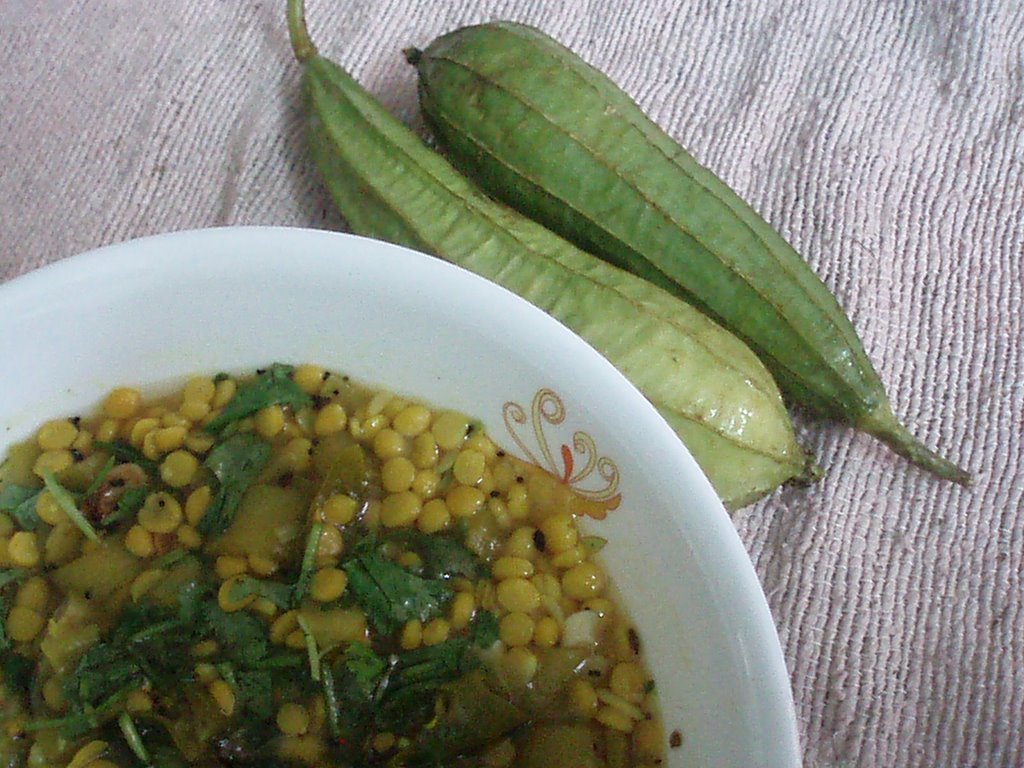
Funny how I forgot this dish existed and was a great favourite with me when my Grandmom was cooking! I recently saw a post on Masala Magic for Beerakaaya Pappu made with toor daal but as I said in my comment there, this was one daal that escaped our home, and the homes of others I knew. We made many others, though – with tomato, raw mango, a variety of greens, dosakaaya (cucumber/melon cucumber, as it was called in one of these blogs), vaakkaaya (sour little purple-green berries) …
Many days later, however, I suddenly remembered this dish. And I know why Beerakaya Pappu sounded unusual to me – we didn’t call our version by that name, but with an extra detail added – Beerakaaya Senagapappu, for the Bengal gram/yellow lentil that went into it. I remember Gran cooking a huge quantity of this and once even freezing it; for two or three days in a row, she would take this speckled green-and-yellow dish sparkling with ice out of the freezer, ladle a few servings into another dish, heat it and serve it.
I wasn’t interested in cooking then, and I couldn’t find the recipe in any book that I have now, but found one for ridge gourd with toor daal that promised to emulate the consistency of this old favourite. Only, it didn’t turn out as great as my Gran’s. This one used tamarind, I’m not sure hers did.

Here's how:

Ridge gourd/Beerakaya, diced – 250 gm
Bengal gram/yellow lentil/channa daal – 1 cup
Onion, chopped – 1
Tamarind – Lime-sized
Green chillies, slit – 6
Chilli powder – to taste, but half a tsp would do
Turmeric – a pinch
Salt

For the tempering:
Mustard seed – 1 tsp
Jeera/Cumin – ½ tsp
Black gram/split urad daal/minapa pappu – 1 tsp
Garlic, squished under the knife – 4-5 cloves
Dry, red chillies – a couple
Curry leaves – a few
Coriander leaves/cilantro, chopped – a fistful
Oil – 1-2 tsps

Soak the daal in water for a couple of hours, then cook with some water – it has to hold its shape. Then put in the ridge gourd, onion, green chillies, salt, turmeric and chilli powder and cook for another 5 minutes. Extract the juice from the tamarind, add it to the pot and cook some more. Or you can cook it in a pressure cooker/pan from the beginning but use the weight only at this stage. After one hiss, take it off the fire. Wait for the pressure to come down on its own. Don’t force the weight open, it’s dangerous.
In a small frying pan, heat the oil, splutter mustard, cumin and black gram, then the garlic, then the red chillies and curry leaves. Make sure it doesn’t burn and blacken. Pour this into the daal, garnish with coriander leaves. Serve with rice or even puris/chapathis. As you like it!
Tags:

Thursday, September 14, 2006

Nutty Beginnings!

Hi, my food blog's finally cooking! I thought about the name for days and it came to me in a flash, then I got caught up with work and a holiday and then with several thoughts about what I should feature in the first post. I wasn't inspired to write about the everyday food I was making either because most of it was turning out brown, thanks to a certain masala I got from my wanderings last week. And everyday brown is such an uninspiring colour, and I wasn't sure it would reproduce well on the blog either!
So, here's a very simple, no-fuss breakfast I sometimes have and like to recommend - curds/yoghurt with nuts and dry fruit! It can double up as dessert as well, with a sprinkle of sugar or jaggery if you have a sweet tooth. And you can add any dry fruit you want - the dish in the picture contains raisins, walnuts and toasted sesame seed but other breakfasts have seen a mix of dates (makes it really sweet), pista nuts, almonds, cashews, peanuts, maybe even a slow splash of honey, though I've never tried that. My folks have a mixture of honey, ripe bananas and curds for dessert in a silver bowl; indulgent, but not for me. I tried it with a bit of nutmeg for a touch of the exotic, still think this nutty creation's better. There are no proportions, though I find it tastier when the nuts don't swamp the curds.
Bon appetit!