Showing posts with label WHB. Show all posts

Sunday, October 16, 2011

Tasty Solutions To A Hairy Tale

Coriander and mango-ginger chutney - don't you love the colour?

Idiyappam with shallots and mango-ginger

To go from really short hair to hair that's just 2-3 inches longer is an endeavour fraught with impatience, irritation, heat, sweat, rubber bands, clips and such paraphernalia one hasn't used in a while. Enough is enough, I told myself, a good stylist will not whine about the non-growth, but they did. I walked out of one salon as the smile on the stylist drooped but stayed put in the second because frustration took over - and, of course, the stylist there marketed it (my hair - to me) better. It really isn't that much longer, he said, acquiescing to my request to 'give me more volume at the top but retain the length' and doing none of that (or so it seemed). He spent a few minutes, charged a lot and I came away looking and feeling just as I had earlier. Just a lot poorer.

My friend, who came over to drop off a macaroni-spinach-paneer creation yesterday, exhorted me not to give in to frustration. "It's only going to get cooler. Grow it, grow it, he's cut off just half an inch anyway," she said. So for now I've abandoned the thought of cutting my hair after six weeks, and will probably only cut it six months later. I have been looking at various Web sites to find out how to make hair grow faster and one of them has some really kinky suggestions, including grinding up birth control pills and mixing them up with some shampoo, and trimming the tips of your hair each month during a waxing crescent moon.

In the face of such exotica, bizarrerie or whatever you may call it, I'd rather fall back on my own innovativeness for hair growth. Which includes grinding up some oh-so-good for health good old greens and a cup of mango-ginger into a chutney.

Mango-ginger, cut

I love mango-ginger (go here for another picture) and how it smells all mangoey and summery, but haven't used it with much variation, so I'm glad I came up with this recipe one night after coming home to dosa batter and no accompaniment.

Mango-ginger, sliced: 1 cup
Coriander: About a handful
Curry leaves: About a fistful
Green chillies: 2
Peanuts: Less than a fistful ***
Oil: 2 tsp

Heat the oil and fry the mango-ginger for about 6-8 mins on a low flame.

Add the coriander, curry leaves and green chillies and fry for a couple of minutes more.

Grind with the peanuts and just a little splash of water.

*** I only added the peanuts to give the chutney some body. The amount I used did not affect the taste but next time I would use more coriander and curry leaves and not use the peanuts at all.

The other discovery I've made recently is idiyappam. Yeah, yeah, I know it's been around for ages, just not in my home or in my consciousness. The abovementioned friend had me over to lunch a couple of weeks ago and that's when I learnt idiyappams could be crumbled and tossed with tomatoes and onions. I did that for a couple of weeks. It's a very convenient and simple thing to make if your grocer stocks ready-made idiyappam. (A friend tells me I can do this with the rice sevai/noodles that one finds in stores - I haven't tried it.) When I brought the mango-ginger home, I tossed the idiyappam with some minced shallots and grated mango-ginger. I resisted the temptation to add lime and was glad I resisted.

Idiyappam, broken up: 2-2.5 cups
Oil: 2-3 tsp
Mango-ginger, grated: 1.5 tsp
Shallots, minced: 10
Green chilli, chopped: 1
Mustard seed: 1/2 tsp
Turmeric: 1/2 - 3/4 tsp
Water: A little
Salt

Heat the oil and temper it with the mustard seed.

Add the shallots, chilli and the mango-ginger and fry for 3 minutes.

Add the idiyappam and the turmeric, moisten with a little water.

Mix carefully. Taste it (the idiyappam already contains some salt, and add salt accordingly.) Let the flavours meld on low heat for a few minutes and then turn off the heat.

This post if off to Cinzia at Cindystar who's hosting Kalyn's WHB.

Saturday, September 03, 2011

Salad Days, Green in Judgement, Hot in Chilli*


You're not an original!" screamed the Internet back at Sra.

"Oh, alright, alright," said Sra, sullenly. "How many other crazed foodies do you think would call their dish cucumber noodles? Well, quite a few, it looks like," she muttered, teetering on the edge of a sour soliloquy, pausing to wonder if they had also tempered olive oil with red chillies and garlic and seasoned it with zatar, and all this only after adding some zucchini noodles to the cucumber.

And that, dear audience, is exactly what I did.

Peeled three tired old cucumbers and again peeled their flesh into strips - these are what I - and several other foodies - call noodles. Did the same with one tired old zucchini which hid its fatigue very well. (Tired meant that I had to discard quite a few bits.)

Chopped up an onion and added it to the above.

Heated a splash of extra-virgin olive oil and tempered it with two red chillies and two cloves of garlic

Added about 2 tsp of zatar, a splash of red wine vinegar and some salt

Tossed it all together in a bowl and let it rest an hour or two until dinner.

Then I tasted it and discovered it was one chilli too hot for comfort. And I'm no wimp when it comes to chillies.

But I ate it up anyway because no one else would - there were two other diners - and adding some dal to the salad reduced the heat.

You could do that too. It's also my tried-and-tested substitute for rice in rice-and-dal - I've done it before. You needn't peel the cucumber into strips for that, though, just cut it up regular.

And my favourite use for zatar is to use it on baked potatoes.


*I'm no Cleopatra, so I hope Shakespeare will at least forgive me if not appreciate me for twisting his words this way ...

Wednesday, March 30, 2011

LessWord Wednesday

These are 200 gm of baby bittergourds, slit, boiled with some salt in 1/4 cup of tamarind extract diluted with more water till just tender.

They are then drained, and fried in 1-3 spoons of oil. Then removed, after which, saute some 2 spoons of chilli powder (or a mix of it with coriander + cumin + garlic + curry leaf) in the same oil and add the bittergourds back to the pan and mix. All this on the lowest flame.

Crusty-tender-hot-seed-y bittergourds are ready!

This post goes off to Susan of The Well-Seasoned Cook who's hosting Weekend Herb Blogging now run by Haalo and created by Kalyn.

Thursday, February 24, 2011

How Green is Your Upma?


I'm not one of those who wrinkle their noses in disgust and whose faces take on a scornful expression when upma is mentioned. Most people I know dislike it. I don't eat it a lot myself for various reasons but I do like it.

As is normal with me, there is a box full of semolina in my pantry though I don't recall why I bought it. I do recall roasting it right away and storing it, which is why I didn't see any of the fine creepy-crawlies that generally populate semolina stored for long.

I was in a contrary and subversive (or so I like to think) mood this morning and decided to make the usually white upma green. I had all the accoutrements - green beans, green peas, green curry leaves' powder, and I set about making it. I wasn't disappointed.

Roughly, this is how I made it:

I chopped up a fist-sized onion and two green chillies

I microwaved a cup of chopped green beans and an equal amount of peas till they were three-fourths done, about three and two minutes each.

I heated about two spoons of oil, tempered it with a teaspoon each of mustard and urad dal/hulled, split black gram.

Then I fried the onion till pink. And then I added the green chillies and vegetables, sauteed them for a minute.

Then I added two big spoons of curry leaf powder and salt. For more information on curry leaf, you can go here.

Then I added water - I intended to use four cups but I was so carried away by the brainwave (of the green upma - rendered oh so fibrous and healthy) that I probably added only two.

Only after adding two cups of semolina to the boiling water, I realised I had goofed, so I hurriedly added a random amount, but you, you do as I say, i.e., add four cups of water.

Then I prayed like anything to get the semolina to soften.

My prayers were answered.

I thanked God and immediately ate some of it.


I'm sending this off to Simona who's hosting WHB this week, administered by Haalo and created by Kalyn.

Thursday, February 17, 2011

Mixed Vegetable Kachri


Scene1

Spouse, Sra having dinner

Spouse: Uncle just didn't like this dish, you know, he found it too sour, but I loved it, of course, because I love sour stuff.

Sra: Hmm.

Scene 2

Dinner next day

Spouse: Hey, there's brinjal (eggplant/aubergine) in this!
Sra: No, there isn't.
Spouse: Come on, I can see the pulp, all squishy.
Sra: Yes, it's there.

Spouse, Sra continue with their dinner

And so there was, the brinjal pulp. But it wasn't any ploy to get the Spouse to eat something-that-he-doesn't-which-is-good-for-him, just a way to include more vegetables into a mixed vegetable dish and include him in the process of cleaning it out faster!

Most of the vegetables are stuff that the Spouse won't even deign to look at when their identity is clear - yellow pumpkin, beans of the country variety, small gourds further cut up, you get the picture ... It did have something the Spouse took a liking to, though - kachri powder from my recent trip to Rajasthan.


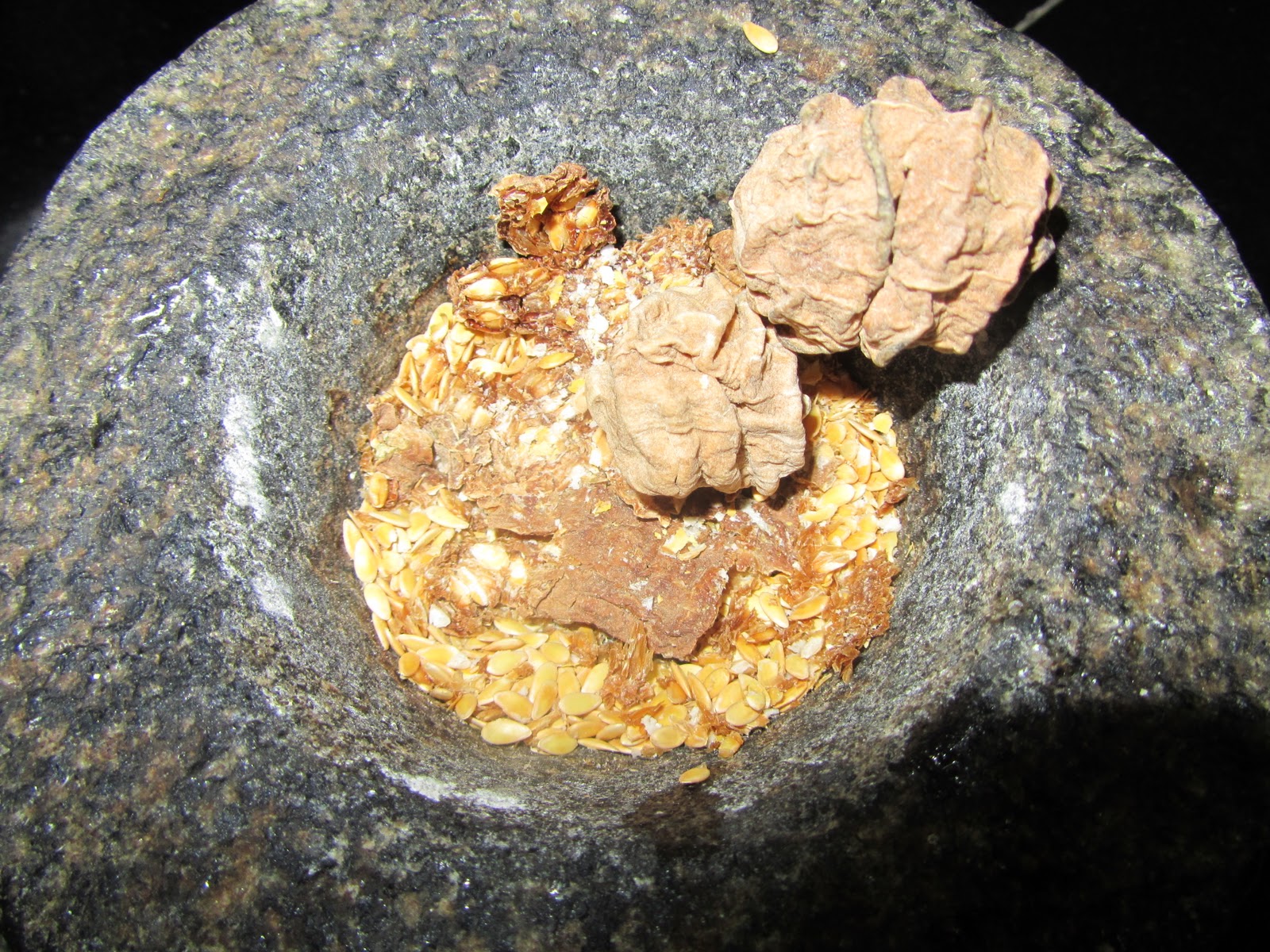
See that wrinkly little thing there, looking like a bleached walnut, a crumpled dead leaf? It's actually a gourd itself, like a small, tiny watermelon. My friends and I visited the market near our hotel in Jaipur at about 8 p.m specifically for this - I bought about half a kilo of the fresh ones and during the vegetable seller's patient description of how it could be used in a chutney, lost patience but kept nodding, so naturally, I did not know what to do with it when I got back home. More frustratingly, peeling it didn't help - it depleted the gourd of three-fourths of its substance and I was left with very little to use - the peel was quite tough and took much of the flesh with it!


I probably didn't know how to do it right, because there's a picture below from my trip that shows that someone in Rajasthan got it right!

I put it in dal and it tasted very much like dosakai (melon cucumber). But I got tired of it after two dals and gave it away. Perhaps there is a recipe for fresh kachri chutney on the Net, but none else.


Then I launched into the dried kachri that I had bought in Jaisalmer (which is also where I saw the fresh kachri first). It needs to be pounded to powder, a chore I somehow enjoy. Perhaps pervertedly, but I do.

I used Tarla Dalal's recipe at first but two tries on, I've developed my own mix of vegetables with whatever's available, and spices. In doing so, I'm probably violating some hallowed rule about amounts and proportions or ratio of hard to soft vegetables and non-includables, but that makes it an ever-original, and evergreen recipe, doesn't it, with surprises at every stage! Most recently, I used a combination of yellow pumpkin, brinjal, dondakai/tendli/coccinea and I forget what else, with this recipe.

What you need:

Assorted vegetables, chopped - to make 3-4 cups
Garlic: 5-10 cloves, minced (optional)
Shah jeera/jeera/caraway/cumin seed: 1 tsp
Plain chilli powder/mixed up chilli powder: 1-2 tsp (I use the latter)
Turmeric powder: 1 tsp
Tomato: 2-3, diced
Kachri powder: 1 tbsp
Lime juice: To taste
Salt: To taste
Oil: 2-3 spoons

Temper heated oil with the cumin/caraway and the garlic.

Add the vegetables and the turmeric and chilli powder and mix well. Cover and cook on a slow flame till the vegetables are cooked, ensuring they aren't sticking to the bottom of the pan.

Add the tomato and salt and cook for a few more minutes.

Add the lime juice and kachri, and mix well.

This is a very popular meat tenderizer. See a pretty picture and more info here.

And here's more info from Tarla Dalal herself!

Quite a few recipes mention amchur as a substitute and I've made similar curries with both - the tastes are very, very different.

Here's a post that attracted my attention and two more discoveries and experiences of kachri from the blog world.

This post goes off to Graziana of Erbe in Cucina who's hosting Weekend Herb Blogging now run by Haalo and created by Kalyn.

Friday, February 04, 2011

Not Quite Curd Rice


As you know, losing weight is one of my obsessions. And in pursuit of that, going around organic food stores in search of interesting things to eat and replace routine things with, my pastime.

That's how I came across amaranth seed (or rajgeera as it's known in Hindi) a year or two ago. The leaf (thotakura, in Telugu) is popular, I regularly use it with dal or by itself to make a stir-fry. It looked like tiny globules of dry yeast, stuffed into plastic packs with cooking instructions typed on white paper. I took a pack home, and quite liked it. I learnt this was the same grain that the rajgeera chikki (brittle) or laddu was made with. There's also popped amaranth sold in these organic stores - the suggested use is as breakfast cereal, but I'm coming around to realising microwaved idlis, eggs and fruit are my kind of breakfast. (I'm the kind who buys idli batter off a shelf but today, there were reports in the newspapers that 55 per cent of the readymade batter brands, including four well-known ones, were contaminated with fecal matter, so I won't be buying it for a while, I'm sure.)

Back to amaranth, though! The pack suggested it could be eaten with dal and curds/yoghurt, just like rice. I don't remember what I did with the majority of the pack, but I do remember how good the curds mixed with the cooked seed tasted, and that's what I made today, with my second pack of amaranth.

I have a small problem, though - this current pack has some mud/stones in it, and I don't quite know how to rinse this teensy-weensy grain efficiently - in a way that the mud/stones are weeded out, but it's not too bad. Maybe I just got a badly done batch - as long as I don't find out it's fecally contaminated, I'll be fine.

Quite the wonder food it seems to be, with no gluten, high levels of iron and amino acids not often found in grains:

"Amaranth seed is high in protein (15-18%) and contains respectable amounts of lysine and methionine, two essential amino acids that are not frequently found in grains. It is high in fiber and contains calcium, iron, potassium, phosphorus, and vitamins A and C.

The fiber content of amaranth is three times that of wheat and its iron content, five times more than wheat. It contains two times more calcium than milk. Using amaranth in combination with wheat, corn or brown rice results in a complete protein as high in food value as fish, red meat or poultry."
Read more here.

There's a lot of information about amaranth seed on the Internet, it sounds good and healthy though I have only done a little bit of reading about it, and I may eat it more often to give my meals more variety - and, of course, hopefully consume fewer calories or a better class of calories in the process. Here's a curd preparation with it - tastes like the traditional curd rice in my South Indian home, with the seed giving it the touch of the exotic!

Here are the seeds.

Close up, they look big, but they aren't.

This is a cup of amaranth seed after being cooked in 1.5 cups of water brought to the boil 
and simmered until absorbed.

Up close, doesn't look very appetising, does it?

But persevere.

Take about two ladles of curds/plain yoghurt and add it to a cup of cooked amaranth seed. Add some salt to taste.

Temper a spoon of hot oil with a little bit of mustard seed, cumin, red and green chilli, chopped and broken up, and some curry leaves.

Garnish with coriander.


Enjoy!

Somewhere along the way, I forgot I knew that amaranth was also a colour. Did you know?

I'm sending this off to Weekend Herb Blogging hosted this week by Janet of Taste Space, administered by Haalo and created by Kalyn.

Wednesday, May 12, 2010

Salad Days

It's often the very small things in life that can make you feel wildly happy.

(Ah yes, the armchair philosopher has begun spouting Wisdom for the Week - but do humour her - just as you would a rather green-behind-the ears DJ on a music channel proffering love and life advice - it's just some home-spun experience extrapolated to a world, nay, universal view ...)

Well, yes, how would you account for the fact that one of life's happiest moments, perhaps the only one, was when she discovered how to get dry yeast to work?

And the second happiest moment, just a few days ago, when she discovered her favourite brand of frozen (cleaned and deveined) prawns had made a comeback?

And the third happiest moment was when she discovered that she had refrigerated the avocado at the perfectly ripe moment so much so that when she cut through it, there was a paragon of green, glossy, buttery perfection in her hand?

Out went plans for an avocado, papaya, tomato salsa, in came what we shall now call a 'shrimp' and avocado salad. By the way, the difference between a shrimp and a prawn is this. (But I didn't go through it because it seemed boring, and who knows, my prawns might have been shrimp anyway!)

(It's a synthesis of various recipes I found on the Net, try as I might, I cannot zero in on the two I synthesised.)


But enough of meandering, here's how this impressing-friends salad is made!

Shrimp 500 gm
Oil: 1 tbsp
Red chilli powder: 1 tsp
Garlic, minced: 2 tsp
Salt, a pinch

Avocado: One, diced (sprinkle lime juice all over immediately to prevent browning)
Hard-boiled eggs: 3, cubed
Tomatoes, de-seeded and julienned: 1 cup
Carrots, julienned: 1 cup

Dressing
Olive oil: 3 tbsp
Lime juice: 4 tbsp
Sesame oil: 1 tbsp
Salt
Crushed black pepper

Stir fry the shrimp/prawns in the oil with the ingredients for just 2 minutes.

Now add the tomatoes, eggs and carrots.

Whisk the dressing ingredients well and pour over the salad.

Mix well, but with a light hand so that the eggs don't disintegrate.

Chill.


This salad goes off to Marija of Palachinka, who's hosting Kalyn's WHB this week.

In other matters, the second edition of Chalks and Chopsticks, Aquadaze's idea, has rolled around and the Bong Mom is waiting for you to spin your yarns and send them to her. Go on, do that and delight all of us, yours truly is a co-host.

Friday, April 09, 2010

Of Lucky Escapes, Quinoa & The Past Week

The week started off with what was meant to be a spouse-pleasing biriyani, but the dustbin, not his stomach, became its receptacle instead.

Don't try to imitate the dum action by weighing down a light and unsteady lid with a heavy stone mortar and pestle. They will overturn the lid and fall inside the biriyani if you're lucky, otherwise spill the biriyani all over the stove and under the microwave, in which process you would burn your arms too.

I was lucky.

After fishing out the hot mortar and pestle from the hot biriyani and washing your arms to make sure the experience doesn't leave any scars, a most familiar fire and brimstone smell (well, not really, it smelt like well done kababs) tells you your biriyani is going going gone to hell anyway - that you should have trusted your gut instincts and added some water to the meat underneath the rice in the heavy-bottomed pan despite the instructions in the fancy cookbook.

Cook in its own steam? Hah!

It's a few days later and you remember having soaked some dried cranberries overnight a few days ago, forgotten that you drained and stored them in the fridge. You have an hour before work starts, why don't you set about making the salad as planned with quinoa, that wonder grain with all the eight essential amino acids, among other goodnesses?

Step 1: Retrieve the cranberries. Reach in, pluck that dish out and realise it was the milk after it spills all over the fridge and under. There's some on your feet too - rub it in for a free beauty treatment! Clean up the mess (the bonus is that the dust bunnies under the fridge come out).

Step 2: Set to making the salad on the dining table with the TV news on in front of you. Topple the basket of TV remotes over, fix all the loosened parts and leave it in the same precarious position.

Mince, chop, boil, grind.

Chill.

The salad, that is.

Meanwhile, YOU can go have the third bath of the hot, humid summer's day that it is, sit under the fan a while to try and calm and cool the tortured spirit and flesh and give thanks that bigger misfortune hasn't befallen you.

Get through the day thinking of this new, never-before-in-your-experience salad.


Here's the original recipe, or is it from here? (And below is how I made do.)

1 cup quinoa
2 cups water
4 tbsp honey
1 tsp finely chopped garlic
1 1/2 teaspoons minced green chillies
1/2 cup dry cranberries, soaked overnite, drained
Juice from 2 big limes
1 tbsp finely chopped fresh mint
1 tbsp finely chopped fresh coriander
1/4 cup finely chopped red onion
Salt to taste

Rinse quinoa several times. Boil water, add quinoa and simmer 20 minutes or until all liquid is absorbed. Let rest, cool a bit. Add some salt, fluff.

Meanwhile, combine half the honey, garlic and green chillies in a bowl.

Whiz the cranberries and remaining honey and lime juice in a mixer.

When quinoa has cooked and cooled a little, stir in both mixtures.

Add the mint, cilantro and red onion to the quinoa and mix thoroughly, but not with a heavy hand.

Chill.

This goes off to The Cabinet of Prof Kitty who's hosting Kalyn's WHB this week, now administered by Haalo.

Tuesday, November 03, 2009

An As-You-Like-It Curry

De-cluttering is as much about getting rid of unnecessary and surplus stock as it is about shedding undesirable fat. (Let's, for the moment, not talk about clearing the cobwebs in the mind.) Eating your way through your fridge and pantry is probably not the best way to achieve the latter objective, though it's a practical solution to the first. Donation is another, of course, but I want to eat most of what I have.

My resolve to clean out the cupboards began with the kitchen and ended at my computer - I've spent the past couple of weeks trying to eat my way healthily and steadily through my pantry and fridge, but the unceasing supply of nourishment got on my nerves and I ended up bingeing my way through it, neither making a dent in the supplies nor, naturally, cutting out the fat. The wardrobe and other storage spaces are waiting, impatiently.

De-cluttering can be so all consuming (I swear that pun just arranged itself as I was writing the sentence)! It weighs on your mind and enervates you just the way extra weight does - you want to do something about it but simply can't seem to summon up the will; then, disgusted, you attack the problem, but soon, a sense of futility takes over (it's the hard work, you see) and you go on a binge.

I don't know what the equivalent of a binge in terms of de-cluttering My Pictures on the computer is, but in food, a worse kind of binge is when you buy additional stuff to use up what you already have - say, flour, if you have too many eggs wobbling towards rottendom, or sago and extra milk, if you have too much sugar.


Taking myself firmly in hand, I called my favourite cause this morning and made an appointment with them for collection (now I can't not de-clutter); and then I made a completely as-you-like-it egg curry just to get rid of some stuff from the fridge. (Actually I'm lying - the onions got charred because I was inattentive and I had to throw them out and dream up this recipe.)

The amounts are completely arbitrary, all you need to have is some sense of proportion. (I don't.)

Eggs: 5-6, boiled, shelled, scored lightly

Grind to a paste with a little water the next three ingredients:

Coriander: Grab as much as you want
Mint: Same - grab as much as you can
Tomatoes: 5-6, halved

Seasoning: Salt, chilli powder, garam masala, turmeric - per taste
Oil: 1-2 tsp

In a large pan, heat the oil and saute the paste.

Season with all the ingredients and let it come to a boil.

Add the boiled eggs and simmer for a while or till the gravy thickens.

I imagine this gravy would taste good with potatoes, koftas, paneer and tofu too.

This goes to Haalo at Cook Almost Anything where Kalyn's Weekend Herb Blogging is being hosted this week.

Wednesday, August 19, 2009

'Shrooms With A View, Sage & Rosemary Too

Once, not long ago, I ranted about dry herbs here. I'm not about to eat crow (now that's another post) or my words, or even dried herbs, but as some of you pointed out in that post, dried rosemary is an exception, as I discovered today.

My aunt in the US, with whom I stayed in July, has several herbs in her garden - sage, rosemary, French tarragon, two kinds of basil, chives, mint and a few others. I would often pick a few leaves off the plants and pop them into my mouth, enjoying the fresh and spicy feel. When I was leaving, she picked some fresh sage for me, which held up rather spotlessly till today, and gave me her stash of dried sage and rosemary. A creative cook, she uses permutations and combinations of these herbs to flavour all her cooking, even Indian food, and I decided to do the same, though I did not employ any logic except that of the palate.

After years, I bought mushrooms recently and they blackened only a little bit after two days, unlike earlier when they would do so very rapidly. I also had two slabs of paneer/cottage cheese that needed to be used up fast so I decided to throw it all into a big stir-fry and flavour it with these herbs.


Here's what you need:

Onion: 1 big, thickly sliced
Button mushrooms: 2-3 cups, halved
Paneer/cottage cheese: 2-3 cups, cubed
Red chilli flakes: 1-2 tsp
Garlic: 10 cloves
Sage: 6-7 leaves
Olive oil: 2 tbsp + 1 tsp
Salt: To taste
Rosemary: A sprig or two

Grind the garlic, red chilli and half of the sage roughly with 1 tsp of olive oil - I did this with a stone pestle and mortar.

In a large wok, heat the olive oil and add the above ground mixture. Saute for a few seconds.

Now add the onions, saute for a minute on high flame, then the mushrooms and the cottage cheese.

Saute again for a minute, and add salt.

Lower flame.

The mushrooms give out some water, let this dry up but keep turning constantly so as not to burn the dish.

You can choose to let some oily juice remain - good to mop up with bread - or dry it completely.

Now crumble some dried rosemary over the top and mix it lightly. Serve.

This goes off to Weekend Herb Blogging, Kalyn's event, managed by Haalo and hosted this week by Prof Kitty at The Cabinet of Prof. Kitty.

Wednesday, December 17, 2008

Biriyani Turns Over A New Leaf


Every year, when Id comes around, a friend of the family sends over biriyani and other festive delights for us to consume. He usually calls to tell us not to cook anything for the day as the amounts he sends are huge. One year, the call hadn't come yet, and Dad, who was eagerly looking forward to it, got antsy.

This friend is my grandfather's friend. My grandfather's name ended in Rao. "How about we give our friend a reminder?" Dad suggested. "We call him, chant 'Pulao, pulao, X X Rao, Pulao pulao X X Rao' and hang up?" Naturally, that led to a lot of giggles, but happily, the friend called soon after and we had ourselves a feast as usual.

That was a very involved biriyani which spared no effort, I'm sure, but this biriyani/pulao that I made the other day was chosen for its no-fuss method. The inspiration came from another recipe which I will post and acknowledge as soon as I make it, but the tweaking I did with the herbs and spices is all mine.

Chicken: 500 gm (Vegetarian can subsitute chicken with potatoes, peas and carrots)
Basmati Rice: 550 gm (note the volume)

Curry leaves: A handful (Read more about curry leaves here)
Crushed peppercorns: 1.5 tbsp
Thick coconut milk: 200 ml
Water: 1/2 cup + twice the volume of the rice
Coriander powder: 1.5 tbsp
Turmeric powder: 1/4 tsp
Powdered cinnamon and cloves: 1/2 tsp each


Cinnamon sticks: 3
Cloves: 4
Marathi moggu, crushed a bit: 3
Whole pepper: 1.5 tsp
Ghee/Oil/Mix of both: 75 ml/4 tbsp
Salt to taste


Soak the rice for 10 minutes and strain.

Wash the chicken and set aside.

In a heavy bottomed pan or pressure cooker, heat the fat and fry the cinnamon, cloves, Marathi moggu and pepper.

Add powdered cinnamon and cloves.

Add coriander and turmeric powders and fry again for a couple of seconds.

Add the curry leaves and the chicken pieces, sauté well. When the chicken changes colour, add salt and crushed peppercorns.

Add the coconut milk plus the 1/2 cup of water and cook the chicken for a couple of minutes.

Now add enough water (If the rice came to 3 cups, add 6 cups of water)and allow it to boil.


Add rice. Cook till done after sealing the lid. In a pressure cooker, let it cook for 5 minutes on simmer after two or three whistles.


One eater said it was alright, but that it didn't taste of anything in particular.

Another liked it, but that the whole pepper interfered with the eating. I liked it for that very reason. And the fragrance imparted by the spices boiling in the coconut milk - that was Joy of Discovery.

Yet another, bless his kind soul, said it was tasty, and served himself twice.

I made a raita to go with it but it wasn't really necessary - I've never really felt the need for any accompaniment to biriyani, though that's not to say I don't like them. I even believe it robs the biriyani of its taste. Have any of you felt this way?

As I believe curry leaves in biriyani are unusual, and this would make a great main dish for Christmas or any other festival/event where biriyani or pulao could be the main attraction, I am sending this off to Kalyn's Weekend Herb Blogging, organised and hosted by Haalo.