Sunday, September 28, 2008

My Legume Love Affair & A Recipe


Come October, and I will be the month's guest host for the Fourth Helping of Susan's My Legume Love Affair. I am expecting to be inundated with entries for this popular event, so don't disappoint me, please.

Legumes must feature as the central ingredient in your entry. It could be any kind, sweet or savoury. In Susan's words, all cultures and courses are welcome.

The prize on offer from Susan is Not Your Mother's Slow Cooker Cookbook. Those who aren't bloggers are also invited to send recipes/photos; you will be included in the round-up and drawing. Family and friends are not eligible for the prize. Neither Susan nor I have any connection to the author of the book or its publishers.

The Instructions

Please post a new recipe or a newly posted one from your archives, linking to this announcement, and to Susan's post here, with the following details to me [srablogATgmailDOTcom] by October 31. Please say 'MLLA Entry' in the Subject field.

Name

Name and URL of Your Recipe Post

Location: Optional

Photo: Optional (400 X 300 or 300 X 400 depending on orientation. If your image is exactly square, fine tuning the dimensions to avoid distortion is encouraged while keeping in mind the general size requirement.)

Use of the logo above, designed by Susan, is optional.

I hope to post the round-up sometime during the first week of November. If I haven't acknowledged your entry either by mail or by comment in your blog, please check with me after three days to see if I've received it.

Now here's a recipe that makes use of legumes in a very creative way - this is an aunt's recipe and substitutes quite well for coconut or other nuts that come in handy when you want to make a gravy for meat or vegetables or paneer.


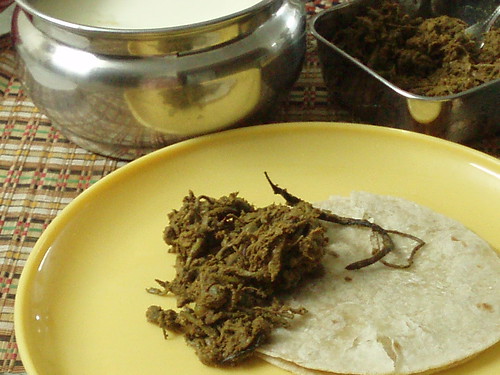
It uses green gram/mung dal sprouts as the base. I've used paneer to illustrate its use but my aunt uses it with chicken.


Ingredients

Green gram/mung dal sprouts: 2 cups
Curds/yoghurt: 1 cup
Green chilli: 1, chopped

Grind these three ingredients to a fine paste.

Onion: 1, minced
Tomato: 1, chopped fine
Green chilli: 1, slit/chopped
Oil: 2 tsp

Paneer/Indian cottage cheese: 200 gm or two big handfuls
Curds/yoghurt: 2 tsp
Ginger-garlic paste: 2 tsp
Red chilli powder: 1 tsp
Coriander powder: 1-2 tsp
Turmeric: 1/2 tsp
Salt: to taste
Coriander leaves, to garnish

Marinate paneer with the rest of the ingredients mentioned below it for 30 minutes.

In a pan, heat the oil. Saute the onion till it browns, add the chilli and fry it for a few seconds more.

Add the tomato and let it cook till it gets all soft - you can cover it and simmer it on a low flame.

Now add the paneer with its marinade, cover and let cook well - till the juices begin to dry up.

Now add the ground paste, mix it well and let it cook. It will begin to thicken very soon so keep adding a few teaspoons of water to let it achieve the consistency you like. The paste tends to smell a bit like batter initially so it's important to let it boil well.

Check for seasoning and remove from fire. Garnish with coriander leaves.

You can find the MLLA-Third Helping here, on Lucy's beautiful blog, Nourish Me.

Thursday, September 25, 2008

Eating Crow

If you think this is just an expression, I can prove you wrong. But more about that later. During graduation, I lived in a hostel where I got acquainted with a spectacularly indistinguishable world of cooked vegetables, weekly confections which called themselves apple cakes though there was nothing remotely apple about them except the shape, dreary meals that stuck to their weekly timetable with unfailing regularity and a weekly serving of crow.

You will well guess that I’m calling a poorly nourished specimen of chicken by that name, and you are right. A scrawny wing in a dreary brown gravy in a steel quarter plate would be waiting on the counter and despite the knowledge that there would be nothing more, that was something to look forward to every week. Sad, but true. It was also the day for floury, rather uncooked and tasteless chapattis, grated carrot (salad, in hindsight), some pea/chick pea curry, the sourest, thinnest buttermilk ever found on the face of this earth, and maybe it was the apple cake day as well, I don’t remember.

Good food was available only during a festival or event that was celebrated by the college, and those were pretty rare. Even then, those serving would be asked to go easy on the meat or the paneer so that everyone could have a little. Needless to say, those with robust appetites and even more robust expectations had to go to bed still hungry and unfulfilled.

So when it was time to move to another city and another hostel, both very different from the ones above, there wasn’t much to expect. In any case, I was too apprehensive about the rooms and the loos to worry about the food but happily, neither gave cause for complaint.

This new hostel was generous with the food. Not only was there more variety, there was taste too. And even though it followed a timetable, it didn’t seem so bad. Wednesday’s tomato rice and chips would cause a run on the mess, some reserving it in dabbas so that they could eat it later, watching a favourite programme on TV in the common room. Apart from the usual idli and dosa, there would be Maggi noodles and ketchup for breakfast, toast and jam, and I’m sure it was the real McCoy, because I would see tins and bottles of those brands being opened in the kitchen and brought out straight to the mess without a detour for dilution.

Of course, the mess bill was a good Rs 200 more than the previous hostel so they could afford to be generous. We also used to get a delicious vegetable pulao with coriander chutney. Chatting with my friend from the hostel a couple of years ago, I asked her what she made for lunch, and she said she’d made that chutney because she had liked it in the hostel. Another thing unusual we were dished out was the dal with bits of unpeeled potato in it.

However, all this good food was not without its blips. My tummy took a while to get used to it, and I took a while to get used to having tiffin for dinner - something that I hadn’t ever come across, but that wasn’t surprising, because I hadn’t lived in too many places.

Idlis and dosas for dinner seemed very strange, and so did the curd rice accompanying it. Once in a while, we would run off to the airport in our backyard to have the egg and chicken sandwiches available in the canteen there, and feel like we’d had something very special.

During exams, the cooks would brew kettles of sweet cardamom tea and leave them in the mess so we could stay awake to study - there were no touches like this in the previous hostel where it was lights out at a certain time and exams would give us light for a little longer only in the common room. Of course, some of the daring and enterprising ones would cover the vents and windows of their room with black paper and continue to use the lights, forcing Warden to come by and look for stray beams of light escaping from underneath the door.

What was your hostel food like? Did any of you like anything about it? Did you too eat crow?

Tuesday, September 23, 2008

Rooted To The Spot

My personal training classes at the gym have become just that - personal. More than I like. Every detail of what I've ingested is investigated and met with raised eyebrows, sober and solemn "Hmms..." and other trying-not-to-be despairing expressions. So when my passionate, desperate, young and charming trainer pointed to the weighing machine and pleaded with me to eat just fruit for dinner till I reached a certain weight, not brooking my arguments that it wouldn't be a real reflection of what I weighed, I reluctantly agreed. Neither she nor I are happy with my more than decent loss of inches, we want to see the kilos tumble away, and I don't want to be confronted with questions of how many grammes I've lost every day.

Now, dinner's my nemesis - contrary to all diet advice which says don't eat much at dinnertime, that's exactly what I do - I can easily forgo breakfast and lunch and not miss them but at the end of the day, I look forward to an unhurried dinner, a good book, a good DVD. An unhurried dinner also means a variety of good food and watermelon and apple alone do not a good dinner make.

As a via media between my trainer's desires and mine, and also to rescue some vegetables that have been lying around for a while, I concocted this salad.


My weight is still rooted to the spot, and my trainer's still pleading with me, so I make no claims to how healthy or filling or low-calorie it is (but it can't be, it's full of roots, and yeah, yeah, I've done the obligatory Googling for nutritional info).

It's an "As You Like It" salad, just add or subtract whatever you don't like.

Beetroots: 2, boiled, peeled, sliced
Turnips: 2, boiled, peeled, sliced
Capsicum/bell peppers: 2, diced

Dressing

Limes: Juice of 3
Garlic: 2 cloves, minced
Green chilli: 1, deseeded, minced
Oil: 1 tsp
Sugar: 1/2 tsp
Salt, to taste

Garnish

Sesame seed: 1 tbsp, toasted

In a bowl, place the lime juice, garlic, green chilli, sugar and salt. Mix and let it sit for a while, about 30 minutes.

In a larger bowl, place the vegetables and add the oil and dressing. Mix well but gently.

You can choose to strain the dressing too.

Garnish with toasted sesame seed. By mistake, I used cold-pressed gingelly (sesame) oil and the flavour was rather overpowering - I decided it needed some crunch to take my mind off the flavour and added the sesame seed, it was a good idea!

Wednesday, September 17, 2008

Okra, Tart, Sweet and Gravied!

Growing older makes me realise that many things I believed to be true about myself are not so, or are no longer so. Now, this is not the introduction to some ponderous, introspective spiel about myself and my life lessons but this past week, I discovered that I am not as lazy a cook as I thought myself to be.

A vertiginous Spouse confined to home resulted in both of us eating both lunch and dinner at home. All this consumption led to the happy consequence of very few leftovers (which in their limited leftoverness only added to the variety on the table), as a result of which we cooked five days a week. And, I actually enjoyed it - I got to make traditional stuff I haven't in a long while, or traditional stuff that I failed at and gave up on earlier came out well because I paid it some more attention. (Oh, we still got stuff from the takeaway when we felt carnivorous or needed that little bit extra to liven up the day, but most of it was home food, most of which I am so enjoying re-discovering.)


Here's one such dish, the sweet and sour pulusu (tamarind-based gravy), that turned out really well both times I made it, once with plantain and once with ladies finger. It was all about discovering long-lost tastes - my grandmother used to make these often, our cook a little less often and me, rarely.

Here's the recipe:

Ladies' fingers/okra, wiped, topped and tailed and cut into 1 inch-long pieces: 1-1/2 cups/250 gm
Onion: 1, medium, chopped
Tomato: 1, medium, chopped fine
Tamarind: 4-5 one-inch strips, soaked in 1-1/2 cups of water
(Squish to extract the juice and discard the pulp)

Mustard seed: 1 tsp
Cumin seed: 1/2 tsp
Fenugreek: 1/4 tsp
Curry leaves: A sprig
Garlic: 2-3 cloves, crushed (Optional)
Oil: 1 + 1 tsp

Salt
Red chilli powder or Sambar powder: 1 or 1-1/2 tsp
Turmeric: 1/2 tsp
Jaggery: 2-3 tsp

In one tsp of oil, saute the ladies' fingers well, till there is no stringy goo left.

Keep them aside.

In a pan, heat the other tsp of oil, temper with mustard seed, cumin, garlic, curry leaves and fenugreek.

Add the onion and fry. Sweat it till it turns pink, at least.

Then add the tomato and the salt, turmeric and chilli/sambar powder.

Cover and cook on medium/low heat till mushy.

Add the tamarind juice, ladies' fingers and mix well. Bring it to a boil and let it thicken. Check for seasoning.

Just before removing it from the fire, add the jaggery and mix well.

Bon appetit!

Sunday, September 14, 2008

A Year Older


Your pet."

"No, my life. My OTHER life."

(She chuckles) "Yes, your secret, wicked, other self ..."

completes two years today.

******************************

"I forgot the birthday candles. I meant to get a couple."

"Oh, to light up the computer?" The hope in The Spouse's voice is hard to miss. I can still hear him laughing himself to sleep at his own joke. A pleasant bone of contention between us on account of the time I spend on it, blogging has brought me much joy, masked a few blues, and given me quite a few highs.

Much of what I want to say is here, in my first anniversary post. Thanks to all you folks - readers, fellow bloggers, family, friends, commenters, lurkers. (Won't you de-lurk just this once at least? Just for thrills, c'mon, be nice to the birthday girl! I especially would like to know who visits my blog regularly with searches for "Chef/Indian puking" and "Malayali Chechi Kerala".) A special thanks to all those bloggers who have deemed this blog/blogger worthy of an award/a mention, I truly appreciate them even if I haven't been able to put them up here.

I will let you go now, here's to more fun times together!

Wednesday, September 10, 2008

My Less Leguminous Affair

When I put up a picture of the meal I’d cooked for a friend recently, some of you asked me for the recipes. Most of them were standard and popular dishes, so I hesitated to put out yet another recipe for them but when I made one of them again a few days ago, I fell so in love with its looks that I have to extend the narcissism to my blog. I don't really like radish but the thin discs showing through the soup/stew looked nice and I had to take photographs. This is radish pappucharu, pappucharu (or pappu pulusu) being a lighter version of the sambar.


I could never get sambar right. A simple and standard dish that most can turn out in a jiffy eludes me. Any affection or unconcern that I may have had for it went out of the window once I came to sambar territory for a college education and joined the hostel.

Day in and day out, we would have sambar, with not too many different vegetables in it everyday. For six years, through three hostels in two different cities, there were very few days without sambar.

“Oh, it should be a breeze,” I thought, when I attempted to make sambar occasionally, for The Spouse, soon after I got my own kitchen. It wasn’t. Telling a friend had her coming over to teach me how to make sambar. It really did seem simple. The first few attempts were good - even I liked the sambar I made. Then I don’t know what happened - maybe I didn’t make it for a long time or whatever, I forgot her instructions and was back to square one.

I’ve decided I will no longer spend time trying to master it. Instead, I will make pappucharu which, as I discovered through a process of trial and error, is rather similar to what is made at home. I don’t know if any tiresome masalas are ground at home for this, I’m not bothered. I do know that this is what I like and this is what I’m comfortable with.

On with the recipe, then!

Toor dal/moong dal: ¾ cup (It’s more often made with toor dal rather than moong dal - I used moong for this)
Vegetables: 1.5-2 cups, chopped/sliced (Actually, go by instinct; You can use a single vegetable or a combination of a few, such as radish, bottle gourd, pumpkin white and yellow, carrot, onion***, tomato**** )
Tamarind: 3 strips, 1 inch in length, soaked in 2 cups of water for 30 minutes at least
Green chillies: 2
Red chilli powder: ½-1 tsp
Turmeric: ½ tsp
Coriander powder: 1 tsp (optional)
Salt, to taste

Oil: 1-2 tsp
Fenugreek seed: ¼ tsp
Cumin seed: ½ tsp
Mustard seed: 1 tsp
Curry leaf: A sprig or two
Garlic: 3-4 cloves, crushed
Dry red chillies: 2, torn up (optional)

Squeeze the tamarind in the water well and strain the juice.

Pour the water into a pressure cooker/pan (you can even make this without a pressure cooker), add the vegetables, the green chillies, the turmeric, coriander powder and the salt. Let it cook till it whistles once.

Empty the contents into another dish and in the same pressure cooker (so as not to use too many dishes), place the dal and immerse it in enough water till it’s just about soaked, just above the level of the dal. Pre-soaking the dal helps it cook faster.

The dal should be done in about two whistles, after which you can turn down the heat and simmer it for five minutes. Once you switch off the stove, let the pressure drop naturally and open it then.

Mash the dal with a masher or the back of a ladle. Add the tamarind juice-vegetable mixture to this and boil till it becomes all bubbly. Check for seasoning.

In a small wok, heat the oil. Splutter the mustard, then the cumin and the curry leaf and garlic. Add the red chillies. Then add the fenugreek and turn off the heat. Tip this into the pappucharu and cover it. You can garnish it with fresh coriander.

Best eaten with rice, and even with idli/dosa.

***Onion: Peel off a few layers if the onions are big, but let it remain bulbous.

****Tomato: It is recommended to use a smaller amount of tamarind if you’re using tomatoes but I find that only the country tomatoes are sour, the hybrids aren’t.

Pappucharu is a thick soup, more of water and less of lentils, while sambar is a much thicker preparation. Think of pappucharu as a rather transparent variety of sambar, and you’ll probably get the right consistency.

This goes off to My Legume Love Affair, being hosted by Lucy of Nourish Me for Susan of The Well-Seasoned Cook.

Wednesday, September 03, 2008

Hello From Home!

FestiveSeason's Greetings!


It's Vinayaka Chaturthi today but at home we kept it simpler than ever and there isn't much food to train the camera on, so here are some flowers instead!


I don't know what this is called but it looks like an orchid at close quarters. In reality, it's quite a small flower!


This creeper has followed us through the years, across homes. We were told the flower's name is Jooka Malli. It has a heady scent and always has some ants or other tiny insects running in and out.


Another of those nostalgic favourites that we don't seem to see in big cities anymore! The scent can perfume a room in minutes and give you a headache as well! It's growing wild and blooming in abundance in my aunt's house.


That's a small cluster of the orchid-like flower above.


This is a popular in many homes nowadays. I think of it as a modern flower because I didn't see this growing up, have only seen this in the last few years.


This pink hibiscus keeps the yellow and red ones company. As you can see, it's a beautiful, clear - and hot! - day.


I don't know what this is called either, but I loved the colour.

Friday, August 29, 2008

Stuffed! And Charred!

We once had a guest cook. She was with us only for a few weeks. She told me that in her community, known for some royal and other feudal entities, the use of copious amounts of oil proclaimed their status, and hence no one, rich or poor, would skimp on that.

The food made by cooks from that household (who would visit us on and off) was, for the most part, tasty, but literally dripping with oil or soaked in it. I would squeeze a fistful of food right in front of their eyes, make my point, take triumphant delight in their embarrassed smiles, and get on with the eating. The oil could have added to the taste, I don't really know, but their frying left a lot to be desired. Their stir fries of many vegetables would be charred black, beyond crisp, spices and other food matter coming off in black specks, and I would wonder what the point was.

Recently, I got hold of a recipe for stuffed brinjals (eggplant) from an aunt, and in a rare fit of unlaziness, decided to go the whole hog with the grinding of the paste, etc as I had all the ingredients. It called for grinding a handful of coriander and some spices, mixing them up with onions, stuffing the eggplants and frying them on a slow simmer - the result is a wonderfully stuffed and almost (but not quite) charred mixture that almost has me wanting to taste those stir fries to see if I had missed discovering something then.


Here's the recipe!

Small, round purple brinjals/eggplant: 1/4 kg or about 10-12
(Make a 'plus' (+) sign with the knife on the bald side of the brinjal and cut through, into four, but not so deep that the pieces separate. You should be able to hold them with the stalk. Drop into a bowl of salted water while you're doing the rest.)

Onion: 1, big, minced as fine as possible
Coriander leaves: 2 cups
Green chillies: 2, chopped
or
Red Chilli powder: 1 tsp
Garlic: 3-4 cloves
Ginger: 1/2-inch knob
Salt, to taste
Coriander powder: 1/2 - 1 tsp
Cumin powder: 1/2-1 tsp
Oil: 3-4 tsp

Mustard seed: 1/2 tsp
Cumin seed: 1/2 tsp
Urad dal/Split, hulled black gram: 1/2 tsp
Curry leaves: 6-8 (optional)

Without adding much water, grind the coriander, green chillies, garlic, ginger and other spices to a rough paste.

Mix this with the onion.

Stuff the brinjals with this mixture. Reserve the leftover paste.

In a pan (a non-stick works well for this), heat the oil, and once it's heated, turn the knob into 'Simmer' mode.

Season with mustard, cumin, curry leaf and black gram.

Place the brinjals. Pour any remaining mixture over them. Let sizzle for half a minute and cover.

Keep checking and turning the brinjals around, very, very gently. If you think it needs more oil, add a drop or two around each brinjal that seems to require it. Ensure they get cooked and soft on all sides - for signs of doneness, you can check the picture. It should be a bit squishy. And the mixture inside and outside the brinjals should be a crusty green-brown.

This is most delicious with soft, hot rice or fresh thick curds.

I'm sending this to Marta's event Fresh Produce of the Month being hosted by Simona of Briciole in September.


Tuesday, August 26, 2008

Egging You On

I've done a guest post for Paz of The Cooking Adventures of Chef Paz. You can read it here.

Sunday, August 24, 2008

Thaied & Tested

What is the main constituent of this dish? What does it look like to you?

Everything in it, except me, came out of a packet. What was supposed to be a quick meal turned out to be a rather gargantuan one, some of which is sitting in my fridge and has me wrestling with my conscience yet again - dustbin or digest?
As things turned out, this post is going to be a WHB special about how not to cook the main ingredient rather than how to. After three pages of Google results, I am no wiser, the deadline is closer and the host must be on her way from 'eager' to 'anxious' as she recalls my many promises about this entry. It's not as delicious as the Blossip (due credits to you and you for this term) we shared last week, but it's interesting, at least for the texture.

When I returned from my holiday in Thailand last December, I brought back three packets of dried mushrooms. Two rotted before I could use them, this held on. 'This' is silver ear mushroom, also known as tremella mushroom, snow fungus, white fungus, white jelly fungus or white tree fungus. I found it in a packaged soup that I had also brought from Thailand where it floated peacefully in the broth, light and hardly there.

Despite my blog being named for soup and the agonised weight watching that I talk about all the time, I am no soupie, so for me this had to go into something substantial. A packet of Pad Thai noodles that came with its own spice mix and some fresh tiger prawns seemed the apt companions for this packet.

I washed the mushrooms and soaked them in water, thinking I needed to do that - all the instructions, if any, on the packet were in Thai. That was my mistake - each mushroom, just a fistful in size, swelled to the size of a sunflower.

I tore them up into pieces and tossed them according to the instructions on the Pad Thai packet with the prawns and the noodles earlier softened in hot water, the spice mix. Then I garnished it with peanuts and coriander.

By evening, it had diminished in volume as the water ... uh ... evaporated. And lay there limp and unappetising in its dish. I ate it with gobs of chilli-tomato sauce to camouflage the bland and woody taste.

Now when I surfed the Net, I found out it's a great health and beauty aid, favoured by none less than "an imperial concubine" who used it for "facial and body maintenance". Read more about it here.

See more pictures here.

Monday, August 18, 2008

Variety Is The Spice ...

Flavours of the desert, I thought romantically, wondering whether it would make a nice opening line for this post. And the desert came to me indeed, in the form of grit and sand that I found myself chewing mid-chapati-bite.
For a few weeks now, I'd been trying to visit a new shop near my place that promised "different foods", but managed to visit it only last week. It had the usual different foods but what set it apart were the ker (on the right) and sangri (on the left), both dry, desert vegetables that I've not seen sold anywhere else, and two or three different kinds of kokum. In a rare moment of self-control, I let go of the kokum and bought just the ker and sangri. And then scrabbled frantically among my many cookbooks for Tarla Dalal's Rajasthan Cookbook.


I didn't know if I had amchur with me - there was a hazy memory of it being somewhere in the cavernous pit that's my kitchen shelf but after a week of reluctance, convenience vs moral dilemma (why can't I just buy another pack of amchur, why should I look for it), I finally dragged the stool up to the shelf, got on to it and peered into the dark recesses, only to find the packet right in the front, in foil pouch nicely bound with rubber band.

Then I shot off a mail to the hostess, asking her whether amchur would be considered a spice and when she replied in the affirmative, I went ahead with this dish.

But.

After two days of ker sangri-from-the-fridge, I've come to the conclusion that the spice in my preparation was more asafoetida than amchur. Well, this morning there was some amchur, but this evening, I could taste only the asafoetida. As I use neither that often, amchur even less than asafoetida, I've decided I will enter the Think Spice event with both. Well, there's a third spice - red chilli powder - that this dish celebrates (oh yes, it causes tears) but I'm going to recommend lesser.

You need:

1 tablespoon ker
1 cup sangri
1/2 tsp turmeric powder/haldi
3 tsp chilli powder
2 tsp coriander/dhania powder
1-1/2 tsp amchur/dry mango powder
1 tsp sultanas/kismis
salt to taste

For the tempering

2 Kashmiri chillies (I used 1 ordinary red chilli)
1/4 tsp ajwain/carom seeds
1/4 tsp asafoetida/hing
3 tbsp oil

Pressure cook the ker, sangri and salt with 2-1/2 cups of water. Let the cooker hiss thrice.

Let cool, then drain the water and add the rest of the ingredients. Mix well.

For the tempering, heat the oil in a pan and add all the ingredients in that list. When it crackles, pour it over the ker sangri mixture. Mix well and cook for a few minutes. Serve hot with puris, parathas or missi rotis.

I don't think my mushy ker sangri is the real McCoy so I have kindly linked to this.

Here's another recipe with sangri

I liked my ker sangri with a dollop of curds/yoghurt - I found it too intensely dry/dusty-flavoured otherwise - at present, I can't describe it any better.

It did mellow with age.

And for the authentic experience, please have it with homemade rotis, unlike me, whose rotis came from a plastic pack and were warmed in the MW!

This goes to Think Spice's anniversary event.

Valli and I have been in touch regarding some fund-raising for her helper's daughter, Lakshmi, who has a severe heart condition and needs surgery to correct it. You can find the details here, please do your mite.


Friday, August 15, 2008

Rajmah, Reconsidered

Kinder weather, a day well spent in the gym and at work, a little girl enveloped and tangled up in strings of plastic Indian tricolours which made me wish I carried my camera everywhere, and rajma that turned out creamy and tasty - these are the memories I will carry of today's Independence Day.

I've made rajma in the past but hadn't liked it much. I also especially didn't like the sad tomato gravy that went as the base; I especially hate the tomato skins that separate and float in triangular, rolled up bits in the gravy, so I gave it up altogether. .Recently, however, I started eating rajma again, but only in the form of a bean salad. When I soaked a cup of rajma last night for today's salad, I had a sudden change of heart - I'd been looking up leguminous recipes and this seemed to be calling out. And why not? I had all the ingredients at hand, and was ready to take up the challenge of rajma gravy afresh. The recipe is from Vimla Patil's book Indian Cuisine Dal Roti. I made adjustments in the quantities, not the method.

Rajmah (kidney beans): 1 cup, soaked for 12 hours
Onions: 1 large and 1 small, minced
Garlic paste: 1/2 tsp
Ginger paste: 3/4 tsp
Coriander powder: 1/2 tsp
Oil: 2 tsp (the recipe recommended ghee)
Tomatoes: 3 small ones, chopped up after skins are removed by blanching, either on stovetop or in MW
Green chilli: 1, chopped
Turmeric: 1/4 tsp
Salt to taste
Ghee: 1/2 tsp
Water: 1-2 cups

Drain the rajmah and wash it thoroughly. Place it in the pressure cooker and cover with water just a little above its level. Pressure cook rajmah for 30 minutes. After the first whistle, lower heat to 'simmer' and let it cook for 30 minutes. Do not remove from fire unless you are worried about it burning. After the 30 minutes, remove from the fire and let it cool down gradually.

In a pan, heat the oil and fry the minced onions.

Add the turmeric and coriander powders. Also the ginger, green chilli and garlic.

Keep stirring and add the chopped tomatoes and salt.

Add some water, cover and let it cook to a mush.

If it's drying out and not pulpy enough, add some more water.

When you think it's thick and mushy enough, add the kidney beans.

Cook till creamy and soft.

Add the half teaspoon of ghee to this and serve hot.

  • Notes: It is important to slow-cook the rajmah, and for that long - I don't remember cooking it this long earlier, no wonder I hadn't liked the results.
  • The tomatoes: It's a personal preference that I like them skinless in gravies - makes the gravies smoother.
  • And keep turning the gravy around - this mashes some of the beans and thickens the gravy further.
  • Adding that bit of ghee at the end made it all the more mellow. I hadn't ever done this before.

The South Indian that I am, I had assumed the traditional accompaniment to rajmah was rotis. As I found out just a couple of years ago, it's rice. I imagine it would taste great with a fine, scented variety such as Basmati but as I hadn't been particular and The Spouse had already made the rice, it was eaten with the everyday variety. It's going to frequent my table from now on!

This goes off to aid dear Susan's love affair with the legumes.

For a more comprehensive post on Rajmah (and instructions on how to cook it without a pressure cooker), go here.

Wednesday, August 13, 2008

Oranges 'n ...


Orange Tart: Not mine

Fabric accessory (fancy name for dupatta): Mine

Being sent to: Bee & Jai

Friday, August 08, 2008

Some Reading, and Some Drooling

When Jayashree tagged me to do this book meme, I decided to ignore the first rule - it requires me to pick up the nearest book. Well, the book nearest to me now has some pretty boring stuff in the fifth, sixth, seventh and eighth sentences on Pg 123 (methought it was a murder mystery; it turned out to be more of a romantic thriller - one pair of charismatic cops and one pair of charismatic suspects for nice balance), so I hunted for a book which I thought held more promise, but while the book is very interesting and funny, this extract doesn't say much about the book itself.

To recap, here are the rules for this meme:
Pick up the nearest book
Open to page 123
Find the 5th sentence
Post the next three sentences
Tag 5 people and acknowledge the person who tagged you.

Here's the extract:

The 5th sentence (which is a quote from another book): "If someone tell you an obviously untrue story, on the Continent you would remark, "You are a liar, Sir," and a dirty one at that."
"In England you just say "Oh, is that so?" Or "That's rather an unusual story, isn't it?"
Turned down for a job as a translator, for which he was completely unqualified, Mikes was told, "I am afraid your English is somewhat unorthodox." He found this hilarious.

The book: Talk to the Hand
Chapter: The Universal Eff-Off Reflex
Author: Lynne Truss, also known for the international bestseller Eats, Shoots & Leaves
Whom She's Quoting: George Mikes, How to be a Brit

I'm tagging Sig of Live to Eat
Jayashree of Spice and Curry
Pragyan of Sorisha
Sukanya of Hot and Sweet Bowl
and
Vidya of Tales Grandma Never Told and Hooked on Hobbies for this meme.


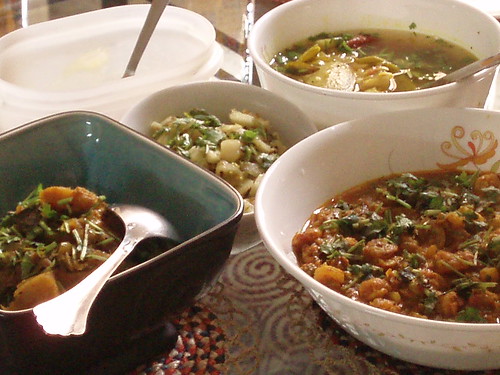
Till next week, here's some food for you to drool over - all very "homely items" made for my friend S who came over to spend a couple of hours, and who brought some really creamy and I think, vegan, Aloo Dum for us to eat. It's not visible but it's in the white plastic container at the back. The rest are pappu charu with bottlegourd, prawn curry, dosakaya pachadi and pumpkin curry with jaggery.

Tuesday, August 05, 2008

Of Cabbages & Things

The best thing about getting married, it seemed, was getting my own kitchen as the folks at home had never been happy about my cooking and baking pursuits.

Getting my own kitchen, however, did not mean anything fancy. We had a small, portable, one-burner stove and that was it. I had all my cookbooks, of course, and maybe it was during some festival or the other that I hit upon the idea of making something new and unusual to distribute to my kind neighbours.

Being the feminist that I was, I had prepared The Spouse to expect him to pull his weight in the house and that evening saw both of us kneading one kilo of maida (white flour) and some rawa (semolina), rolling it out, rolling it up, cutting it into bits and folding it all over again and pinning it with a clove, frying it in oil and dunking it in sugar syrup to make some confection called Lavang Latika (LL).

"No way, I'm not going through with this, you shouldn't have used so much flour," said The Spouse.

"I can only follow recipes, and recipes are not mathematics that you can just halve or quarter them," I retorted. Actually, I'd never kneaded anything before, so the whole process was new to me, but it was thrilling, because there was something exotic to look forward to. Huffing and puffing, we managed to tame the dough to the best of our ability and fried the whole thing, almost running out of containers to house the LLs. The smoke and the smell of oil lingered for days after that and my kneading experiments stopped as soon as they began.

It was only post matrimony that I learnt to cook ordinary, everyday food, often going off certain foods for weeks because I'd cooked them so badly and couldn't shake off those memories. Today's recipe is a simple one devised out of the need to use up some frozen sweet corn, coriander and some shredded cabbage I got from the store.

Cabbage, chopped: 2 cups
Sweet corn, fresh/frozen and thawed: 3/4 cup
Oil: 1-2 tsp
Mustard seed: 1 tsp
Cumin: 1 tsp
Chilli powder: 1/2 tsp
Turmeric: a pinch
Garam masala: 1/2 tsp
Coriander, chopped: 1/2 cup

In a pan, heat the oil. Pop the mustard and then the cumin.

On a low flame, add the cabbage and stir fry. Cover and let it cook for a while. Don't let it wilt too much.

Now add the salt. Add the corn, mix.

Cover and cook some more, till it softens just enough to your liking.

Add the chilli powder, mix well. Take it off the fire.

Sprinkle the garam masala, add the chopped coriander.

Bon appetit!

Friday, August 01, 2008

Grindless Gravy For Curry Mela

As my friend A and I were chatting yesterday, the conversation veered to how sleepy she was feeling. I wasn’t feeling sleepy, probably because my lunch had comprised an omelette made mostly of egg whites. I told her I’d added curry leaves, coriander and red chilli powder to the omelette and she was almost aghast. Almost as if I’d sullied the yellow beauty of the eggs with all that green and red. But if you’re vigilant and don’t let the omelette brown, it’s a pretty combination of yellow and green, I told her. It’s such an omelette that I put into this tomato gravy a few days ago - I’d intended to make the Parsi version where the eggs are broken into the gravy and cooked until set but as an omelette for lunch was on my mind I thought combining the two would make a nice variation. I quickly put together a thick omelette made from four eggs as the gravy was bubbling, tore it up and added it to the gravy and let it cook a while. I’d heard about this from my aunt and made this once earlier, long ago, and it makes for a nice, fulfilling meal either by itself or with rice or bread or chapattis.

Omelette

Eggs, beaten: Four
Coriander: Chopped, as much as you want
Curry leaves: 20
Red chilli powder: 1 tsp
Or Green Chillies: 3, chopped
Garam masala: ½ tsp (optional)
Turmeric: A pinch (optional)
Salt, to taste
Oil: 1 tsp

Oil the griddle, heat it on ‘medium’.

Beat eggs well with the spices. Then add the coriander and curry leaves and green chillies, if using, and mix well. Beat it again a little.

Tip the mixture onto the griddle and let it set. Turn it over and cook on the other side too. Do not let it brown on either side.

Tomato Gravy

Tomatoes: 5-6, chopped
Green chillies: 3-4, slit
Or Red chilli powder: 1- 1-¼ tsp
Onion: 1, chopped
Ginger-garlic paste: 1 tsp
Cumin seed: 1 tsp
Oil: 1 tsp
Garam masala: 1 tsp
Salt, to taste
Turmeric: a pinch
Water: 1-2 cups

In a pan, heat the oil, add the cumin.

Once the cumin pops, add the onion and fry well, till soft and translucent.

Now add the ginger-garlic paste and fry till it mixes well.

Add the green chillies, fry for a minute.

Add the tomatoes and the salt, red chilli powder, turmeric and half of the garam masala. Let it cook till it starts getting pulpy.

Add some water, cover and let it cook well. If the gravy’s consistency and volume is to your liking and if there’s enough to hold the omelette, add the omelette pieces at this stage, otherwise add more water and cook for a little longer.

Once you add the omelette, let it simmer for five or six minutes. Sprinkle with the rest of the garam masala.

This grindless gravy is my submission to Srivalli’s Curry Mela, which, I must say, has almost as many "should nots" as my event did. Eh, Valli?

Tuesday, July 29, 2008

My Magnetic Attractions

One of my blogger friends, during the course of an online chat, said she found herself in danger of becoming an "event blogger". (That phrase struck me as so funny I had to use it somewhere.) I, on the other hand, would love to be an "event blogger" but often find I have little to contribute, either due to the stuff I don't eat or due to the lethargy that sometimes envelops me even if the event suits my pantry. Also, I told the friend, if I cook for every event that's on, I'll have to sit outside and let all that food occupy the house, which, as many of you already know, is the sad story of my fridge and pantry. So my way of overcoming this is to do a post and hunt for an event to send it to, which I'm sure many of you do too!

It's quite refreshing to participate in an event where you don't have to cook anything - in fact, sometimes those events are the most attractive - no need to think, rouse yourself, get hold of ingredients that aren't already there, stumble into the kitchen ... So when I saw the link to the Fridge Magnets event on Taste of India, I knew it was right up my alley.

I've grown up with fridge magnets, we've always had several at home. So when I got my own fridge, I got some of the folks to get me a couple and they obliged. Then I got lucky and my travel streak started, about five years ago. I got a magnet for every city I visited, maybe even every attraction, and now the first of my two fridge doors is rather well covered with memoirs of my trips. Please wish me luck for the other door too ;)


Yeah, that's the top door of my fridge. Of course, some of them are from friends' travels too, not entirely my own. I don't have too many foodie magnets but I don't miss them either - I do have the kohl rabi (I think it's kohl rabi), and the lemons and chillies hanging on to the magnetic peg, on the left, are quite lifelike. I know there's a Magic Lamp going around the blogosphere promising our blogs good health and good luck. Well, let's hope these lemons and chillies ward off the evil eye to our blogs! ;)


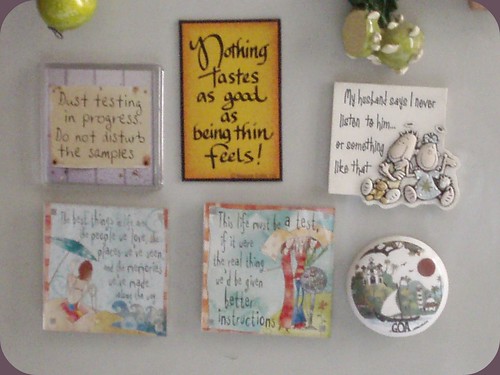
These are my favourites. The ones on the extreme right and left in the top row are the most recent acquisitions, bought in Singapore on a layover en route to India from Japan. The Spouse often complains that I rarely listen to what he says and just say "Hmm ... Hmm ... " so it was only natural that I picked up that one, and the other, about the dust, the humour and self-directed sarcasm struck me as very funny. The others are from a trip to the US five years ago.


I don't remember where I bought this but once in a blue moon, I do refer to this.


I love this magnet for the scene it evokes: company, sunny, vacation, travel and a host of other things I'm not listing here. I also like that the words reflect the things I enjoy the most.


And this! The minute I spied it on the shelf I knew this pithy statement is what frequently defined my feelings and attitude to life. I was about to give it to a friend but suddenly diffident and superstitious, wondered about the appropriateness of gifting black humour, so I kept it for myself. Many of my friends have the same doubts, I know, about life, and the three girls/women there remind me of us. Sig, I just figured out what that grey thing on the right is - it's a grill and they are grilling sausages on it - I've a good mind to send it to the event you're hosting! LOL!

These magnets are off to Veda for her event.

Wednesday, July 23, 2008

Mind Your Pounds And Quarts!

Glug glug glug glug glug glu... can you hear that? What do you think that is? Not me imbibing anything, but the cook on the TV show pouring out "just a bit of oil" into the pan! The "just a bit", which resembles a torrent rather than a trickle, is variously referred to as "a couple of teaspoons/tablespoons", "a splash and that's it" and I don't remember what else.

This rant has been on my mind for many weeks, and it's not limited to oil. Just now, I saw a star chef recommend "just a bit" of flour and proceed to empty about a quarter of the pack into the bowl! Star chefs or home cooks, they seem to lose their sense of proportion when it comes to presenting a recipe. I often wonder whether I should cut the home cook some slack - it's probably her/his first time on TV, and as most home cooks are wont, they go by feel/rough/personal measures rather than tablespoons and cups and ounces, but then they shouldn't use those terms, should they? What's wrong with the star chefs then? Give up on weights and measures because, training all done, they've discovered what they really learnt after all those years in catering college is to cook with the senses, have discovered a healthy disregard for the stifling confines of measuring bowls and decided recipe be damned, viewers be confounded, it's the free spirit that matters!!! And makes for great showmanship.


Just this morning, I followed a recipe from a book to the letter, didn't even stint on the three tablespoons of oil it mentioned. That's a lot of vegetables, I told myself in justification, and consolation - a small head of cauliflower, two medium potatoes and 100 gms of peas, not to mention two tablespoons of coriander powder and one teaspoon of cumin powder and some other whole spices. What did I end up with - a scorched and singed pan, oil that got absorbed in the 2+1 spoons of powdered spices, charred vegetables and an inedible dish that I have not the heart to throw out because, let's face it, the potatoes and peas at least are somewhat edible, if not redeemable. Don't you writers try the recipes before you put them in print? Don't the publishers? Oh yeah, and pinches of this and that - now, those are tablespoons and teaspoons and even cups, in reality; not pinches or smidgeons or soupcons. The only pinch there is the one I give myself, hard, to make sure I'm not seeing double!

And what of those recipes which call for just 50 gm of cheese but positively ooze the stuff in the end result? I do not claim much knowledge of cheese. Where I live, I don't get much variety beyond cheddar and mozzarella unless I travel a considerable distance and pay obscene amounts for packs that are dangerously close to their expiry date, but how far can cheese crawl? I mean, the melty, spreading variety exists, but 50 gm can't cover an entire pizza, can it? I WANT MY CHEESE TO FLUFF! I WANT IT TO OOZE, I WANT TO BE ABLE TO DIGGGG INTO THE BAKE AND COME UP WITH OOEY GOOEY LAYERS, I WANT THE DISH TO LOOK CHEESY, AND I WANT IT ALL IN 50 GM!

And what's with all these TV cooks? Why are they so lax when it comes to using fuel judiciously, and using their cookware wisely? Why oh why do they put an empty pan on the fire, turn away and start talking to us? Because the "tad" of oil they're putting in the pan won't make a difference anyway?

Monday, July 21, 2008

Sunday humour, Bengal hangover

Once in a while, we visit an Uncle and Aunt who live at one end of town. Uncle is always exhorting us to bring a spare set of clothes, stay over and go to work right from his home but we've managed that just once. Aunty whips up a feast of home-made stuff typical of the cuisine we grew up with but yesterday, they both felt five home-made dishes weren't enough, so supplemented that with four Chinese dishes that they ordered in!

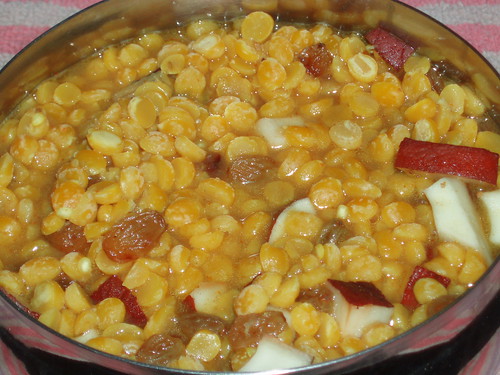
In any case, this was a problem of plenty, compounded by the fact that I'd carried along one of my dishes for them to sample. I'm still on a high from my Calcutta trip and the last couple of days have seen me trying my hand again at Bengali food, which I used to experiment with earlier. Funnily enough, I found parwal in my vegetable store the day after I came back from Calcutta, and bought a few other vegetables to make the shukto and charchari that are so typical of Bengali cuisine. While most of those vegetables are waiting in the fridge, I put to use the one coconut that I retained from a bounty of about 10 that were presented to me last month. It had dried neatly inside its shell and I finally cut it up into pieces and put it in the fridge. I had planned on buying some chicken to make a Kerala-style chicken curry with coconut chips that my friend S introduced me to, but the bird proved elusive, so I made this dal instead.


I had made it for a potluck years ago, when some of us still had the schedules for one without much planning - and it had been much appreciated. Now all I needed to do was buy some raisins, brush up on the recipe and my chholar dal would be ready! I couldn't make out which of my two Bengali cookery books I'd referred to all those years ago, but one book didn't mention the coconut and raisins and neither mentioned whether the dal had to be cooked to a mash or to soft but grainy - I went for the latter as that's what I remembered.

I did away with the 2 tsp of sugar that was mentioned in the recipe and added more raisins than prescribed. I didn't powder the spices as was required. Amidst hoots of laughter over a funny anecdote narrated by Uncle, we savoured this mild and mellow dal. Aunty said it was "variety ga undi", a famous Telugu-English expression for anything unusual, the Spouse said it tasted like prasadam (food made for rituals, as offerings to the deity and worshippers) and Uncle picked out the pieces of coconut and ate the rest.

And the funny anecdote: Well, a visiting nephew of Uncle's was about to reach for a cup of coffee which was on the table when Aunty said, "Oh, God! Chee Chee! That's for your Uncle, don't take that! We'll make other coffee for ourselves!" "You do exaggerate, Mama!" I said, giggling. But Aunty piped up honestly, saying, "No, I DID say that, I think," and also giggled herself, setting us off on another round of laughter. It must have been the sugarless/diet nature of the coffee that provoked that outburst, but it was so funny listening to my Uncle who narrated this with a mixture of amusement and indignation.

On to the recipe now!

Channa dal/Bengal gram: 100 gm/1 cup
Green chillies: 2, slit
Coconut pieces: 1/2 a cup
Raisins: Half a handful
Water: 2-3 cups (and more if you need later)

Salt, to taste

Turmeric: 1/2 a tsp
Bay leaf: 1
Red chillies: 1-2, broken
Cumin seed/Jeera: 1 tsp
Whole clove, cardamom: 2 each
Cinnamon: 1/2-inch stick
Oil: 1-2 tsp

Wash the lentils thoroughly. You can soak them ahead to cut down on cooking time.

In a pan/saucepan, boil the water.

Once it comes to a boil, add the dal. Cook till half-done, then add the salt, turmeric, green chillies.

Cover and cook till done on a medium fire. Add some more water if the lentils are not done. As seen in the picture, they should maintain their shape but should crumble when prodded with a finger. Stir the dal now and then so that it doesn't stick to the pan.

In another frying pan, heat the oil to smoking. Lower the heat and add the bay leaf, cardamom and cloves. Once they sizzle, add the coconut. Let the coconut brown slightly. Add the raisins. Add the cumin and red chillies and wait just until they begin to turn colour, a couple of seconds. Switch off the fire and pour it over the dal.

Cover and simmer the dal for five minutes.

I am sending this to Mansi's Healthy Cooking event. I think it qualifies because I've done away with the sugar (though I do realise some is present in the raisins), the coconut can be omitted if necessary or left uneaten and the oil can be limited to one tsp.


Thursday, July 17, 2008

Oh Calcutta!

We didn't go for a holiday, we went for an experience! And the city lived up to every letter of that word!


On the conducted tour of the city, we were taken for lunch to a smelly, hole in the wall South Indian, yes, South Indian restaurant somewhere in the Esplanade area. Unable to bear the fact that our first day started off with less than authentic food, we sought comfort in kulfi in the restaurant next door. It was the first time we were having kulfi with semiya (vermicelli) and some red sherbet poured all over it. I held back till I tasted a bit of my friend's, and then ordered one for myself.


Street food in Calcutta. En route to the Kali temple in Kalighat, we settled on this restaurant for our lunch. Several parcels of good-looking biriyani were being dispatched in cars as we waited for our lunch to be prepared.


Why, when you order a mutton tikia, is it served all scrambled? And how did our chicken kabab turn into mutton? The paneer is a concession to vegetarians, but processed on the same tawa that the meat is cooked on!!! And the lacha paratha was glorious and well done.


Back from the Kalighat temple, after two hours of waiting that culminated in a mighty stampede that succeeded in crushing us but not our spirit, we treated ourselves to some food at a wayside cafe - thick, substantial rossogulla at Rs 3 a piece and some samosas. This man was making ... kachoris, I think.


Fishing in the Hooghly. Aboard the ferry to Haldia and back. The clayey soil at the back brought back to mind geography lessons of Gangetic West Bengal, alluvial soil and silt deposits.


A glimpse of rural Bengal. En route to Raichak, a day trip from the city. The villages are full of trees, of which I could only recognise the jackfruit tree, banyan and bamboo. There were some rice fields too, along the way.


A Kolkata evening in the monsoon


Kolkata and its cabs, near the now crumbling Great Eastern Hotel


On Howrah Bridge, shot from our car.