Showing posts with label Bengali. Show all posts

Tuesday, August 11, 2009

A Li'l Bit of 'merica

When it became clear a few months ago that I would be going abroad, it also became clear that I would have to tell myself sternly that I couldn't come back with stuff for the pantry that I would only throw out a while later. It's quite another matter that while I shopped very little, all my purchases were heavyweights which attracted their own set of consequences on the way back home.

One of them was a packet of split peas which I've never seen in the parts of India I live(d) in. Of course, I didn't want to make anything as ordinary as green pea soup with that - I had plans for it already, which I executed once I returned. It helped that I had had a great Bengali meal at Sandeepa's place when we met - Begun Bhaja, Dal, kaancha amer ambol/chatni Jhinge Chingri Posto, Pathar Mangsho, so I knew which book to consult for a split peas (matar dal) recipe as soon as I returned.

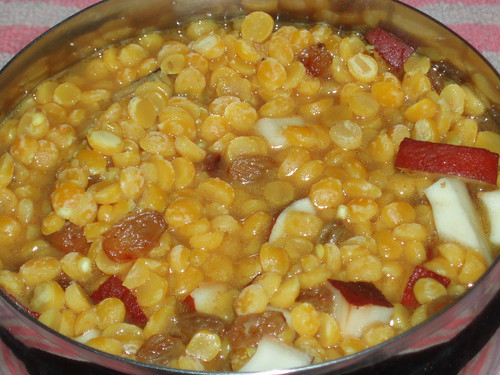
This is a book of Bengali cuisine called Pumpkin Flower Fritters by Renuka Devi Choudhurani and has a recipe for Split Pea Lentils With Vegetables. Since it's only been a little over a week since I've returned, I don't have too many veggies crowding the refrigerator so I made do with just one of the many listed in the recipe.


And that's the result in the photo - don't miss the jaunty chilli in that bowl - it arranged itself so, I didn't arrange it that way.


Split pea lentils/matar dal: 1 cup
Drumstick (vegetable): 1
Tomato: 1, small
Green chillies: 3-4
Salt, to taste
Oil: 1 tsp
Ghee: 1/2 tsp

Water

Tempering
Red Chillies: 2, broken into pieces
Bay leaf: 1
Panch phoron with some mustard seeds: 1 tsp
Asafoetida: A pinch

Strip some of the hard skin from the drumstick and cut it into two-inch pieces. Slice the tomato into 6 pieces and slit the green chillies.

Wash the dal in warm water and rub with salt and a little oil. Set to boil in a pan of hot water (I haven't mentioned the amount as I initially used just over one cup of water and then added as and when I needed).

When the dal is half cooked, add the salt.

After it cooks a little more, add the drumstick and a few of the green chillies. When it all cooks, remove from the fire.

Heat the oil and ghee and temper with the chilli, bay leaf and the panch phoron. Add the asafoetida and tomato. Saute for a few seconds and add the rest of the green chillies. Pour in the dal and boil for 2-3 minutes.

This entry goes to Susan's My Legume Love Affair - 14.

As I mentioned in my previous post, I had a great day out with Susan, whom I met in New York City. She planned a day of walking for us and took me through Wall Street and several other areas. We walked from about 10 a.m. to 6.30 p.m. One of our stops was Madison Avenue - as soon as we saw this scene, we had to stop and shoot several pictures of it.


I'm not sure how good it is technically, but for me, it felt like the sight of the day.

Sunday, June 07, 2009

Legumes, And a Bit of Cheese

A few weeks ago, our air-conditioner went kaput and we spent as much of the day as we could outside our house. Quite a few air-conditioned stores that day saw us wandering about aimlessly, touching and feeling the goods, never buying. Our last stop before we went to dinner in another air-conditioned place, was a bookstore. Or rather, as large bookstores tend to be, a books, music and gifts store.

For a while now, my favourite bedtime reading has been cookbooks, when mysteries and chicklit are hard to come by, and though my conscience knows I don't need any more cookbooks, I succumbed when I saw this well-produced book called Pumpkin Flower Fritters on Bengali cooking. I told myself that it had recipes my other Bengali cookbooks didn't, paid for it, and walked out without daring to look at it any longer in case the guilt got compounded.

It turned out my justifications to myself were well-justified - it DID contain some recipes that my other books didn't. Here's one recipe that I tried from it - it's unusual in that paneer/cottage cheese is mixed with moong dal, delicately flavoured, very heavy, and I don't think I'll try it again.

It's not really this yellow!

Warning: The quantities here make A LOT!

Roasted split moong dal: 250 gm
Paneer: 15-16 pieces
Potatoes: 2-3, medium-sized, cubed (The book recommends 8-10 small new potatoes, halved)
Chopped ginger: 2 tsp
Green chillies: 8-10

Crush
Cardamom: 2-3
Cinnamon: 3-4 pieces

Tempering
Red chillies: 2-3, broken into pieces
Cumin seeds/jeera: 1 tsp
Fennel: 1/2 tsp
Bay leaves: 2

Sugar: 1 tsp
Salt, to taste
Oil: 2 tsp
Ghee: A little

Boil the dal in hot water. Cook till half done. Set aside.

Heat the oil in a pan, fry the paneer pieces and remove. Fry the potatoes.

Add to the dal, and boil till cooked. Add half the chopped ginger and sugar.

Heat more oil in the pan and add a little ghee.

Add the red chilli pieces, cumin seeds, fennel, and bay leaves. Now add the rest of the ginger and the crushed garam masala.

Add the dal.

Bring to a boil and add the panee pieces and green chillies.

Simmer a few minutes.

This goes off to Susan's My Legume Love Affair, hosted this month by Annarasa.

Monday, July 21, 2008

Sunday humour, Bengal hangover

Once in a while, we visit an Uncle and Aunt who live at one end of town. Uncle is always exhorting us to bring a spare set of clothes, stay over and go to work right from his home but we've managed that just once. Aunty whips up a feast of home-made stuff typical of the cuisine we grew up with but yesterday, they both felt five home-made dishes weren't enough, so supplemented that with four Chinese dishes that they ordered in!

In any case, this was a problem of plenty, compounded by the fact that I'd carried along one of my dishes for them to sample. I'm still on a high from my Calcutta trip and the last couple of days have seen me trying my hand again at Bengali food, which I used to experiment with earlier. Funnily enough, I found parwal in my vegetable store the day after I came back from Calcutta, and bought a few other vegetables to make the shukto and charchari that are so typical of Bengali cuisine. While most of those vegetables are waiting in the fridge, I put to use the one coconut that I retained from a bounty of about 10 that were presented to me last month. It had dried neatly inside its shell and I finally cut it up into pieces and put it in the fridge. I had planned on buying some chicken to make a Kerala-style chicken curry with coconut chips that my friend S introduced me to, but the bird proved elusive, so I made this dal instead.


I had made it for a potluck years ago, when some of us still had the schedules for one without much planning - and it had been much appreciated. Now all I needed to do was buy some raisins, brush up on the recipe and my chholar dal would be ready! I couldn't make out which of my two Bengali cookery books I'd referred to all those years ago, but one book didn't mention the coconut and raisins and neither mentioned whether the dal had to be cooked to a mash or to soft but grainy - I went for the latter as that's what I remembered.

I did away with the 2 tsp of sugar that was mentioned in the recipe and added more raisins than prescribed. I didn't powder the spices as was required. Amidst hoots of laughter over a funny anecdote narrated by Uncle, we savoured this mild and mellow dal. Aunty said it was "variety ga undi", a famous Telugu-English expression for anything unusual, the Spouse said it tasted like prasadam (food made for rituals, as offerings to the deity and worshippers) and Uncle picked out the pieces of coconut and ate the rest.

And the funny anecdote: Well, a visiting nephew of Uncle's was about to reach for a cup of coffee which was on the table when Aunty said, "Oh, God! Chee Chee! That's for your Uncle, don't take that! We'll make other coffee for ourselves!" "You do exaggerate, Mama!" I said, giggling. But Aunty piped up honestly, saying, "No, I DID say that, I think," and also giggled herself, setting us off on another round of laughter. It must have been the sugarless/diet nature of the coffee that provoked that outburst, but it was so funny listening to my Uncle who narrated this with a mixture of amusement and indignation.

On to the recipe now!

Channa dal/Bengal gram: 100 gm/1 cup
Green chillies: 2, slit
Coconut pieces: 1/2 a cup
Raisins: Half a handful
Water: 2-3 cups (and more if you need later)

Salt, to taste

Turmeric: 1/2 a tsp
Bay leaf: 1
Red chillies: 1-2, broken
Cumin seed/Jeera: 1 tsp
Whole clove, cardamom: 2 each
Cinnamon: 1/2-inch stick
Oil: 1-2 tsp

Wash the lentils thoroughly. You can soak them ahead to cut down on cooking time.

In a pan/saucepan, boil the water.

Once it comes to a boil, add the dal. Cook till half-done, then add the salt, turmeric, green chillies.

Cover and cook till done on a medium fire. Add some more water if the lentils are not done. As seen in the picture, they should maintain their shape but should crumble when prodded with a finger. Stir the dal now and then so that it doesn't stick to the pan.

In another frying pan, heat the oil to smoking. Lower the heat and add the bay leaf, cardamom and cloves. Once they sizzle, add the coconut. Let the coconut brown slightly. Add the raisins. Add the cumin and red chillies and wait just until they begin to turn colour, a couple of seconds. Switch off the fire and pour it over the dal.

Cover and simmer the dal for five minutes.

I am sending this to Mansi's Healthy Cooking event. I think it qualifies because I've done away with the sugar (though I do realise some is present in the raisins), the coconut can be omitted if necessary or left uneaten and the oil can be limited to one tsp.


Friday, April 04, 2008

Of Coconut Milk and Bengal

As schoolchildren in a small town, we only had a few schoolmates from other ethnicities. So when someone came in on a transfer to this district headquarters from a strange town or bigger city, and if they spoke no other language but English to us, their exotica didn’t fade for quite some time. We also had the other kind – children who were originally from our State but who had rarely lived there, and who would fondly refer to their past place of residence as their true home, often discounting or denying the influence of Telugu and Andhra Pradesh in their lives, amusing/irritating/angering us as we saw fit.

One such of my classmates was a Telugu girl who had some family connection to Bengal, I think her grandparents had worked there; I remember that much about her though I don’t remember where she herself came in from. She was not like the others, spoke Telugu quite well, but constantly referred to Bengal, aloo dum and curds mixed with sugar. To put it mildly, that last thing took us some getting used to, but it was also my first exposure to Bengali cooking, if only in hearsay.

It was not till about seven or eight years ago that I found my first Bengali cookbook – not a very slick production, the author didn’t even sound Bengali (though there’s no rule that ethnicity determines authenticity), but the recipes worked very well. Though I have added another book or two on the cuisine to my collection since then, I always turn to this book when I look for Bengali recipes because the tastes of whatever I made from this were the same that I experienced in an ethnic Bengali feast I was lucky enough to sample a few years later (ratification, I mean).


However, I have to admit that this recipe sounded most un-Bengali to me, though I do know that coconut milk is used now and then. Only, I was familiar with chingri malai curry, not with egg malai curry – well, either I’ve not been reading the Bengali blogs too attentively or I haven’t been cooking or eating enough Bengali food, but this curry seemed as South Indian as it could get.

IF you don’t count the deep-frying of potatoes and egg yolks that is prescribed.

However, in the interests of our arteries, we can safely avoid this portion and go ahead with the discovery of Bengal.

This, of course, goes to RCI-Bengal, hosted by Sandeepa.

Egg Malai Curry

Eggs – 5, yellows only
Tomatoes – 3, big; blanched and sliced
Onion – 1, big
Garlic – 2 cloves
Ginger – ½ inch
Sugar – ¼ tsp
Potatoes – 2, medium-sized, boiled, peeled and quartered
Coconut Milk: 1 cup
Ground cumin – 1 tsp
Bay leaves – 2
Turmeric powder – ½ tsp
Garam masala – ½ tsp
Salt – to taste
Chilli powder – to taste
Coriander leaves, chopped – to garnish
Oil, to deep fry
Ghee, to sauté – 3 tbsp (I used oil, and only 1 tbsp)

Grind onion, ginger and garlic to a paste.

If you want to be true to the recipe, deep fry the egg yolks and potatoes on both sides. If not, you can use the boiled potatoes and fried eggs (a bulls eye, fried both sides, no runny yolk).

Heat the oil, add the bay leaves and onion-ginger-garlic paste.

When that seems well-fried (changes colour, loses smell is my cue), add the blanched tomatoes, salt, sugar and all the spices. Fry till dry.

(Well, dry isn’t exactly what I noticed, but it does become thick and concentrated.)

Turn down the heat, add the potatoes, then the coconut milk. Let simmer.

Once it begins simmering, add the yolks.

Simmer for five more minutes. Garnish with coriander leaves.


You can use the egg whites to make an omelette or scrambled eggs. Here’s an idea.

I'm away for a week or more, so until then, Ugadi greetings!