Friday, April 30, 2010

A Thing of Dirty ...

... is a joy forever.


If you need an unusual mould for your cottage cheese or puddings, use the strainer in the sink.

And don't forget to pay me a royalty.


Technique:

Buy four packets of milk.

Freeze for a week or more.

Then, empty one pack into a pan, set it to boil on the lowest flame, watch it curdle, throw it away.

Next day, repeat the action - and face the same consequences.

The third day, history repeats itself.

On the fourth day, put it in the pan, recognise the signs, give up.

Neatly deposit the block of milk-ice in the kitchen sink.

Leave well alone, even though there are more recent packs of milk in the freezer.

Go into the kitchen about 40 minutes later for a drink of water. Et voila, what do you find?


Disengage carefully, with the back of a spoon.

Look for the camera, click away.

Wednesday, April 21, 2010

Cabbage, Chalks And Chopsticks


The jaundice had whittled her down by half or more, and everyone was exclaiming over the transformation. She was just nine, too young to hope the loss of appetite would be permanent in the interests of her figure. Her grandparents fussed over her, making sure she took the Liv 52 and other medicines on time, pleading with her to eat “something at least”. She just couldn’t, she had no hunger and the oil-less food that was served, lovingly and carefully made by Ammamma, did nothing to titillate her numb taste buds.

She welcomed the break from school, though she wondered what it would do to her rank. After three weeks, would she still be able to come first in the monthly exam? Or would she be somewhere in the middle of the list? Dad always said, “If you’re not in the first five, then …” and would trail off ominously.

When she wasn’t lying down and reading books, she would be receiving visitors, mostly her other set of grandparents who lived close by. That grandfather was a doctor, and he would often tweak the skin under her eyes to see if the yellow had faded.

“How are you feeling today?”, he would ask, and she would tell him she was alright. One day, the skin on her lower lip began to chap, and when she pulled at it, it peeled off, just like that. That day, when he came to see her, she peeled off some and showed it to him. “Tatayya, what is this, is this normal?”, she asked, holding out a scrap of skin. “Oh, it’s alright, don’t worry about that. Are you feeling hungry today?”, he asked.

“I want to eat tamata chaaru. Can I?” she said. “Go ahead and eat it, absolutely no harm in it,” said Tatayya.

Ammamma was amazed, even a little hurt, she guessed. “Papa, if you had wanted it you could have told me, I‘d have made it for you for lunch,” she said.

“No Ammamma, I felt it only now, will you please make it for dinner?”

“I will, darling, is there anything else you want?”

“Umm … no, just tamata chaaru.”

That night, at dinner, she ate rice and tamata chaaru to her heart’s content, the grains floating in a thin, red river. There was some spicy cabbage-channa dal to keep it company. The cabbage was a mixture of fiery red and yellow, the channa dal undistinguishable from it at first glance. Had Ammamma got it wrong? It was usually a pale green, why did it look almost orange today?

Hesitantly, she asked Ammamma to serve her some cabbage. She put some in her mouth. It didn’t taste of anything. She had a little more rice mixed with chaaru. Then she had some more of the cabbage. She did this two more times, alternating between the rice and the cabbage. Some taste began to come through - slightly spicy cabbage steamed with dal cooked a little earlier, a little bit of resistance when a grain of dal asserted itself amidst the soft shreds. The tang of the tomato and the heat of the cabbage tickled her palate, and she was on the road to recovery - both of good health and every single lost kilo.


Here’s the recipe for the cabbage:

Cabbage, chopped: 1 medium-sized (3-3.5 cups)
Channa dal/Split chickpea: ¾ cup, soaked for a while and cooked until soft but not mushy
Mustard seed: 1 tsp
Cumin seed: ½ tsp
Urad dal/Split & skinned black gram: 1 tsp
Broken red chilli: 4-5 pieces
Curry leaves: 3-4
Salt, to taste
Chilli powder: 1-1.5 tsp
Turmeric: 1 tsp (or less)
Oil: 1-1.5 tbsp (actually you may not even need that much; definitely not if you’re jaundiced)
Some water, optional

Heat the oil and pop the mustard, cumin and urad dal. Add the curry leaves and red chillies.

Before the chillies and urad dal turn black, add the cabbage and saute well.

Lower the flame and add the salt, chilli powder and turmeric. Mix well, cover the pan and let it cook in its own steam. If you’re not confident of that, add one or two tablespoons of water before you cover it.

Once the cabbage is cooked, add the channa dal and mix well with the cabbage. Cover again and simmer till the dal absorbs the flavors.

Tomato chaaru: Put two small pieces of tamarind, 3 sour tomatoes, rasam powder and salt in about a litre or more of water and pressure cook for a while (or boil for a very long time till it looks all well blended and mushy.)

Temper with ½ a tsp of mustard and cumin and 3-4 curry leaves in ½ a tsp of oil.

This post goes off to Aquadaze's event, Of Chalks And Chopsticks. Spun a yarn yet? Hurry, you have another 10 days left.

Friday, April 09, 2010

Of Lucky Escapes, Quinoa & The Past Week

The week started off with what was meant to be a spouse-pleasing biriyani, but the dustbin, not his stomach, became its receptacle instead.

Don't try to imitate the dum action by weighing down a light and unsteady lid with a heavy stone mortar and pestle. They will overturn the lid and fall inside the biriyani if you're lucky, otherwise spill the biriyani all over the stove and under the microwave, in which process you would burn your arms too.

I was lucky.

After fishing out the hot mortar and pestle from the hot biriyani and washing your arms to make sure the experience doesn't leave any scars, a most familiar fire and brimstone smell (well, not really, it smelt like well done kababs) tells you your biriyani is going going gone to hell anyway - that you should have trusted your gut instincts and added some water to the meat underneath the rice in the heavy-bottomed pan despite the instructions in the fancy cookbook.

Cook in its own steam? Hah!

It's a few days later and you remember having soaked some dried cranberries overnight a few days ago, forgotten that you drained and stored them in the fridge. You have an hour before work starts, why don't you set about making the salad as planned with quinoa, that wonder grain with all the eight essential amino acids, among other goodnesses?

Step 1: Retrieve the cranberries. Reach in, pluck that dish out and realise it was the milk after it spills all over the fridge and under. There's some on your feet too - rub it in for a free beauty treatment! Clean up the mess (the bonus is that the dust bunnies under the fridge come out).

Step 2: Set to making the salad on the dining table with the TV news on in front of you. Topple the basket of TV remotes over, fix all the loosened parts and leave it in the same precarious position.

Mince, chop, boil, grind.

Chill.

The salad, that is.

Meanwhile, YOU can go have the third bath of the hot, humid summer's day that it is, sit under the fan a while to try and calm and cool the tortured spirit and flesh and give thanks that bigger misfortune hasn't befallen you.

Get through the day thinking of this new, never-before-in-your-experience salad.


Here's the original recipe, or is it from here? (And below is how I made do.)

1 cup quinoa
2 cups water
4 tbsp honey
1 tsp finely chopped garlic
1 1/2 teaspoons minced green chillies
1/2 cup dry cranberries, soaked overnite, drained
Juice from 2 big limes
1 tbsp finely chopped fresh mint
1 tbsp finely chopped fresh coriander
1/4 cup finely chopped red onion
Salt to taste

Rinse quinoa several times. Boil water, add quinoa and simmer 20 minutes or until all liquid is absorbed. Let rest, cool a bit. Add some salt, fluff.

Meanwhile, combine half the honey, garlic and green chillies in a bowl.

Whiz the cranberries and remaining honey and lime juice in a mixer.

When quinoa has cooked and cooled a little, stir in both mixtures.

Add the mint, cilantro and red onion to the quinoa and mix thoroughly, but not with a heavy hand.

Chill.

This goes off to The Cabinet of Prof Kitty who's hosting Kalyn's WHB this week, now administered by Haalo.

Monday, April 05, 2010

Of Chalks And Chopsticks

Soon after I took Sandeepa's cue and wrote my foodie short story, Aquadaze mailed us both wondering whether we'd like to turn this into an event. Both of us liked the idea a lot, I think mainly because it would get us to dust the cobwebs off our fiction writing, and asked Aqua to kick it off.

Well, she has. So please head over to her blog, read the rules for Of Chalks and Chopsticks and put on your thinking and writing caps - we would love to read the outcome of your fevered imagination!

Saturday, April 03, 2010

The Nutcracker And The New York Times Natural Foods Cookbook

A short while ago, I wrote a post saying I didn't know if my family/community had many cooking traditions, and what they were. I'm sure they did, just that I never bothered with them that much. But we did have one tradition, no, two, that I remember right now. One was to pour ice cubes into a napkin, gather the ends and clutch it so that none of the ice-cubes fell out, and bang it heartily against the wall. And we would have crushed ice. (Though I no longer remember what it was used for.)

The other, more mine than family's, was this.


The Nutcracker

Don't do that, the doors will get damaged, my grandmother would say, but who would listen to her? (I'm sure one of the adults showed me this trick.) The walnuts, whenever they were available, would be cracked like that in the space between the door and the hinge jamb, and consumed. I wouldn't crack that many walnuts, and never did the doors get spoilt.

A few months ago, my mother sent me a bag of whole walnuts. (Aside: I'm suddenly anxious to buy more whole walnuts even though I have half a bag of them with me still, are they still sold whole?) Anyway, I was more exasperated than happy and I suspected she was getting rid of them (there will be rather indignant recriminations if she reads this, I'm afraid) but managed to sporadically use up about half of them in sundry cakes - I recently went through a baking phase.

They are beginning to smell rather odd from being cooped up inside a plastic packet inside a plastic container, and I despair of using them up before they smell more desperate.

But asides and digressions aside, here's what I rediscovered in my cookbook shelf:

This is The New York Times Natural Foods Cookbook, by Jean Hewitt. How I could have not tried something from this since I bought it a few years ago beats my comprehension (or have I?). It's in excellent condition and the inside cover has 'Senke' written on it. Of the many links that I came across about this book, I read just a few, and all of them related how the writer had stumbled on to this cookbook at a sale. Here is some more information about the book.

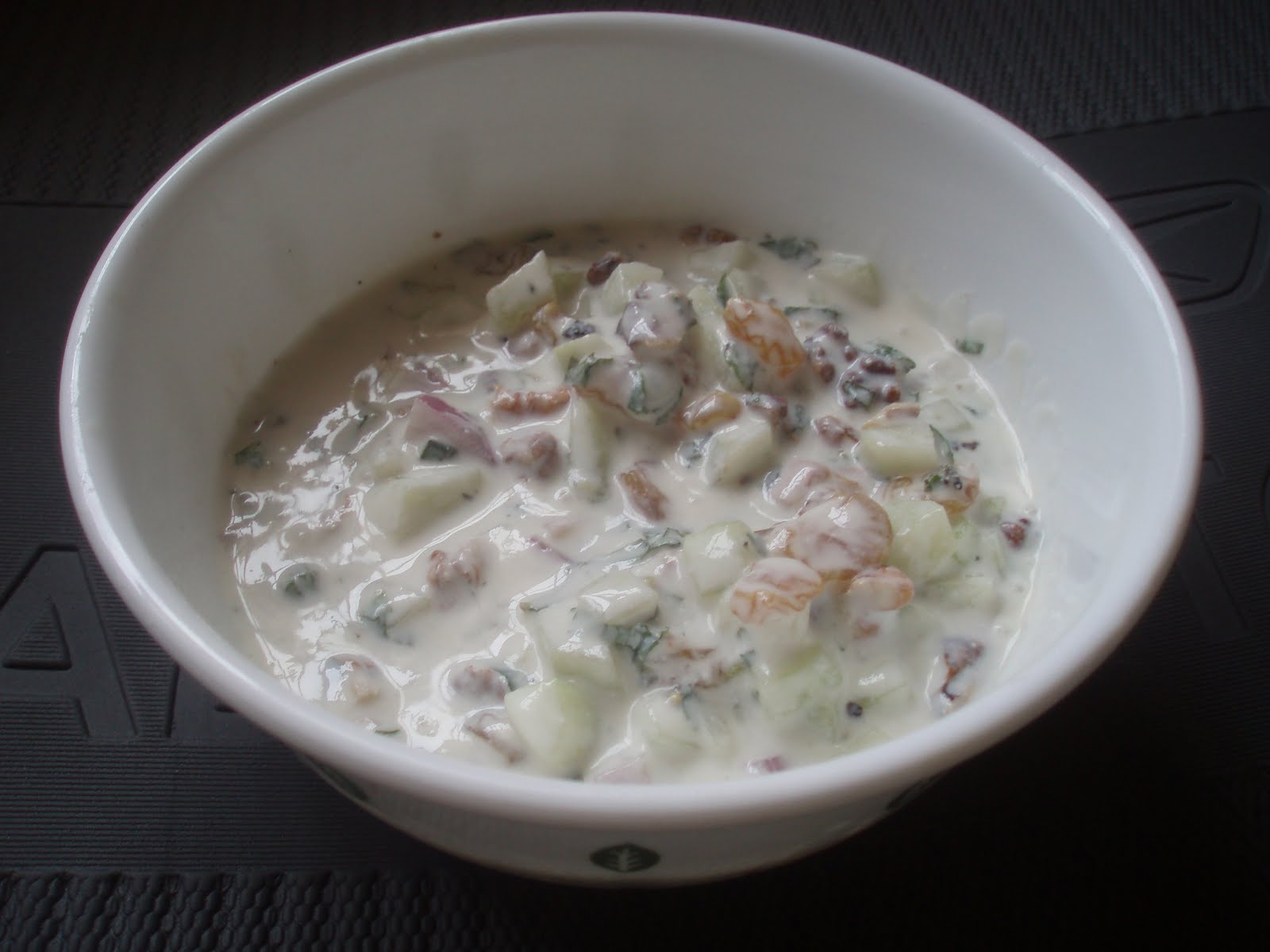
Bereft of a mystery or a sitcom to immerse myself in, I took this book to bed, and came across this Mediterranean Cucumber Salad, which I made today. It was attractive to me because I had all the ingredients, though the cucumber was regular size, not small, and the raisins were not monukka. I let it chill from morning to evening and ate two helpings of it for dinner. The Spouse has promised to have it for breakfast.

I think the raisins did it. Made all the difference, I mean. This recipe was contributed by "Jane Margulies, New York, NY"

Here's what you need:


Cucumber, peeled, seeded, diced: 1-1.5 cups
Curds/Yoghurt: 1 cup
Raisins: 3 tbsp
Onion, chopped: A small fistful
Walnuts, chopped: 1/4 cup
(Sea) Salt and freshly ground black pepper to taste
Mint leaves, chopped: 1 tbsp


Place the cucumbers in a bowl. Add the remaining ingredients and mix well. Chill and serve very cold.


And yes, I've started another tradition here - using my expensive, branded, and very impressionable (read 'not stain-proof'), ab stretch exercise mat as background for my pictures. What crazy traditions did you follow?

This post is off to Haalo who is hosting Weekend Herb Blogging this week, the event started by Kalyn.

Thursday, March 25, 2010

In An Instant, Pickle & Fiction Both


Aunty and her friend were chatting in the back garden, the long lines of drying clothes ensuring they couldn’t be observed very well from inside the house. The niece came out and called to them. Aunty’s brow furrowed in irritation but when she separated a skirt and a sari and peered through them, her gaze softened - her niece had come bearing a plate of green mangoes along with a knife for them to enjoy.

The mangoes had been downed from the tree just a couple of hours earlier with a tall stick to which a hook was attached. The backyard was home to several trees - mango, gooseberry, coconut, sapota/chikoo and banana. Ammamma would get the mangoes and gooseberry plucked and pickle them, pickling day being an event to remember. And even though the pickle would mature only after a few days, a little bowl of it, pungent and somewhat bitter with unmellowed mustard and fenugreek, would always be scooped out into a gleaming steel dish and set on the table with some homemade butter to be enjoyed with some soft and steaming hot rice.

“Oh, why did you bring the knife? You could have hurt yourself!” said Aunty.

“No, Aunty, Ammamma said it wouldn’t hurt because the knife is on the plate and I’m holding it properly. Eat the mangoes.”

“But she forgot the chilli powder and the salt, go, get us some, will you?”

“Ok, Aunty!” said Niece and bounded back into the house.

Aunty began cutting and slicing the mangoes. Funny, she and her friend are wearing saris with a paisley motif. Nice coincidence, that!

Friend and Aunty continued to converse, about History classes, exams and the merits of an MA versus a B. Ed. What could be taking Niece so long? “Sra …!” she called. There was no answer, but she could see her mother moving about in the bedroom facing the backyard. After a while, she called again, exasperated. Ten minutes had passed, and no sign of Niece. What on earth could she have got up to? Resigned, she prepared to walk inside and look for Niece, and get the salt and chilli powder herself, when Niece came out.

“Aunty, here’s the chilli powder and salt.”

“Why did you take so long?”

“Ammamma went in for a bath, and she told me where to look for them in the storeroom.”

“Oh, ok! No, don’t go away, sit and chat with us …”

Aunty smeared the chilli powder and salt on to three slices of mango, handed her friend one and took another herself. Niece refused.

The next moment, an odd look crossed the faces of the adults, and they yelped. And spit out the precious, homegrown mango. Because what the beloved niece had fetched was not red chilli powder, but kumkum.

I knew what my next post was about, but not how it would be written. When Bong Mom mailed me this evening suggesting I also try my hand at Food Fiction, I responded enthusiastically, little knowing inspiration would be in low supply. But determination overtook that weakness and I’ve dipped my toe in the water. Like Sandeepa’s, only a part of this is fiction. The mangoes, red chilli powder and salt are not.


Here’s a recipe for an instant mango pickle. It’s an old, old favourite, one I've tried my hand at, but better guidance came from here, and happily, tasted just like the one made by grandmoms and great aunts.

Raw mango, chopped unpeeled: 4 cups
Red chilli powder: 4 tsp
Salt: 4 tsp
Roasted fenugreek powder: 1 ½ tbsp
Gingelly oil: 8 tsp
Mustard seeds: 2 tsp
Garlic: 5-6 cloves, peeled, bruised

Marinate the mango pieces with a tsp of oil, the chilli powder and salt for 30 minutes.

After 30 minutes, add the fenugreek powder to the marinated mango and mix again.

Heat the rest of the oil and pop the mustard. Add the garlic and let fry till it’s sated with oil. Cool a little and add it to the mango. Mix well and cover.

I know it’s supposed to keep for a few days but I’d rather store it in the fridge as I’m no expert in pickling. I just know enough to tell you that everything used during preparation, mangoes, hands, vessels all, should be squeaky clean and squeaky dry.

Thursday, March 18, 2010

Egg & Spinach Baked With Nut Crust

I'm the Pacman!


Laziness got the better of the scrambled eggs and leeks you wanted to make for lunch.

Later in the evening, you remember a handful of grated cheese resting in the refrigerator for the past few days.

There are over a dozen eggs waiting to be used as well.

Your resolve to eat less, if not lighter, in the nights would be well exercised with a simple combination of the two, you think, the mere thought making you float.

Come home, whip out the cheese and four eggs.

There is three-fourths of a cup of chopped leeks in the refrigerator.

Mince three chillies and two cloves of garlic.

You notice a bunch of spinach as well, so wash it well and chop it, it makes about two cups of spinach.

In about a tablespoon of olive oil, saute the garlic.

Once it's all nice and smelly, add the spinach. Let it wilt well, hurry this along by stirring it. Make sure there's no water left from the spinach.

Now add the leeks and the chillies. Add a little salt. Saute a few seconds. Let cool.

{{Idea!!! There are flaked pistachios and almonds in the pantry, and some broken cashewnuts as well!}}

Meanwhile, beat the eggs with a pinch of salt and half of the cheese.

Mix it with the greens and pour into a greased baking bowl.


Mix the rest of the cheese with the nuts and spread over the eggy mix. Both ingredients should be dry.

Bake at 200 C till a knife inserted in the centre comes out dry.


This eggy delight goes off to Yasmeen of Health Nut who's hosting Kalyn's Weekend Herb Blogging, now managed by Haalo.

Monday, March 15, 2010

Not Going By The Book

Two months ago, Jayashree tagged me in a meme, asking some of us to show off our favourite books/cookbooks. Very honestly, I can't home in on just one and say it's my favourite because I approach different books for different cuisines.


Very often, though, I find myself turning to Aharam which is a nice combination of the traditional cuisines of Tamil Nadu. It also makes an effort to highlight the non-Brahmin vegetarian cuisine of the State, unlike many books on vegetarian South Indian cuisine, known and little known, which seem to say vegetarian and Brahmin cuisine is one and the same thing.


"Indeed, the non-Brahmin vegetarian cuisine from Tamil Nadu is totally different from the delicious sambhars, kootus and poriyals that are part and parcel of Brahmin diets. Most of the curries with green masala, red masala and pepper masala double as vegetarian curries, potatoes being added instead of meat, accompanied by any other vegetable of your choice, like knolkhol, carrots, beans, cabbage or peas."

There are some interesting recipes in this book. Snake gourd cutlets, for instance. Radish-chickpea curry, another. I've never made those. I've tried out some non-vegetarian recipes but not too many, because many of them call for coconut. Which I do not have on call. And I am lazy. Unless I find it ready-shredded. Then I am just a little less lazy about grinding it to a paste. Aside over, yesterday, I made this Kaikari Pulav (Vegetable Pulav) with my own twists and departures - it brought back my rice-eating days to me and made me feel accomplished, if not tired, because I slaved over it for 90 minutes.


That is nothing to do with the recipe, but everything to do with my small kitchen. Have you ever felt hampered by the lack of space in your kitchen? I have to shift things around everyday to be able to find space for the chopping board, the various bowls, water bottles, the spice jars ... ugh!

Anyway, here's my version of the original recipe.

Rice (I used a mixture of Basmati and ordinary): 1.5 cups
Potatoes, cubed: 2 cups
Peas: 1 cup
Shallots, chopped: 10
Big onion, chopped: 1

Grind to a paste
Cloves: 4
Cinnamon stick: 1.5-inch
Cardamom seed: from 4 pods
Green chillies: 4
Ginger-garlic paste: 1 tbsp
Fennel seed: 1 tsp
Poppy seed: 2 tsp


Seasoning
Ghee: 2 tsp
Bay leaf: 1 big or 2-3 small
Oil: 2 tsp
Mint: 2 tbsp (I used the spicy mint chutney that I had)
Chopped coriander leaves: 3 tbsp
Salt to taste

Clean and wash the rice. Soak it in water.

Heat the oil and ghee in a pressure cooker and season with bay leaves.

Add onions and shallots and fry till they are a light brown.

Add the ground masala and fry for a few minutes on low heat. Add the mint chutney and coriander leaves.

Add 3 cups of water, mix well and add the salt. Add drained rice and vegetables. Close the cooker and after the first couple of whistles, turn down the heat and let cook for 4-5 minutes.

The author suggests a garnish of boiled and halved eggs and fried cashew nuts and coriander leaves, and to serve it with a raita and egg curry. She also prescribes some chilli powder, turmeric and coriander powder in the 'grind to a paste' list which completely skipped my eye. We enjoyed the outcome though, and it was spicy without being hot, spicy without causing heartburn.

Wednesday, March 10, 2010

What's Your Tradition?

This is something that has been on my mind for a while but reading Indo's and Sandeepa's latest posts, I decided it's time I did some musing too, though my post is not directly related to theirs.

As bloggers, and those who write mostly about food, there's a lot we write about 'the tradition in my family'. We romanticise (me included) how our mothers and grandmothers made this or that, how a recipe is traditional, peculiar to our homes, or twisted (you know what I mean - with a twist in it), etcetera etcetera. In my case, it's not only the loss of these treats that makes me nostalgic, it's also that I sometimes cannot bear to face what I've cooked myself that makes me miss them, the people and the dishes, all the more.

I would even go so far as to say that I really don't know much about my community's special culinary tradition, if it has one, or that in the home I grew up, we just didn't discuss food much (unless it was to tell me to eat less of it). It was there, it was tasty and varied enough to make us look forward to it and we ate it. Of course, if there was some new-fangled dish, like cauliflower pickle, it would be discussed and perhaps forgotten promptly, I really don't know.

My mother works, and so doesn't have any time to spend in the kitchen unless the cook takes a day off. My grandmother cooked for us as long as she could, and then a cook took over. Excited about a new cook, who came from a canteen, we asked him to make something special, and he was handed the vanilla essence when he asked for something that sounded like essence. We had chilli chicken flavoured with vanilla essence that day.

None of the women on either side of my family were taught to cook. It was always 'Study, study, knowledge and career aren't as easily achieved as cooking'. In fact, an aunt says she would often wish her mother had taught her how to cook - when she migrated to a new country, she found herself at a loss, not knowing what to make or how to make it. Perhaps my grandmothers' unfulfilled dreams for their own lives made them decide their children shouldn't end up just cooking and planning meals day after day. Some of my aunts are great cooks but I think it was their own interest and circumstances that helped, but no one, not even my great-grandmothers, as far as I know, said anything about it.

It's a life skill, of course, but to women who were immersed in housekeeping, probably not one of great consequence. One of my great grandmothers, who passed away just 12 years ago, would always ask me if I'd got a raise, but never a traditional question. At the most, she would tell me to spend well and eat well, but that's it. And some of the aunts were so uninvolved with food that after a hard day's work, they would heat up cold rice, mix it with salt and chilli powder and make a meal of it.


I don't know what I'm trying to achieve through this post, probably trying to say how 'traditional' isn't always traditional. And that perhaps, 'no tradition' is a tradition all its own. I'm no authority on anything but it is generally agreed that the 'masala box' is quintessentially Indian. But in fact, we never had one at home. I do, but not my parents. Even if they do, it's probably tucked away somewhere in the storeroom. My grandmother, and the cook after her, mix up the mustard, cumin and the urad dal in a jar and just throw in a bit of it when they need to temper something. The cardamom and cloves are in the storeroom as they aren't used as much as the other spices, and the salt, turmeric and chilli powder are in their own containers. So strange, and novel, was the discovery of a masala box to me - everything in one place, in plastic, steel and even Tupperware (not that I possess the very latter).

Then there's the spice level. Just as Sandeepa gets "Rosshogulla" each time she tells someone she's a Bengali, I get "Oh, spy-sssee! (spicy)" or "I love the avakai pickle you guys make!" I have to confess we are a great avakai family, with vats of it being made every year for our own consumption as well as that of aunts and uncles living overseas, but the funny thing is, we don't call it avakai. We just call it 'mamidikaya pachchadi', avakai coming from the mustard powder that goes into the pickle.

And I don't ever remember eating food so spyzee (spicy) that it would have you burn and bleed over the toilet the next day - that was more or less the odd case, it's not as if we Telugus uniformly make that kind of spicy food. And I hate it when 'Andhra restaurants' paint their food in red (chilli powder) just so that they can keep up with the popular image of the mouthwatering, and yes, eyes-watering food the State is supposed to produce!

Am I giving you the idea of a very practical, even boring, family kitchen? Practical, maybe, but not boring. The cooks themselves (grannies) did not go into raptures over this recipe or that, they must have had enough for a lifetime, or perhaps believed in the 'eat-to-live' principle. (Two generations later, younger now than they were then, and on a bad day, I feel the same way.) But parties always saw cocktail sausages and French fries on toothpicks, pressure cooker caramel custard; festivals saw the traditional pulihora and payasam. And to me tradition and habit were as much those as rice and curd and pickle as well as ootappam with tomato ketchup, milk without sugar, and tiffin with anything but coconut chutney.

Wednesday, March 03, 2010

An Education From Stalks

We all know that a cauliflower is nothing but a cabbage with education, right?

"Training is everything. The peach was once a bitter almond; cauliflower is nothing but cabbage with a college education."


So here's a lot of education for you, about four cups of the stalks.


Waste not, want not, we say. Waste I didn't, but would I want it?


As it turned out, (a resounding) YES!

The recipe is from here. The measurements are mine.

Cauliflower stalks, chopped up: 4-5 cups
Jeera/Cumin seed: 1 tsp
Asafoetida, a pinch
Salt to taste
Turmeric powder: 3/4 tsp
Red chilli powder: 1 tsp
Coriander powder: 1 tsp
Amchoor/dried mango powder: 1 tsp
Garam masala powder: 1 tsp
Oil: 2 tbsp
Coriander leaves: To garnish

Heat the oil in a pan and add cumin seeds. When they change color, add the asafoetida.

Now add the chopped up stalk, salt and all the spices except the amchoor and garam masala. Mix well.

Cook covered on low heat till stalk turns tender.
(When it felt like this was taking ages, I transferred it to a pressure cooker and pressure cooked it for three whistles with half a cup of water.)

When the pressure falls, open the pressure cooker and add the amchoor and the garam masala. Mix well and simmer till any residual water evaporates. Garnish with the coriander.


This cauliflower fed us for three days. Call it kima (mince) or upma, here's another thing I made with it.


The stalks are off to Susan who's hosting Kalyn's Weekend Herb Blogging this week, now administered by Haalo.

Wednesday, February 24, 2010

Mt Nacho


We scaled its heights - and grimaced. I didn't really know what I was letting us in for when I ordered this starter. (Yes, it was an 'appetizer', not the main dish.) I thought it was a typical menu illustration where the picture has been magnified a hundredfold. It was, but that didn't mean the original was a rational size. I have a little more respect for menu illustrations now. Needless to say, our meal ended here.

(We had also ordered some corn and cheese poppers. They were only marbles, in comparison, and disappeared as soon as they appeared on our table.)

The dish itself underwhelmed, despite its overwhelming proportions. Beans in a hot cream sauce with some vegetables and lettuce swimming in it? Nah!

Want to try some brilliant (literally - look at the colour) potatoes? Here's my post on The Great Vega'n Vegetarian Project.

Wednesday, February 17, 2010

Couscous, And Some News

The appearance of some live forms of protein was no deterrent. It had cost good money, and it had to be used, so this was what I made with the last of my last batch of couscous.

I now have another batch of two big packets. It made its way here last January, a year and a month ago. I finally managed to inaugurate it last week. Along with that batch of couscous came a batch of other Mediterranean delights, which included sumac, thyme mix, zatar and orange flower water. I've used some of them on and off in the past year, the last is waiting to be opened. When that momentous occasion occurs, you, dear readers, will be the first to know.

Some chickpeas were waiting to be used up; so was a pack of commercial tomato puree. (I don't remember why I bought it, as I don't like it.) I thought I need to make a beginning on the couscous before it attracted life again, so out of the first 2 lb packet I had, I used half a cup.

I cooked this couscous by following the instructions on the other couscous packet, substituting plain water for stock, so I suggest you just follow the pack instructions if you make this dish. (Why didn't I do as I say? The pack I used didn't have instructions.) I had made savoury couscous just once before - it was bigger, and while the sauce used some of the same ingredients, the spices added to it made it very different so it was a new venture all over again for me.


Here's how you make the sauce:

Tomato puree: 200 ml (or just a little short of 1 cup)
Chickpeas/channa: 1 cup, soaked overnight, drained, washed, (pressure) cooked
Green thyme mix: 2-3 tbsp (Mine contains thyme, coriander, cumin, anise, fennel, sesame and salt)
Onion: 1, sliced
Garlic: 5 cloves, sliced
Olive Oil (EVOO): 1 tbsp
Salt*

Heat the olive oil gently.

Add the onion and garlic and sweat them lightly.

Now add the tomato puree and 2 tbsp of the spice mix.

Mix well, keep stirring till well mixed.

*Taste. The spice mix already contains salt so make sure the sauce isn't salty, or overpoweringly spicy.

Depending on this, add salt, and more of the spice mix if you like.

Add the chickpeas and let it cook on simmer till it absorbs the flavours.


Now, I have some news for you. As if work, reading, this blog, a year-round photo-a-day project, insomnia and other businesses aren't enough, I've volunteered to collaborate on a group blog, The Great Vega'N Vegetarian Project. The initiative of Cynthia at Tastes Like Home, this blog was born out of her realisation that much of the food we cook is naturally vegan and vegetarian, and often, unconsciously so. As most of the food that I cook routinely (and does not make it to this blog) falls into that category, I will write about it there.

I'm sending this couscous and the chickpeas off to Presto Pasta Nights hosted this week for Ruth by Mrs Ergul - Passion for Life and Food as well as My Legume Love Affair hosted for Susan by The Cripsy Cook.

Monday, February 01, 2010

Mellow Mallum

There was Baby Bok Choy,
There was Big Bok Choy,
Then there were incessant
Cups of chopped choy.

In went the leek,
Garlic and salt
Green chilli, turmeric
Spicy things all.
Steamed was the mix,
Covered for ten minutes
Stirred now and then
In my li'l kitchen.


Off with the lid
So went the liquid
In went the coconut
Shredded and grated.

Mix it well
Mix it nice
Wait just a minute (or two),
And there's a dish
For your rice!


As in all great literary works, there is much creative licence in this poem too. (One instance of it is that you don't need the rice.) I will not bore you with the technicalities of meter and rhythm, but hasten to assure you that truth has its place in this licentious (poetically speaking) piece.

The weekly shopping expedition resulted in many greens, including a first for me - bok choy. (I've eaten it on the rare occasion, but I have never processed it myself, ever.) I got some fine specimens and though my head told me to search for adequately apposite recipes, my heart immediately knew it would go into only one, a formula I had discovered a few weeks ago when Cynthia wrote about how she made mallum (also mallung, a Sri Lankan dish) for her vegan guests.

The better part of this morning was taken up with cleaning and chopping the bok choy, it came to nearly 12 cups, stalks and leaves together. I had a couple of leeks too, so one of them went into it, sliced. I added some salt, turmeric and five cloves of garlic, minced, mixed it all up and set it to cook, covered, on medium high flame for 10-15 minutes. Stir it every 3-4 minutes. The greens will give off some water so do away with the cover after a while. When the chopped stalks turn a transparent green and the leaves have wilted just enough, add about one-and-a-half cups of grated coconut and cook for another minute or two.


Bok Choy Mallum


Cabbage mallum

In the other mallums I've made, I've used French beans, cabbage and hyacinth beans. With these vegetables, I did not even wait to add the coconut at a later stage, it was a one-shot attempt. With the hyacinth beans, which was more experimental than the rest and did not contain any coconut, I added red chilli flakes (not a cupful, no!), salt and turmeric alone.


French Bean mallum

Truth be told, this is not very different from most South Indian stir-fries but what I'm chuffed about is the absence of oil (other than that contained within the coconut) and water, and the novelty of mixing everything together and letting it cook entirely on/in its own steam!

Your pan needs to be suitably thick-bottomed, or you could end up with some charred coconut and vegetables.

Here are some links I found useful:

Leafy vegetable mallum (mallung)

"Mallum is usually shredded vegetables cooked with spices and grated coconut.

Cabbage is commonly used to make mallum, but Sinhalese also use jackfruit, breadfruit, ash plaintain and unripe papaya."
- From here

"Mallum combine one of any number of vegetables (on Sri Lanka, we most often encountered carrot mallum and green bean mallum) with chiles, onions, coconut, and turmeric. Once the ingredients are mixed together in a heavy pot they're steam-cooked over medium heat. Mallum require minimum attention once they're on the fire, and make an excellent side dish."
- From here

This goes to Simona of Briciole, who is hosting this week's Weekend Herb Blogging, created by Kalyn of Kalyn's Kitchen and administered now by Haalo of Cook (Almost) Anything At Least Once.

Thursday, January 21, 2010

An Accidental Recipe

This is an accidental recipe full of familiar flavors: too much salt, too much grease, un-soft rice, brinjal/eggplant, lime juice.

Funnily enough, some discussion on BT brinjal had me buying two packets of the vegetable, the brinjal part of it, that is, not the BT. They didn’t look oversized or particularly beautiful, which meant that they probably weren’t extra-chemically treated than the other vegetables around them, so I brought them home. I made a simple stir-fry with one packet, but it was so salty that even the juice of one big lime couldn’t redeem it. I refrigerated it in despair, trying to put my fears in cold storage along with it, but come dinner tonight, I couldn’t ignore it any longer.

There was also some plain rice that went wrong very badly - I cannot cook rice to expert softness but I’m not this bad either - and by the time I scraped it out of the pressure cooker and into a container for the fridge and then brought it out again today, it was hard and dry.

At dinner a couple of hours ago, the rice was brought out and microwaved with some water, upon which it achieved its my-usual level of softness. It was then mixed with the eggplant curry in traditional style - full hand on, palm pressed, literally, into action - to ensure that the spices were well distributed and blended. Then it was tasted.

Voila! You know what it turned into? It turned into pulihora (lime rice) with the brinjals providing a - ahem - a wonderful accent. In one shot, I had it all - instant lime rice and a magically redeemed brinjal curry. The microwaving had turned the old, odd rice into rice of the perfect consistency for pulihora.

So here’s the method for the stir-fry, which is all that you need to know:

Depending on the size of the brinjal/eggplant, halve or cube 250 gm of the vegetable into salted water.

In a pan, heat 4 tsp of sesame/gingelly oil. Temper it with ½ a tsp of mustard seed, ¼ tsp of cumin, 1 tsp of urad dal (split, hulled black gram), a few curry leaves, 2 tsp of red chilli flakes (or 1-3 split, dry red chilli). The urad should turn pleasantly brown.

Add the brinjal and saute for about half a minute.

Add salt and turmeric.

Mix well and saute some more.

Turn the heat down to simmer and cook till the brinjals are at the almost-beginning-to-turn into-mush stage.

Douse liberally with lime juice.


Of course, if you want it exactly the way I came about the instant rice, you should oversalt it deliberately - that involves much overconfidence in one’s abilities to shake out the exact amount of salt that one deems right (or exactly too much) directly from the salt box into the pan. Then you can experiment with the amount of cooked rice that you need to add for the perfect mix I chanced upon.

If that sounds incoherent, you've got it - no, you've got ME - right. That's how I cook(ed).

Psst: Turns out I’m not the only bold one to put brinjal and lime/lemon rice together. Check out this and this.

Tuesday, January 19, 2010

When My Soup Didn't Come Alive

Recently, I failed at making chaaru.

Like I had failed with this staple many times in the past, even with ready-to-cook packets and powders that ensured I didn't have to do anything much.

I don't even attempt the varieties made back home, except for tomato chaaru (rasam), and that's mostly only when the several shrivelling tomatoes inside the fridge loudly call out to be pressure-cooked into rasam. Now, tomato chaaru, that sure gets me drooling - it was what I ate as a nine-year-old recovering from jaundice, mixed with rice and some minced lamb on the side, and if I remember right now, that was my staple diet for the next few days. But more on that later, perhaps.

I am fond of the rasam that has some daal in it - the black-brown, plain rasam of the tamarind alone doesn't enthuse me. So when we recently had guests for two days and I had to churn out some decent and tried-and-tested stuff to eat, I attempted chaaru because I thought they would expect it. To satisfy my own self, I decided to add some daal to it.

I asked the lady who helps me at home to instruct me and first off, she told me that the tamarind extract I had was just too much.

What I needed, she said, was to soak a lime-sized ball of tamarind in about half a cup of water, and dilute that with a litre of water.

Then, she said, coarsely grind some pepper, cumin and a couple of red chillis and add it to the mix.

Add a few curry leaves and some coriander.

Squash a tomato, throw it in.

Add about a ladle of cooked-to-a-mush toor daal (split pigeon peas).

Set to boil and turn off the fire the moment it comes to a rolling boil, she said.
Oh, and some salt and turmeric.

So I did (but not without taking pictures of it for this. I never imagined it would make it to this blog, much less to an event.) Switched it off, and it tasted raw. It's not all right, I said. No, switch it off and cover it, she said, threatening bitterness. I did so, thinking that probably it would cook some more in its own heat and the flavours would meld.

Come lunchtime and I had every single eater reassuring me that the rasam was fine.

All I needed to do was add some more salt.

All I needed to do was boil it a little more.

All I needed to do was add some more daal.

But it's nice, they said.

Come dinnertime, I rescued it by adding two more ladles of daal and some more salt.

It was much improved, good, even.

Much better now, the diners said.

All I had needed to do was add some more salt.

All I had needed to do was boil it a little more.

All I had needed to do was add some more daal.

But it had been nice, they said.

-----------------------------------------------------------------------------------

But wasn't a tempering needed? I didn't remember that until now, when I wrote this post, so considering it was so nice, finally, probably it wasn't.

I fail at making quite a few staples - rice cooked to such softness that you can't discern the grains, so good with rasam and pickle and curds; sambar, idlis and chapatis(I do not know how nor will I learn to grind or knead) and rasam (well, hopefully I've got it right now).

What are the ordinary, everyday dishes that defy you?

This post is off to EC who is hosting MLLA for Susan this month.

Friday, January 15, 2010

As Nutty As Ever


My first ever blog post was about breakfast which could double up as dessert. It was a mixture of several nuts and dry fruits. I was inspired by something I saw in a boutique that positions itself as selling healthy food. All for a very high price tag, of course. Apart from the vegetarian protein that it offered, there would be the odd creepy-crawly in the pack, which I did not care for; neither did I care for the odd wheat pop and jaggery that was added to it.

One fine day, I bought all the ingredients necessary for this and made my own breakfast mix. I dry-roasted everything I bought (including the fruit), put it in a tin and then in the fridge. There were toasted sesame seeds, walnuts, raisins, dates, almonds. It was a very satisfying breakfast and used to satisfy my need for a non-oily beginning to the day. I would even have this for dessert if I couldn't ignore the call of the sweet tooth. It left me feeling very virtuous, if not thin. (With all that concentrated sugar in the dry fruit, it's a wonder I didn't gain weight.) The sesame seed would add a nice, nutty feel and the curds the right amount of tang.

This post went ignored for a long, long time (about a week, actually) - My parents tried to comment on it but they couldn't get through, and my father said make sure the curds aren't sour. My first ever comment was on the second post. "Bring on more crazies," it said, and that's exactly what I've been doing these last few years.

Thanks to Jaya's repost event, I get a chance to resurrect that post, and redeem the picture with a better one. The breakfast (I had it for lunch, actually) in this picture is a many-layered affair of cashews, flaked almond and pistachio, raisins and a couple of apricots and curds. I haven't had this in a while, but thanks to this post, might make a batch again.

Wednesday, January 06, 2010

Hosting, Feasting

When was the first time you cooked a meal for someone? What were the reactions? Humour, encouragement, sarcasm, mute acceptance?

Probably the first time I invited someone formally was in the summer holidays during college. In those days, I would only bake though I don't remember why I made a meal too. Maybe it was to make recipes other than the traditional dal and gravies we ate routinely at home, maybe it was to impress my friend - I don't remember. My grandmother kept saying why do you have to bother with it, let the cook do it, but I told her the cook could do the meat, and I would do the vegetable, and I made stew. There was other stuff too, and I must have baked or made some dessert, because I don't believe in putting my guests on a diet, I just don't remember the details after all these years.

My friend came and we sat at the table. I must have told her only then that I had cooked most of the meal, and I received one of the most incredulous looks I've ever come across. (My friend is good at looking outraged.) "Nuvvu chesava?"("YOU made it?"), she asked me, one eyebrow rising rapidly, but she seemed to like the food and we had a good and uneventful time, gossiping over the meal.

At around the same time, perhaps, I made something completely my own, something I conjured up myself - stuffed ridge gourd (beerakaya). I think it was also the time I was experimenting with some make-up, because I remember Kid Brother making the usual aggravating cracks, the rest of the family ignoring him (and me) and my father piping up, amidst the mild clatter of ladles and steel plates, "What is this Beerakaya Horrible?"

The name had such a comical ring to it that I probably took it in good humour though I remember explaining what it was, and of course, Kid Bro latched on to this for the rest of the meal. As I write this, I find many recipes for stuffed ridge gourd on the Net but most of them involve peeling the gourd. Mine didn't, and I must have chanced upon particularly tough-skinned specimens for my venture, which, as my dad's reaction reveals, must have added to the horror. Or caused it.

Last night at dinner in a restaurant, we asked what 'Special Sindhi Chapati' entailed, and the waiter, who seemed to be in an unholy hurry, smiled extremely tolerantly and thin-lipped, and said, "It's phulka." The Spouse wanted paneer so we ordered Seyal Paneer from the list of 'special Sindhi dishes' and I waved off The Spouse when he began to ask what it was, saying it must be just as special as the Sindhi chapati. It was - what else - an oily mix of tomato and onion, but the real surprise was the Hariyali Naan from the Tandoor section. I imagined from the name that it would come flecked with coriander and mint and fenugreek; the waiter said there was spinach in it, but we didn't bargain for this:


Now would you go for this, my stew or even my Beerakaya Horrible? In any case, don't forget to answer the question I asked at the beginning of the post!


I didn't make any lofty resolutions for the New Year, but I did set myself a goal and a mission. Wish me luck! There's a link at the top of the sidebar too!

Sunday, January 03, 2010

Going Back To The Tubers

The potato is a stem tuber, and 'roots and tubers' is a phrase. With this dish, I suppose I'm 'going back to the roots', now a much-used and often abused cliche, so there it is! When my grandmother still cooked for our family, this dish made a frequent appearance on our dining table at night.

Three days into the new year and I cooked only today. Some of the potatoes I had from ten days ago had put out monstrous sprouts, so much so there was too much sprout and very little potato. Off they went into the bin - the rest, peeled and chopped, made up about 1.5 cups. Then there were some tomatoes too that were going soft and squishy, five of those went into this curry.

I didn't add anything more, not even onion, because I didn't want to eat this curry for the next five days. I wanted something that would last me no longer than two days.

In my book, as well as yours, I'm sure, a recipe has to fulfill at least one of these two conditions to be deemed a success: It has to taste and look like your grandmothers' food, or it has to look like it came out of a restaurant!

Mine, I'm happy to say, looked very much like my grandmother's. And it lasted no longer than a day.


Potatoes, peeled, chopped/diced: 1.5 cups
Tomatoes: 5, chopped (about 2 cups)
Curry leaves: A few
Chilli powder: 1 tsp
Dry ginger powder: 1 tsp (you can use fresh ginger)
Salt: to taste
Water: 1 cup + 1/4 cup
Oil: 1 tsp
Mustard seed: 1/2-1 tsp
Cumin:1/4-1/2 tsp

Microwave (or boil till soft) the potatoes with a quarter cup of water for four minutes - in two 2-minute spells.

Heat the oil in a pan, pop the mustard and add the cumin.

Once the cumin sizzles, add the tomatoes, saute for 2 minutes and then add the salt, chilli powder and ginger powder. Add some of the water. Cover and let the mix get mushy on medium flame.

Now add the potatoes and give them a good stir. Simmer.

Let the tomato gravy cover the potatoes (but not quite drown them).

Add the curry leaves, simmer for another minute or two and remove from the fire.

Friday, January 01, 2010

The Choicest Four-Letter Words

May this year and the years to come be full of


Life

Love

Hope

Luck


Here's a charming recipe I found:

Take twelve fine, full-grown months; see that these are thoroughly free from old memories of bitterness, rancor and hate, cleanse them completely from every clinging spite; pick off all specks of pettiness and littleness; in short, see that these months are freed from all the past—have them fresh and clean as when they first came from the great storehouse of Time. Cut these months into thirty or thirty-one equal parts. Do not attempt to make up the whole batch at one time (so many persons spoil the entire lot this way) but prepare one day at a time.

Into each day put equal parts of faith, patience, courage, work (some people omit this ingredient and so spoil the flavor of the rest), hope, fidelity, liberality, kindness, rest (leaving this out is like leaving the oil out of the salad dressing— don’t do it), prayer, meditation, and one well-selected resolution. Put in about one teaspoonful of good spirits, a dash of fun, a pinch of folly, a sprinkling of play, and a heaping cupful of good humor. _ www.appleseeds.org