Thursday, May 31, 2012

Black & White Wednesday - Week 34 - The Round-Up

Here's this week's collection of pictures sent for Black & White Wednesday, Susan's creation. I hosted it this week. Thanks for participating! Next week, Week 35, is being hosted by Sihi of A Wandering Ladle.

Here's Kanchan of Kitchen Gossip, kicking off a Happy Mango Season!


 Cinzia of Cindy Star Blog

Little Doves Cookies 

 
Festive Table  

Happy Toasting Bubbles

Simona of Briciole

Red Russian Kale After A Spring Shower

Fragoliva of Fragoliva
Feeding Butterflies With Fruit

Lata Raja of Flavours and Tastes

Serving You Chaat


Place Setting

Cafe

Lynne of Cafe Lynnylu
Eggs - Study in Black & White

La Belle Aurore of La Belle Aurore
Lunch Time on a Field Trip to Nagai Botanical Garden, Osaka 

Srimathi of Few Minute Wonders
Paneer Soda

Hema of Adugemane
Corn

Susan of The Well-Seasoned Cook

                                                                             Plantains

Blueberry Blossoms

Dried Morels

 Rosa of Yummy Yums
Vineyard

Quick Butterhorns

Bong Mom of Bong Mom's Cookbook
Waiting By The Sea for Clam Chowder

Lubna Karim of  A Click A Day
Coffee or Tea?

Brii of Briggishome
Reserved Table

Shri of Tiffin Carrier Antiques
Birthday Cake

Nandita of Paaka Shaale
Garlic 

Aparna of My Diverse Kitchen
Saying it With Some Signs


And mine 
Mangoes All The Way

Wednesday, May 30, 2012

Mangoes All The Way


Every summer, on a trip home and back, we are confronted with this sight - mangoes being sold in the mango belt on the route. At times, we also come across palm fruit and toddy - these establishments are smaller. In fact, there is no establishment, just a bunch of fruit and maybe a pot and a few mugs of toddy.

Behind these mango stalls are the orchards and if you look closely, you can see the mangoes on the trees. These are on a portion of NH5 and are a popular stop for travellers. Various varieties are sold here. I don't know if all of them are grown in the region, though.


Now here's some colour.


And some more


Here's a post on mangoes and summer in India, something that I wrote five years ago!

This post goes off to Black & White Wednesday, created by Susan. I am hosting it this week.

Monday, May 28, 2012

Black & White Wednesday - Hosted Here This Week

The Well-Seasoned Cook's popular event, Black & White Wednesday, Week 34, is hosted here this week.

 As I've posted this announcement rather late, I'll accept entries up to Wednesday 6 a.m. New York time. Picture dimensions need to be 500 x 700 pixels.

 You must link your post to Susan's post, which contains the guidelines and host line-up, and this one.

 Please send your entries to srablogATgmailDOTcom.

Details I need: Your name, blog name, the link to the post, the photos. Please say BWW 34 in the e-mail subject line. If you're not a blogger but participating, please let me know that.


Saturday, April 28, 2012

Exotic Indian Recipe With Indigenous Vegetable


Red hot and sticky - this was how it was where I was last week.


A week ago, I was sitting at the exit of a sprawling resort in Goa, waiting for a bus to take me (and several others) back to my own hotel. By my own hotel, I mean the hotel I was staying in, about 20 minutes away, not that I own a hotel in Goa. My modest, homely, compact hotel, as opposed to the venue of the conference, where all the proceedings were held in tents, and only one of them was air-conditioned.

I trudged and trudged between tent and tent, carrying my computer, my bags and myself, cursing myself for being inhibited and formal. For all around me were delegates young, old, thin, fat, obese, interns and CEOs alike, wearing beach shirts and shorts and mini dresses, strapless or with spaghetti straps, looking cool as cucumbers in the heat. I was the only one, perhaps, in a salwar-kameez. Why oh why hadn’t I been more relaxed and taken my limp Fabindia cotton trousers? They would have afforded me better ventilation and I would still have managed to remain  formal (and inhibited).

Our bus trundled in at midnight but it only carried us as far as an isolated spot five minutes away. Ringed by coconut trees, it contained many other, bigger buses, and after scrambling down one and up into another carrying computer, bags and myself, we got to our own hotels. Once in, a shower and the air-conditioner revived me, but not quite – the memories of the heat of the last two days had seared themselves into my consciousness – and I had the same temperatures and far-away-from-each-other tents to face the next day.

What would I have given for a glass of light, chilled buttermilk (actually, we did order one on the first day, it was pretty nice) to be brought around at regular intervals during the conference? I don’t know, but today I tried making some of my own, going by a rough recipe a nutritionist told me about a few months ago.

And at this point, let me tell you that the red pepper/capsicum above is a red herring – it has not much to do with this post. My photos are going from bad to worse and rather that to draw in the eyeballs than the one I’m going to present below. It has to do with this, but as I had to leave for the airport early, I gave it away to my help S and told her to chutney-fy it. (I hope she didn’t dump it once my back was turned.) I made the linked recipe with green capsicum/peppers earlier and it turned out great – though the colour wasn’t anything to write home about.

What I do have to present today is this:


Exotic Indian drink with herbs (and spices, you read automatically – but barring salt, there are none) and indigenous vegetable. Now that sounds a bit over the top, doesn't it, exotic Indian drink with herbs and indigenous vegetable?

I took it to work and tried it on my colleagues, the first of whom looked a little alarmed at the trickle of green near the mouth of the bottle it was in, but she said it was fantastic. She couldn’t identify it, though. Another one did. Then I tried it on others, all of them loved it.

Then they asked me how I made it. So I had to tell them that I had turned some uneaten cucumber raita (cucumber being the indigenous vegetable) into this, by adding coriander and curry leaves.

It’s one of my as-you-like-it recipes, a couple of tablespoons of curds/yoghurt thinned with lots of water, some cucumber pieces, maybe a handful, and a fistful of well-washed coriander and curry leaves, all blitzed together in the mixer, and salted. Feel free to add a bit of ginger, asafoetida, cumin powder and pepper. 


Have it strained, or have it unstrained. Have it unrestrained. Then, maybe, you can dump the salwar-kameez, slip on a short, short dress, and feel as cool as a cucumber.

Tuesday, March 20, 2012

Of Dubai, Barberries and Vegetarian Food Without Vegetaybles


In January this year, I flew to Dubai en route to Ireland. I had half-a-day there before I caught the flight to Dublin. After a late lunch, I hired a taxi and set about exploring the place. The photo above is the Burj al Arab hotel photographed from the beach.


I loved the beach. There were hardly any people there even though it was a Sunday. It was almost deserted, except for a family, a couple and a solitary man who kept making sand tunnels and playing with them.


This is the Dubai skyline as seen from my taxi en route to the spice souk.


This was a friendly guy at the first shop I saw in the spice souk. Notice the little sheikh in the picture, behind the preserved limes?

Inside a store at the spice souk. I could identify most of the spices.


Another store at the souk.


Baby corn chips, that's what they're called.


A picture is worth a thousand words.


And a thousand more.

This was where I met the old man mentioned in the previous post. He kept extending his arms and contracting them with a smile. I couldn't understand what he was saying. And then he got off his seat and came up to me and started pointing at me and the shelf and back and forth, keeping up the chatter and the arm movement. By this time, something about his widening smile and the brightening glint in his eye had started to bother me. He must have seen several of them but he wasn't about to dismiss me as an involved tourist photographing all the strange and amusing things that caught her eye. Oh no, he wasn't about to pass up the opportunity of a sale. He thought I had potential as his customer. He was mistaken. I left.


A variety of dates, stuffed and processed in various ways.


Barberries/Zereshk (soaked, above, and below), from Iran, which I bought in the spice souk. I also bought some asafoetida and saffron, those too were claimed to be from Iran.


Dal/Lentil and barberry stew - vegetarian food without vegetaybles (vegetables, of course - just spelling it the way it's pronounced in certain parts of the country, it rhymes with vegetarian, you see).

How to make it:

In a spoon of oil,

fry two cloves and a piece of cinnamon.

Then, add a handful of onions.

Add 1 green chilli, slit

and 1 tsp of ginger-garlic paste.

Add 3/4 cup of boiled but not mushy chana dal/gram dal to the  pan

with 1/2 cup of water.

Simmer. Add some salt.

Add a fistful of soaked barberries and continue simmering for a couple more minutes - don't let the barberries turn brown though.

Remove from fire.

I found out about this stew when looking for barberry recipes on the Internet. The search threw up zereshk polow from a lot of Persian cooking blogs. The stew seemed to be the next most popular recipe, usually one with meat, lots of slivered nuts, lentils and the barberries.

The barberries are a delight - whenever I discover something new, I tend to use a lot of that in the recipe. But I am glad I didn't this time. The sour berries are quite unobtrusive once they are inside your mouth - they are small and you can't feel them unless you try hard - so when you bite into them, it's a tiny and refreshing spurt of sourness.

Notice the picture of the barberries in the sieve above - that's a tip that I picked up from the Persian cooking blogs which was really useful: The berries are very dusty, with mud and stems and such stuff. So put them in a sieve and immerse that in another vessel full of water. Pour some water into the sieve to soak the barberries. (I soaked them for an hour.) This ensures that the dirt sinks into the vessel below the sieve. It yields quite a bit of dirt, believe me. Wash the barberries a few times and use them.


Thursday, March 01, 2012

Currying Flavour, A Month Later

I've always wondered how it would be to begin a post by saying 'I'm back'. This blog has been around for five years so I may well have done it, but I don't think so. Not in such precise terms. I mean, what if I made this announcement, and you (and millions of my other readers) said to yourselves 'But when did you ever go away?' or worse, 'So what?' or worst of all 'Okay, now who are you?'

Consequently, I won't tell you why I've been posting just once a month for the last few months, barring one early reason: Internet problems. And after that, I guess I have to say I was the problem. Let's leave it at that.

I had visualised another post about my travels to strange and foreign lands, one of which made for last month's post. I thought I would write a rib-tickling piece about how a seemingly benign but rather dirty old man tried selling me his non-spice wares in Dubai's spice souk. I visualised bringing to you a barberry-flecked pilaf (zereshk polow) at the end of a photo feature on the spice souk. I imagined you rolling on the floor laughing your butts off (ROFL LMAO) over The Adventures of Sra and The Dirty Old Shopkeeper. I imagined posting stunning pictures of the pilaf, one of them black and white with just the barberries in vibrant ruby red, thanks to the Colour Accent feature on my camera. But alas, it was not to be!

Here's one picture, for now. The barberries are the maroon ones in the front row, between the green slivers of pista and the black raisins.


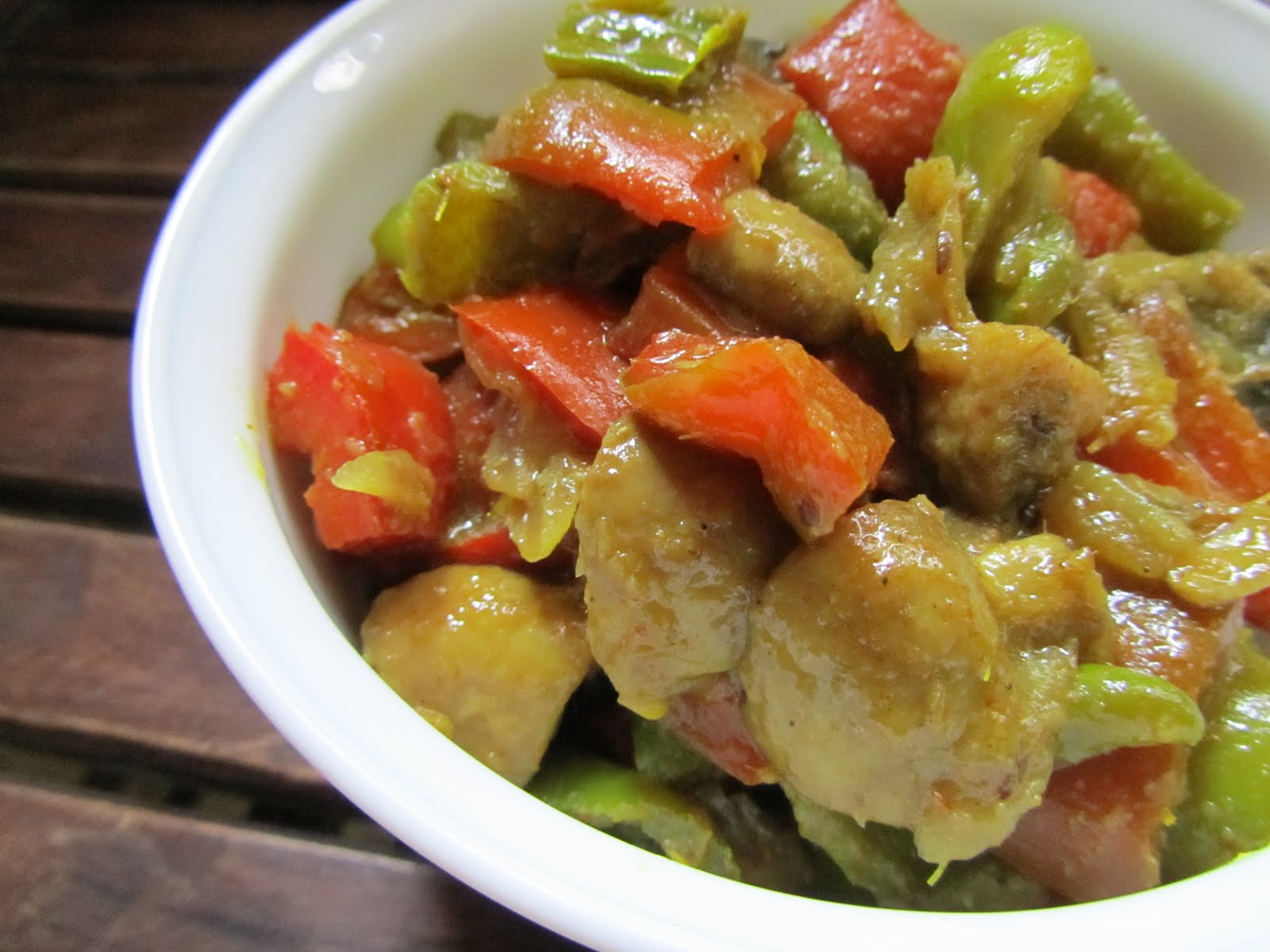
This time, I'm bringing to you a rather quotidian curry that I made on Monday. Actually it isn't quotidian for me, but it's not as exotic as pilaf. It did meet one condition: It had to have some gravy, and the gravy had to be achieved without grinding. Remember Grindless Gravies?


The not-so-quotidian-for-me curry was hastened by the discovery of some nice mushrooms found on Sunday evening at the store. Evening find spells bad mushrooms, but these were good. I also bought some green and red capsicum (peppers) to add crunch and vibrance. A generous hand led to much oil splashing into the pan. It was good. Is good. I still have some left over, though I may go off it by the time I finish with this post.

Here's how you make it:

Capsicum/peppers, chopped: 4-5 cups
Mushrooms, chopped: 2 cups
Onions, chopped: 1.5 cups
Oil: Ahem! (I must have used at least 6 tsp)
Ginger-garlic paste: 1 tsp
Green chillies, halved: 3
Salt, to taste
Garam masala: 1 tsp
Cumin seed: 1 tsp
Water: A few splashes

Heat the oil in a pan, pop the cumin.

Fry the onion till pink, then add the ginger-garlic paste. Fry well for 3-4 minutes, as mushy as you can let it get. If you need to add some water to prevent burning, add a splash or two now.

Now add the capsicum, saute on medium heat but make sure they don't lose their succulence.

Add the mushrooms, mix well and saute. There will be much water as the mushrooms cook - keep an eye on that.

When you've had enough of the watching-over-the-curry experience, and too much water still, turn up the heat and let it evaporate till the gravy reaches the consistency you desire. Stirring it vigorously will speed things up a bit.

When it's looking nice and unctuous, add the salt and stir.

Now add the garam masala stir it once more. Turn off the fire.

Wednesday, January 25, 2012

Dinner At An Irish Pub


Two weeks ago, I went on a short trip to Ireland. Though the first two days were full of work, evening saw us eating out at Irish pubs. We told our hosts we didn't want to go to the Indian restaurant they planned on taking us to and they walked us to Davy Byrnes which was quite close to our hotel. The food was good, I'm sure the drink was better for those who enjoyed it, and everyone kept murmuring knowledgeably about James Joyce and Ulysses till someone said, "Alright, who has actually read Ulysses?" Laughing, he said: "I know the name." Then he continued: "It's a hard book to read, you know." Some others chimed in with similar opinions and we soon gave up claims to much knowledge of Ulysses or James Joyce and got busy ordering.

Here's the photo in original colour:

This is their menu, a tribute to the author

And here's some of the food we ate in Ireland:

Traditional Irish stew, with lamb and potatoes

Fillet of plaice, fried in beer batter

The dark brown bread on the left is Guinness bread. Pure awesomeness, with some butter.

A full Irish breakfast - sausage, poached eggs, toast, potato farl, bacon, black and white pudding (towards the back), mushrooms and tomato

One of the two times that I've liked whiskey. This is whiskey cake. The second time was that evening, when I had my first taste of Irish coffee.

Monday, December 26, 2011

Of Just Desserts and Going Bananas


My first memories of eating out date from the time I was seven. I was visiting my parents in the US and I know we ate out more often than we did in India, where I don’t ever remember being taken to a restaurant except when we went to Madras as it was then known to see off parents and aunts and uncles to the US and stayed in hotels. (My favourite then was a green pea soup at a hotel that is still around and popular.) In the US, some of the places we ate out at were Kentucky Fried Chicken and McDonald’s. I tried spaghetti and meatballs. I tasted pizzas, French fries and other legendary junk food I don’t remember now.

Later we went on an extended road trip of both the US and Europe. I remember being not too fond of the new food. (Could that really have been me?) I was always looking for rice and other familiar food. The one time my parents did locate some rice dish, in some place we had halted for lunch in FRG, as West Germany was known then, it was ice-cold and strange and I threw a tantrum. My father was annoyed, my mother more patient – I’m sure one of those two poor souls downed it so as not to waste resources. (I also made them buy me rolls of coloured wool in some other country though neither they nor I had the faintest idea of what I would do with it, despite my father protesting we were “on a budget” and we couldn’t afford to waste money.)

During that time, I remember, my father would always ask me, “Do you need help?” and lean over and relieve me of a bit of whatever was sitting on my plate. That joke continued throughout the trip and after. I didn’t think it was a big loss unless I liked the food.

It just struck me that the tables have now turned – whenever I visit my parents, my father opens the fridge to find that his nightly dessert of cream, curds (yoghurt) and bananas is halved or wiped out. A fortnight ago, after it happened a couple of times, he factored me into the scheme of things and started adding one more banana and some more cream and curds.

My father seems to have discovered a way to add more taste – and where taste lies, calories follow – to this nightcap. This visit, he told me that the inside of a kajjikai (karanji) crumbled over the curds-banana concoction is a great addition. It seemed interesting, but where would I find kajjikai with the same filling here? As I was mulling the possibilities, the brain in me ticked off the idiot in me (the morning diet of soaked almonds must be working) and told me I didn’t have to go searching for a kajjikai, deconstruct it, extract the filling, crush it and sprinkle it on the dessert. I could simply make the filling myself.

The pictures that you see are my father's, photographed at my request, but in the interests of his diet, I didn't ask him to add the topping, so there is no picture of that.


Banana: 2, sliced (I prefer the chakkarakeli variety, seen in picture above, the second and third from left)
Cream from the top of curds: 2-3 tbsp


Note the layer of cream on top - this is home-made curds/yoghurt.

------------
Topping
------------
Dessicated coconut: 1 tbsp
Semolina/rava/sooji: 1/8 cup
Sugar: 1/8 cup
Cardamom powder: A smidgeon
Chopped cashew: 1 tsp
Raisin: 1 tsp
Ghee: 1 tsp
In a pan, heat the ghee and toast the coconut in it on medium flame for a few minutes. Remove, keep aside.
In the same pan, add another ½ tsp ghee and roast the semolina 7-8 minutes.
Powder sugar, mix with the sooji, coconut, cashew, raisin and cardamom powder.


To assemble: Put the sliced banana in a bowl and top with the cream. Mix lightly. Sprinkle with topping.

Wednesday, November 16, 2011

A Wedding In The Sixties - Black & White Wednesday


These are from my father's pictures of his sister's wedding sometime in the Sixties. Ingredients for the festive meals were usually bought by the family, not a wedding contractor or planner, those days.

The photo seems to be full of family members. I can only recognise one.

Notice the graceful bottlegourds. I think the vegetables in the other basket above are ladies' fingers/okra, towards the right, and I don't know what is in the other basket which is full of straw. Mangoes, perhaps, because that was how they were sold and ripened.

Do click on them to see them at their best.


This goes to Susan's B&W Wednesday.

Tuesday, October 25, 2011

Egging You On


On a boring Sunday evening, that’s two days ago, I had a brainwave. I wasn’t very hungry but wanted to eat a snack before I turned in for the night with a nice book to read. I wanted something somewhat spicy. There were four old eggs in my refrigerator. I suddenly started craving a bullseye with crisp edges and cracked pepper. I’ve already forgotten whether I thought of it then or at the moment I poured the first spoon of oil into the pan, but I got the jar of mango pickle, took a spoon of oil from it and added it to the pan. It couldn’t be any worse than an omelette with some pickle smeared on it, and that’s not such a bad idea, try it if you haven’t already!

So here’s an idea for a different version of fried eggs. I don’t like it sunny side up and always like mine fried on both sides.


The oil traditionally used in the mango pickle (mamidikaya pachadi/avakaya) I have is gingelly (made from sesame seed). A mixture of mustard, fenugreek, red chilli powders and salt goes into it. So do tiny black chickpeas and skinned garlic.


I don’t know the procedure or the proportions but all these are mixed with the mango and heated and cooled oil is poured over the pickle. It takes about 4-5 days to mature, for the spices to go from salty and bitter (from the mustard and fenugreek) to mellow. All the same, steaming hot rice, butter or ghee, and a small bowl of the new pickle are set out to be enjoyed right on the first day.


As the spices steep in the oil, which has to be a few inches above the rest of the pickle so that it can provide a protective medium against contamination, it gets flavoured with them, not to mention the mango and other ingredients.

So you don’t need anything except a little salt, in my opinion, to get the eggs to taste great!


What you need:
Oil from the pickle: 2-3 tsp (or it could be a mix of regular and this)
Eggs: 2
Salt: To taste
Heat the pan and spread the oil around.
Break the eggs into the pan, sprinkle the salt over them and let the whites set.
Turn over and let the yolks set.
Turn off the heat, slip it into a plate and enjoy!

Here's another idea for the pickle oil

Wednesday, October 19, 2011

Done Washing Up


Honestly, I can't fathom how and why the little cooking I do results in this mountain! My help, S, has to deal with it, and sure enough, on days such as this, quite a few dishes have little crusts of green dishwash soap on them. I guess I should be happy I don't live in a country where I'd have to deal with this myself. But, when it comes to manual (and not machine) labour, I'd do the dishes rather than wash clothes. Any day.

This goes to Susan's B & W Wednesday.

Sunday, October 16, 2011

Tasty Solutions To A Hairy Tale

Coriander and mango-ginger chutney - don't you love the colour?

Idiyappam with shallots and mango-ginger

To go from really short hair to hair that's just 2-3 inches longer is an endeavour fraught with impatience, irritation, heat, sweat, rubber bands, clips and such paraphernalia one hasn't used in a while. Enough is enough, I told myself, a good stylist will not whine about the non-growth, but they did. I walked out of one salon as the smile on the stylist drooped but stayed put in the second because frustration took over - and, of course, the stylist there marketed it (my hair - to me) better. It really isn't that much longer, he said, acquiescing to my request to 'give me more volume at the top but retain the length' and doing none of that (or so it seemed). He spent a few minutes, charged a lot and I came away looking and feeling just as I had earlier. Just a lot poorer.

My friend, who came over to drop off a macaroni-spinach-paneer creation yesterday, exhorted me not to give in to frustration. "It's only going to get cooler. Grow it, grow it, he's cut off just half an inch anyway," she said. So for now I've abandoned the thought of cutting my hair after six weeks, and will probably only cut it six months later. I have been looking at various Web sites to find out how to make hair grow faster and one of them has some really kinky suggestions, including grinding up birth control pills and mixing them up with some shampoo, and trimming the tips of your hair each month during a waxing crescent moon.

In the face of such exotica, bizarrerie or whatever you may call it, I'd rather fall back on my own innovativeness for hair growth. Which includes grinding up some oh-so-good for health good old greens and a cup of mango-ginger into a chutney.

Mango-ginger, cut

I love mango-ginger (go here for another picture) and how it smells all mangoey and summery, but haven't used it with much variation, so I'm glad I came up with this recipe one night after coming home to dosa batter and no accompaniment.

Mango-ginger, sliced: 1 cup
Coriander: About a handful
Curry leaves: About a fistful
Green chillies: 2
Peanuts: Less than a fistful ***
Oil: 2 tsp

Heat the oil and fry the mango-ginger for about 6-8 mins on a low flame.

Add the coriander, curry leaves and green chillies and fry for a couple of minutes more.

Grind with the peanuts and just a little splash of water.

*** I only added the peanuts to give the chutney some body. The amount I used did not affect the taste but next time I would use more coriander and curry leaves and not use the peanuts at all.

The other discovery I've made recently is idiyappam. Yeah, yeah, I know it's been around for ages, just not in my home or in my consciousness. The abovementioned friend had me over to lunch a couple of weeks ago and that's when I learnt idiyappams could be crumbled and tossed with tomatoes and onions. I did that for a couple of weeks. It's a very convenient and simple thing to make if your grocer stocks ready-made idiyappam. (A friend tells me I can do this with the rice sevai/noodles that one finds in stores - I haven't tried it.) When I brought the mango-ginger home, I tossed the idiyappam with some minced shallots and grated mango-ginger. I resisted the temptation to add lime and was glad I resisted.

Idiyappam, broken up: 2-2.5 cups
Oil: 2-3 tsp
Mango-ginger, grated: 1.5 tsp
Shallots, minced: 10
Green chilli, chopped: 1
Mustard seed: 1/2 tsp
Turmeric: 1/2 - 3/4 tsp
Water: A little
Salt

Heat the oil and temper it with the mustard seed.

Add the shallots, chilli and the mango-ginger and fry for 3 minutes.

Add the idiyappam and the turmeric, moisten with a little water.

Mix carefully. Taste it (the idiyappam already contains some salt, and add salt accordingly.) Let the flavours meld on low heat for a few minutes and then turn off the heat.

This post if off to Cinzia at Cindystar who's hosting Kalyn's WHB.

Wednesday, October 05, 2011

Kitchen Under The Stairs


Ever since this kitchen came into being, I've wished I had something like it. My own small kitchen is bigger than this but it's inside an apartment and I feel hemmed in when I'm inside it for various reasons - too many things in too little space, not enough ventilation, not enough light.

I love the al fresco feel, not to mention the fact that it seems so compact. This is at the back of the house, which has a bigger kitchen inside. The stairs lead to the terrace. The windows you see jutting out belong to a room where the cook of this kitchen stays.

I want lots of light, some greenery (though you can't see it in the photo, there is some - a neighbour's tree hangs over the stairs) and some open space in my life.

This goes off to Black & White Wednesday.