Showing posts with label eggplant/brinjal. Show all posts

Friday, August 29, 2008

Stuffed! And Charred!

We once had a guest cook. She was with us only for a few weeks. She told me that in her community, known for some royal and other feudal entities, the use of copious amounts of oil proclaimed their status, and hence no one, rich or poor, would skimp on that.

The food made by cooks from that household (who would visit us on and off) was, for the most part, tasty, but literally dripping with oil or soaked in it. I would squeeze a fistful of food right in front of their eyes, make my point, take triumphant delight in their embarrassed smiles, and get on with the eating. The oil could have added to the taste, I don't really know, but their frying left a lot to be desired. Their stir fries of many vegetables would be charred black, beyond crisp, spices and other food matter coming off in black specks, and I would wonder what the point was.

Recently, I got hold of a recipe for stuffed brinjals (eggplant) from an aunt, and in a rare fit of unlaziness, decided to go the whole hog with the grinding of the paste, etc as I had all the ingredients. It called for grinding a handful of coriander and some spices, mixing them up with onions, stuffing the eggplants and frying them on a slow simmer - the result is a wonderfully stuffed and almost (but not quite) charred mixture that almost has me wanting to taste those stir fries to see if I had missed discovering something then.


Here's the recipe!

Small, round purple brinjals/eggplant: 1/4 kg or about 10-12
(Make a 'plus' (+) sign with the knife on the bald side of the brinjal and cut through, into four, but not so deep that the pieces separate. You should be able to hold them with the stalk. Drop into a bowl of salted water while you're doing the rest.)

Onion: 1, big, minced as fine as possible
Coriander leaves: 2 cups
Green chillies: 2, chopped
or
Red Chilli powder: 1 tsp
Garlic: 3-4 cloves
Ginger: 1/2-inch knob
Salt, to taste
Coriander powder: 1/2 - 1 tsp
Cumin powder: 1/2-1 tsp
Oil: 3-4 tsp

Mustard seed: 1/2 tsp
Cumin seed: 1/2 tsp
Urad dal/Split, hulled black gram: 1/2 tsp
Curry leaves: 6-8 (optional)

Without adding much water, grind the coriander, green chillies, garlic, ginger and other spices to a rough paste.

Mix this with the onion.

Stuff the brinjals with this mixture. Reserve the leftover paste.

In a pan (a non-stick works well for this), heat the oil, and once it's heated, turn the knob into 'Simmer' mode.

Season with mustard, cumin, curry leaf and black gram.

Place the brinjals. Pour any remaining mixture over them. Let sizzle for half a minute and cover.

Keep checking and turning the brinjals around, very, very gently. If you think it needs more oil, add a drop or two around each brinjal that seems to require it. Ensure they get cooked and soft on all sides - for signs of doneness, you can check the picture. It should be a bit squishy. And the mixture inside and outside the brinjals should be a crusty green-brown.

This is most delicious with soft, hot rice or fresh thick curds.

I'm sending this to Marta's event Fresh Produce of the Month being hosted by Simona of Briciole in September.


Tuesday, May 27, 2008

Heritage Comes Cheap?

Whenever there’s a reference to Andhra food, mentions of ‘gongura’ or ‘vankai’ are inevitable. Gongura is a sour, leafy green vegetable and vankai (or vankaya) is eggplant/brinjal/aubergine. Gongura is considered typically Andhra, and many people from Andhra Pradesh consider the eggplant the State’s very own special vegetable and believe they can use it in a variety of ways that others cannot. A friend’s father says tongue-in-cheek that many people in Andhra were named Venkayya (no longer fashionable) after the eggplant! Both gongura and eggplant can be curried, added to dal, ground into chutneys, pickled and what have you, each mode in a variety of ways. I’ve even heard of an eggplant halwa, but let’s get on with what I have to say.

Very often, and more so in a generation which has now reached a certain age, if something had to be dismissed voice and expression dripping with ample scorn, “Aa, gongura! D’you really believe her?” or “Vankai! As if …!” would be the choice of words for many!

I don’t know which came first, the expression or the film song, but if you want to taunt someone saying “What do you know anyway? Squat!” ‘squat’ would translate into “nimmakaya pulusu*” or “vankai pulusu”.

Are there any such expressions in your language? What are they?

It just struck me that something we exalt and proclaim as our own, peculiar to our roots and our State is also the metaphor for something we choose to dismiss. Is it because vegetables like gongura, eggplant and even lime were kitchen garden staples, there for the asking? We didn’t have to shell out anything, or much, for them; we could get some from the neighbour and maybe not have to even give something in return; if we had to buy them, we probably had to spend only a few paise for a bunch as big as a bush. Or is it that they are exalted only now as we leave home and scatter far and wide, routine, everyday, garden-variety vegetables receding into the realms of the rare, prompting us to grow all mushy and patriotic and discuss them in our blogs using terms such as “rediscovery of my culinary heritage/roots/humble Andhra food/quintessentially Andhra” or … well, you get the drift.

I’m quite one of those who has been rediscovering the food I’ve grown up with so here’s a dish with the not-so-dismissable gongura – it’s a favourite accompaniment to mutton and chicken but I decided to try it with eggs. My new early morning gym routine promises to give me the opportunity to take a detour to the market and buy fresh greens regularly and I’m quite thrilled about it.


Here’s what you need for the gongura-egg curry:

Gongura – 1 bunch weighing ½ a kilo (500 gm)
Onion – 1, chopped
Ginger-garlic paste – 1 tsp
Turmeric – ½ tsp
Green chillies – 2, slit
Red chilli powder – ½ tsp
Boiled, shelled and scored eggs – 4
Salt, to taste
Oil – 1-2 tsp
Garam masala/curry powder – 1 tsp

Pick the leaves off the bunch of gongura. Wash the leaves in several changes of water.

Put the gongura in a pan with the chillies, salt, turmeric and red chilli powder.

Boil with a little water till it wilts and becomes a rather unified mess – what I mean is that the leaves sort of meld with each other and it’s just a little short of a paste.

Mash it with the back of the ladle.

In a pan, heat the oil, fry the onion and then the ginger-garlic paste well.

Saute the eggs lightly.

Now add the cooked gongura and mix it well with the onion and ginger-garlic paste.

Let the whole thing cook together for a while.

Sprinkle garam masala on top.

Enjoy!

I have to acknowledge three more awards. One is from Lakshmi of Yum Blog, who's given me the Witty Blogger Award and another is from Pratibha and Jigyasa of Pedatha.com who passed on the You Make My Day Award. Siri of Siri's Corner also gave me the Good Chat Blog award. Thank you!

*(The film song I refer to is “Neekemi telusu, nimmakaya pulusu …” – incidentally, 'nimmakaya' is Telugu for lime, and 'pulusu' can refer to the juice extracted or any gravy using lime).

Tuesday, October 17, 2006

One more chutney (Vankaya-dosakaya)


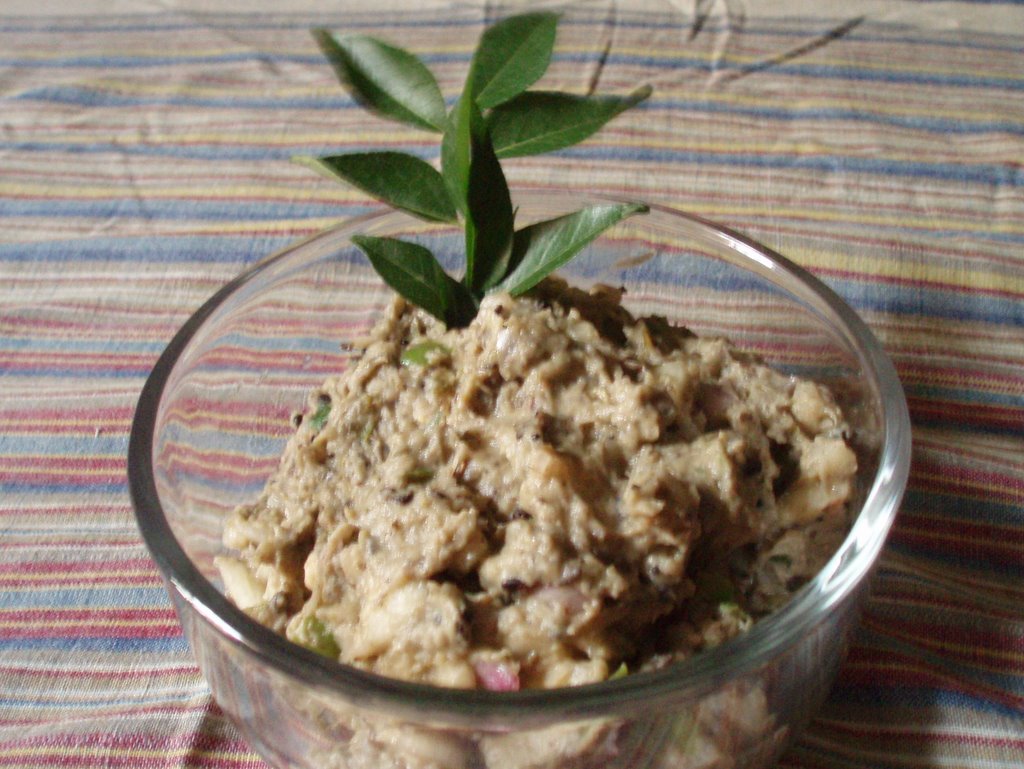
A friend’s mother made this once, and I’ve been sold on it ever since. Mine is not a patch on hers. Anyhow, I think the best thing about these chutneys is the tempering –the brown, crunchy bits of black gram, the cumin and the mustard lend texture to the otherwise soft mix. But again, it’s not as if the chutney doesn’t have texture in its softness – if it hasn’t been whizzed to paste, you can feel the vegetables too. In any case, my friend’s mom’s preparation was a glorious amalgam of purple and yellow, tempering in thick, golden sesame oil pooling in the depressions made by the spoon. I know, I know, oil is not politically correct, but I’m wondering if we should make an exception for pachchadis.


Here’s what you need:
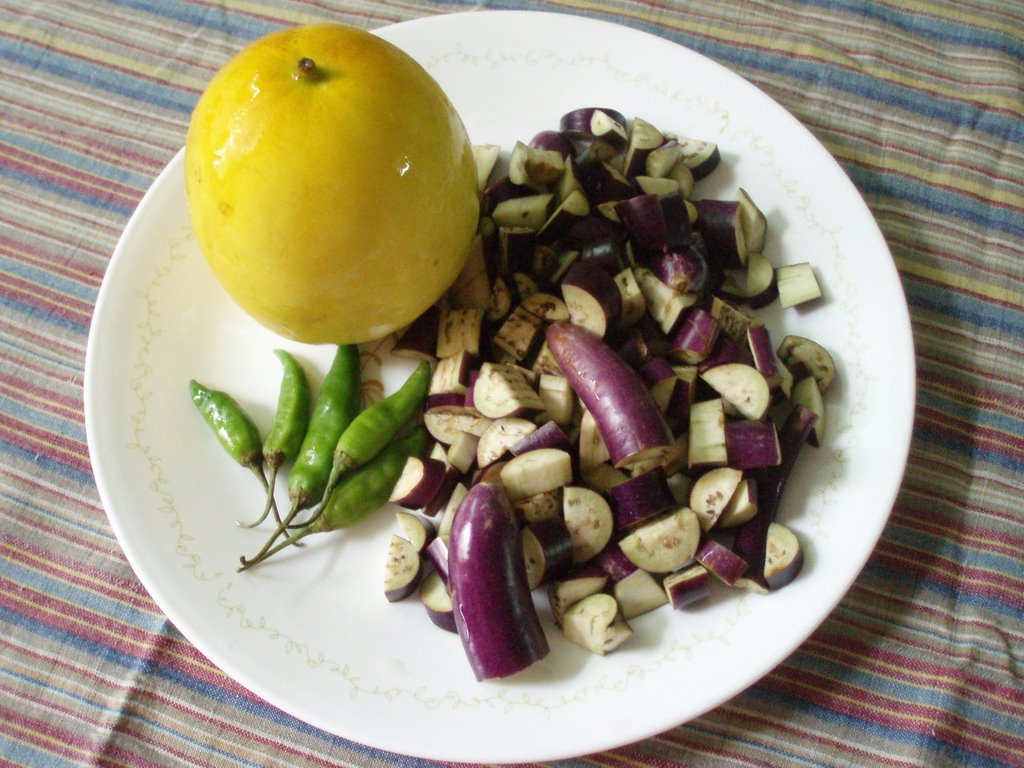
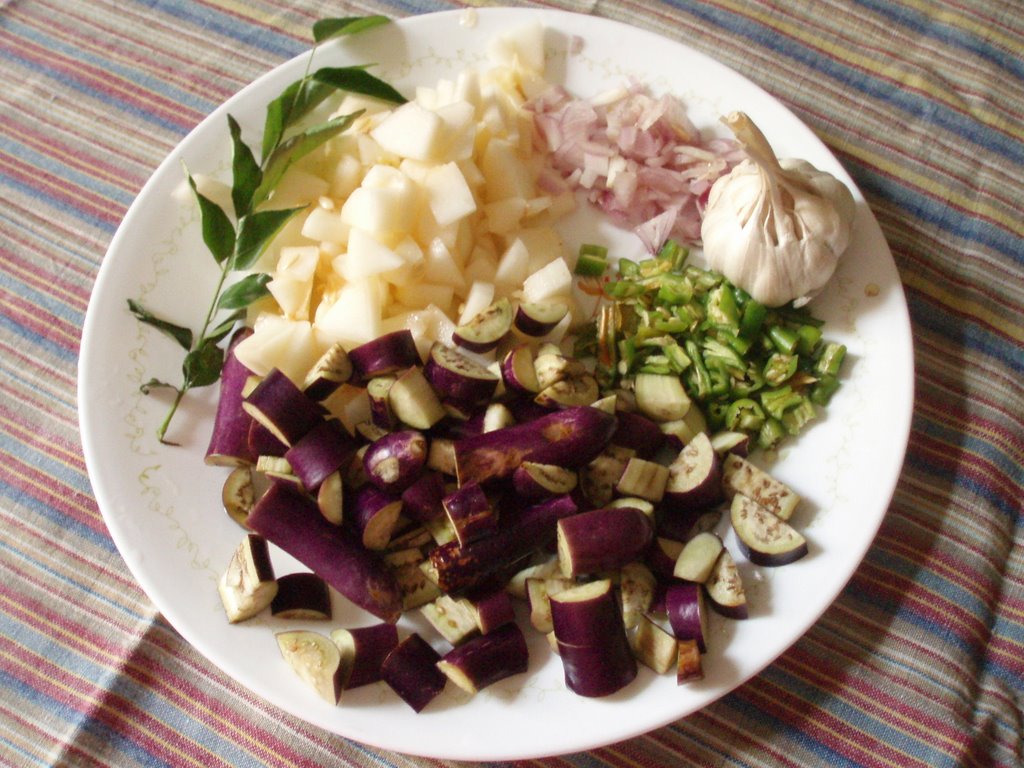
Dosakaya/Round yellow cucumber – 1 (but not a full one if it’s big), sliced rather fine but thick enough to hold its shape Brinjal/Eggplant – ½ a kilo of the long, purple variety, but you can probably use the bigger ones as well – cut into small pieces
Green chilli – 8-10 or more, chopped
Onion – 2 small, chopped
Oil – Ahem! Well, enough to fry the eggplant well, chillies and tempering one after the other
Tempering – Mustard seed, cumin, black gram as much as you like (but not in fistfuls, no), a few curry leaves
Tamarind – marble-sized
Garlic – 7-8 cloves
Rock salt

Fry the eggplant in hot oil till soft, remove and set aside. In the same oil, fry the green chillies. Set aside. Now put in the black gram. As it turns golden, put in the cumin and the mustard seeds, let them pop. Add the curry leaves. Turn off the heat. Cool everything if your mixer’s the kind which should not be used with hot ingredients. Transfer eggplant, chillies and tempering into the mixer jar, add tamarind, garlic and rock salt and use the lowest speed to blend. Do this in very short bursts otherwise you may still end up with paste. Now spoon this into a bowl, mix in the cucumber and the onion. You can add more tempering if you want. Serve with rice and ghee.