Showing posts with label Jihva-JFI. Show all posts

Tuesday, February 27, 2007

Aloo Dum(b), and Oil-free


Now, before anyone can indignantly wonder how the versatile aloo (potato) can be dumb, please rest assured that it’s a transferred epithet – I’m the dumb one when it comes to gravies – too lazy for the great South Indian thickener, coconut, that I rarely use, somewhat lazy when it comes to other grinding and processing, and clueless when it comes to shortcuts to achieve the same effect, but this is so simple and seems a handy formula to employ whenever I need a gravy, whatever the vegetable! And what’s more, as the title tells you, it’s oil-free!

I didn’t think I’d make it to this JFI hosted by Vaishali of Happy Burp, but wanted to try my grandmom’s recipe – in my home, and I’m sure in yours as well, certain dishes were made only for the night, certain only for the morning. Well, my grandmom’s night potato recipe was often a light curry of tomato gravy, and her lunch recipe was a heavier curds/yoghurt kurma.

I knew the kurma would take some detecting as my grandmom’s not around now to give me the recipe and I wasn’t too keen on the tomato gravy as I hate how the skins separate from the fruit and roll into long, triangular bits and float in the curry (and I didn’t know the technique to avoid that except to blanch and puree the tomatoes, which I’m not going to do for the love of anyone), so I pretty much told myself I wouldn’t put up anything for Jihva – till I chanced upon this recipe in this little book of Oil-Free Cookery by Satarupa Banerjee (Rupa & Co, 2003).
And what a discovery it was! The smell and look pre-masala-sprinkling brought back memories of that dinner recipe my grandmom would make, and gave me the base for gravies with other vegetables.

Now, about dum aloo – I’ve been scouring the Net for the history of this dish – there are as many recipes as there are potatoes – there’s a Kashmiri version, a Bengali version, a Benarasi version, a Lucknowi version, a Hyderabadi version, and who knows, maybe a Chettinad version as well! (It may then be called urulaikizhangu kulambu, or equally painstakingly in Telugu, bangaaladumpala pulusu/koora – in Telugu, ‘dumpa’ means root/tuber, and I assume the prefix ‘bangaala’ refers to Bengal. Pulusu refers specifically to a tangy gravy and less specifically to a wet dish.)

A friend in school, a Bengali-phile, would always mention this dish. “Aloo dum,” she’d cry, raising her hand enthusiastically, probably when we were discussing favourite foods. All of us in that charming small town of our childhood would stare uncomprehendingly, wondering what on earth it was, and she’d launch into how she was more Bengali than Telugu because her granddad worked in Bengal. The memory, buried deep all these years, comes back to me as I write.

When I got my first Kashmiri recipe book, aloo dum took on a totally different colour. Literally. Without ambling over to check my cookbook rack, I remember having to saute red chilli powder and perhaps a bit of curds in oil, a pinch of dry ginger and aniseed (saunf) and then putting in baby potatoes to make a thin, brilliant, red gravy.

This evening, I even saw a recipe that involved gouging a hole in the spuds, filling them with pista and walnut and making an aloo dum of them – uber Kashmiri? Not sure, it sounded fascinating, but calorific and tiring. So without further ado, here’s oil-free, fuss-free, cooking-for-dummies aloo dum(b) my way, it requires even less work than the book prescribes – no pastes/powders to be ground, just some peas to shell.

Potatoes, scrubbed, peeled, quartered – 5, medium size
Curds/Yoghurt - 3-4 tbsp
Shelled peas – 1 cup
Ginger – 1 inch, minced/mashed
Garlic – a few cloves, mashed roughly
Onion – 1 medium, chopped
Tomato – 1 medium, quartered
Green chilli – 1 (I used a bit of red chilli paste since I had that)
Turmeric – a pinch
Salt – to taste
Bay leaves – 2
Coriander seed/Dhania powder – ¾ tsp
Garam masala/Curry powder – to taste

Beat the curds. Mix potatoes, curds, salt, peas, ginger, onion, chilli and turmeric. Let it keep for an hour.

Then, heat a cup of water in the pressure cooker/pan. Add tomatoes, garlic and bay leaves. Cook till the tomatoes are soft.

Add the potato mixture, close the pressure cooker, and once the steam emerges from the vent, put the weight on it. After it hisses once, put it on simmer and cook for about 8 minutes.
*The cooker will hiss a couple of times but don’t switch it off in a hurry. (For those using pans, I would recommend a little more water and simmering the dish with a lid on.)

Once the steam escapes on its own (without you fiddling with the weight), remove the weight, check the consistency of the gravy and cook down till it’s as thick as you like.
*You can even crush a few pieces of the potato in the gravy to thicken it.

Finally, add the curry powder and the coriander powder. Check the seasoning and adjust it to your taste.

Finish off with a garnish of coriander leaves. Goes well with rice and breads.
Enjoy!

Tags:

Wednesday, December 20, 2006

Jihva for Coconut - Fish Curry


This is one vegetable technology hasn’t improved. I’ve seen vacuum, hand-held, electric – but nothing as effective nor easy to use as the coconut graters of our childhood.
Sit on the floor, rest your knee against the wooden base the lever and grater are affixed to — turn the lever on the right and the rotary grater on the left scoops out the fleshy part of the coconut held over it into zillions of soft, white snowflakes. Even the kattipeeta (the traditional implement used to cut/slice vegetables – usually a curved blade attached to a piece of wood), which ends in a sharp, serrated disc of steel meant for the coconut is not as effective.
That being said, I must say that when Ashwini announced Jihva for Coconut, I had to rack my brains long and hard to come up with an entry. For me, my fascination with coconut lay, and still lies, in the grater I described, the spray of fresh white against newsprint – but apart from the coconut-red chilli-tamarind chutney and kobbari louzu (coconut-jaggery balls) that used to be made at home, I don’t remember other ways we used it, perhaps to thicken a meat gravy? I’m not sure.
When I grew up and got interested in cooking, cookbooks made using coconut an often tiresome and doubt-ridden process. When it had to thicken a curry, the grinder never seemed to do its job properly, at whatever speed, pulse, frappe, whip, beat – the ‘paste’ would end up a loose mix of water, bits of chilli, coconut that refused to grind — and imparted an overwhelmingly coconutty taste to everything it was used in. I don’t think we used coconut milk at home, ever, so which cookbook was right? Squeeze the grated coconut with bare hands, put it in hot water and whiz it in the mixer, thin milk, thick milk, second extract, first extract? So out the coconut went, out of my kitchen and now and then makes an appearance in milk carton form, whence this recipe originates.
Fish curry
Seer fish: ½ a kilo - skinned, boned and cubed
Onions: 3 small, chopped
Thick coconut milk: 1½ cups
Dry red chilli, ground: 6
Pandan leaf: 2
Basil: A little
Cinnamon: 2-inch piece
Curry leaves: A few
Turmeric: A pinch
Fenugreek: ¼ tsp
Ginger-garlic paste: 1 tsp
Limes: 1-2, juiced
Salt: To taste
Put in everything but the limes into a pan and cook till the fish is done. Once it cools, add the lime juice. That’s it, you’re done!

Wednesday, December 06, 2006

Jihva and Just Deserts

The life of a food blogger is a hard one. Especially when events come around, and the pressure on oneself is to innovate/exhibit rather than humbly participate.
When Kay of Towards a Better Tomorrow announced Jihva for Jaggery and requested us to send in unusual recipes, yours truly immediately lined up two ambitious ventures, only to end up with thumping failures.
The lessons (oh yes, there always have to be lessons from failures): Trying to create a dish merely on the strength of having gorged on it throughout your life does not magically bestow on the eater the recipe; and payasam can curdle at any stage!
A friend recently said she didn’t believe in second attempts with recipes. She never, ever wanted to relive the failure, she said - the dish had turned an enemy, a friend who had failed her. Thanks to Jihva, I did make a second attempt, which is now making the rounds at work because I cannot bear to have a constant reminder at home of the consequence of my hubris.
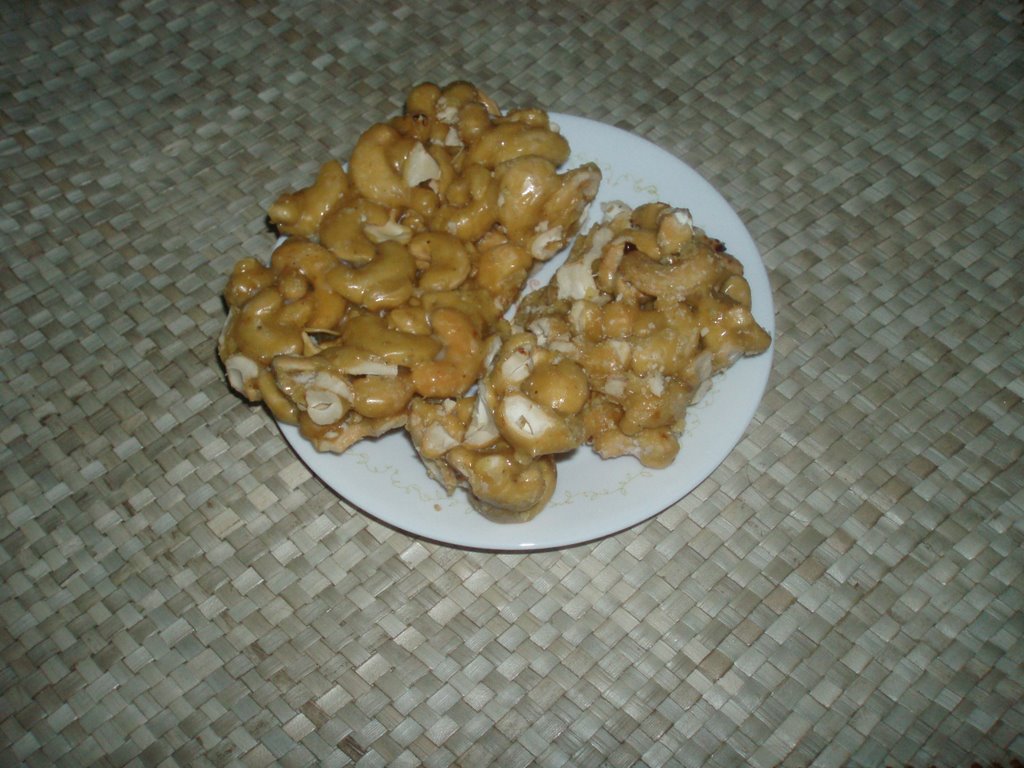
Yes folks, in the first episode, I set out to make this:


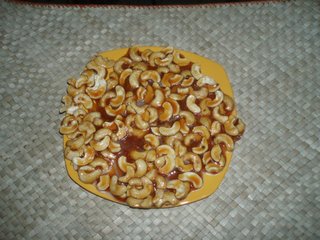
And ended up with this:


Both versions are called Jeedipappu Paakam, and in the parts I come from, the first is celebrated for its addictive, ghee-laden, cardamom-flavoured, expensive existence. The texture of the jaggery against the cashew nuts it envelops is something I can only describe as similar to icing. It comes in great big slabs, or rocks, and sometimes even a pair of brawny hands find the going tough when they have to break off smaller pieces – a firm tap with a hammer, or a sturdy knife driven into it, like the blade of an axe, and then borne down upon with all the might of your shoulders, does the trick.
But this is not to say it’s difficult to eat. On the contrary, it’s easy to get carried away. A friend in hostel used to overdose on this every time I took it back with me after vacation, and even the very real risk of a troubled stomach made only more sickening by the water scarcity in the loos couldn’t deter her from chomping on it all the time.
Well, I couldn’t find a recipe for it but it had to be simple, I thought: Just melt a cupful of jaggery in a little water to a stage where the syrup holds its shape in a bowl of water when tested, pour in a cup of cashews, a few spoons of ghee and a pinch of powdered, roasted cardamom seeds, whisk it off the fire and spread it in a plate greased with ghee, and your paakam is ready. (The rocks and slabs were, I thought, a function of volume – I was no accomplished mithaiwali after all, just a zealous, new food blogger trying to wow the world.) Alas! It was not to be - I ended up with my first chikki.
Not deterred, I stopped off at the store on my way back from work, bought a cannonball of light yellow jaggery, some more cashew and spent a good part of the night powdering the former, all the while dreaming of perfection from the second attempt, and the other dish I planned to display, a traditional, festive one that too!
My second attempt was just as bad, or as good as my first – and while my guinea pigs ate it without question and even the odd compliment, the ignominy of it all rankled – and instead of leaving well alone, I launched into my second sweet soon after I got back from work.
{Drumroll} Paalataalikalu!
My recipe for this sago-and-rice flour noodles payasam came off the Net. The sago was processed as per one of my fail-proof home cooking books, and everything was going along swimmingly fine. Even the rice flour, with which I was working for the very first time in my life, was cooperating. And what did I do? I raised the heat to boil the rice flour noodles, and met my comeuppance in the form of a heaving, creamy-brown ocean of curdle that I couldn’t salvage. I, friends, had got my just deserts!
{Curtain call, bow}
Tags: